
Reworked ‘In the Room’ more spunky: Eric Khoo
SINGAPORE — The uncut but modified version of acclaimed director Eric Khoo’s In The Room opens in cinemas on Feb 25.
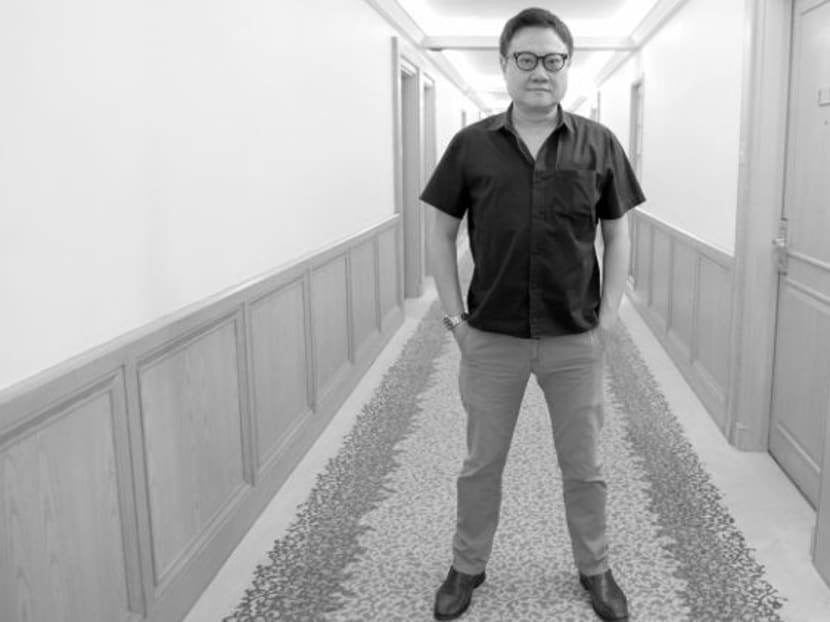
Director Eric Khoo outside his office in Goodwood Park Hotel. Photo: Lam Shushan/Channel NewsAsia
SINGAPORE — The uncut but modified version of acclaimed director Eric Khoo’s In The Room opens in cinemas on Feb 25.
The original version of the erotic drama had failed to get rated by the Media Development Authority (MDA) for general release because two scenes from it had exceeded the regulator’s film classification guidelines for sexual content. For the International Version, rated R21, the art-house filmmaker reworked those scenes but retained the same movie length.
The Cultural Medallion recipient said the steamy film is his “own little tribute to SG50.” Spanning several decades and featuring an international cast, the film strings together six stories that take place in Room 27 of a fictional hotel called The Singapura.
He talks to Channel NewsAsia about the censorship controversy and his sixth big-screen effort.
Q: How is the reception so far for In The Room?
Reception has been very strong. It’s a film that went to Toronto, San Sebastian, BFI London and Busan Film Festival. It was interesting because at those festivals, I would introduce the film and then go in for the Q&A. I’ve never really watched it after its completion. The only time I actually sat through the entire film with a big screen was last year at the SIFF (Singapore International Film Festival).
It was really fun watching on this big screen and I suddenly felt I can make it better. That’s when I started to tweak the film. Now it’s great that we have a film with its International Version released in Singapore.
Q: What’s the difference between the original version and International Version?
It looks a lot more psychedelic. The film basically starts in the 1940s, where we were very influenced by films of that period and the Art Deco style. As it progresses to the 50s - it’s this tribute to Rose Chan, this famous stripper from Singapore - we have very nice blue pastels, a bit of rocket, atomic interior designs. A lot of this we enhanced the colours. So now looking at the finished product, I think it’s even more spunky than what we have shown.
Q: How did you address MDA’s concerns about the explicit sex scenes?
If you look at the sex part of the film, where there was really a lot of it, it’s really in the story of the young Singaporean boy and Japanese lover he has. The whole story rides primarily on just the sex that these two have that it had to be the primary focus. If you look at it, it’s done really delicately, well-shot, but it had to be there and it had to be there in its duration.
Q: What’s your opinion on censorship of films in Singapore?
The censors got a bit excited, I don’t know for what reason. I’m just happy that we’ve got this film now screened uncut and it’s always been my intention that the entirety of the film has to be there.
I think we have progressed a lot. But I still feel it’s actually very embarrassing that we are the only country on earth that has an R21 rating. I’ve said this so many times — 18, you can have a rifle to kill someone, the legal age for sex for boys is 17, but you have to be 21 to watch a film?
On top of that, to censor a 21-rated film is ridiculous. I have been telling the people over there that if a film is R21, just let it go. If it’s just sex and violence, come on just turn on the Internet these days. It was a very different time when the rating systems came out, so they should chill.
Q: Were the actors comfortable acting in these scenes?
I had a very good stills photographer Andy Chow who is based in Japan and he is really good in terms of nude photography. He does all these coffee table books. Whenever I needed any exciting scenes to be done, I would get them to go in first with the actors and he would get them all comfy and we would just move in and shoot it.
Q: Was it a challenge working with an international cast?
Normally when I am directing a film, I like to hang out with my actors. But I didn’t get to do it this time because they don’t live here. It was through emails and phone conversations that I pulled together this team of actors.
It was this trust that I had with these talents, so when they arrived, I had only half to one hour to just walk through the room and tell them the blocking is going to be somewhat like that, when you come tomorrow, you just act it out.
The good thing is they all had prior acting stints and most of them are professional actors so it wasn’t that difficult. Whereas with a lot of films that I made in the past, I used novices and people that had never acted before, so I needed to spend more time to get them into character.
The beauty with all these actors is that they never read the entire script. They only read the script for their own segments. It was important that they had time — maybe about a month and a half or so - to think about what they wanted to do. So when they arrived, they would add points and mostly I would take whatever they want to put into those characters because they made very good sense.
Q: You made this film on a soundstage. Why not on location at an actual hotel for authenticity?
The hotel that was the inspiration for this film was the New 7th Storey Hotel that used to be on Rochor Road. Back in the 1950s it was like the creme-de-la-creme of hotels. As the years went on, it sort of withered away and became a backpacker’s hotel. Unfortunately in 2008 it was demolished, to make room for the MRT.
We had this great art director Arthur Chua, he basically built two mirror rooms and as we were filming one decade, he would then stage the other room for the next decade. My actors would be flying in from all over. They would come for two days, get their stuff done, the next lot would come. After 10 days of shooting it felt as if I had time travelled in some time capsule.
If you’re in an actual bedroom, you don’t have the luxury for different camera angles. And can you imagine if you’re in a physical room and to change the wallpaper to film a different decade — it’s just not doable. This was the best way of getting what we wanted in a very short amount of time.
Q: One of your sons is involved in the production of the film?
He’s been composing for me for a long time. He was 10 years old when he did the score for My Magic. I love his melodies. He’s got this knack for just sitting on the piano and he will play a melody. If I like it I would get him to record it.
Since My Magic, he’s been composing for me every time. For my last feature film, Tatsumi, he won a prize in a major festival. So he’s got talent.
Q: Has he watched the film?
He’s watched it. The beauty is in France — 15 years old and you’re allowed to watch this film.
Q: Is your wife supportive of you making this film?
She’s very supportive. She hardly joins us for these meetings. It’s more like sometimes when I have a problem I would ask her: “Eh, I don’t know what to do with this versus that.” And because she is so out of this, she sometimes gives the best recommendations.
Even my kids dropped by. They came and they took a peek. It’s not as if we are going for real hardcore trashy crap, we are doing art and I think as long as it’s art, then it’s cool.
Q: You’ve made several anthology films. Some film critics have commented on the execution and the uneven tone of this film.
I wanted the stories to be told differently. It’s almost like if you watch the 1940s segment, something that is very stale, to suddenly have in the 1950s an explosive sort of stripper come to life, bright colours. I wanted that sort of impact.
If I just told the whole thing in that same tonality, it would have been quite boring. I wanted to create a bit of a rollercoaster ride.
In any omnibus, in any film with several different stories, there will be some that I think the audience will be more gravitated towards. I think at the end of the day what we pulled off would be quite close to what I envisioned; about 95 per cent.
Q: Looking your body of work, are you mostly attracted to stories about people who are on the fringe of society?
I think if you look at all my films, there is this current theme that runs through every one of them, and that is love.
At the basis of it all I am a pretty mushy person. I love my dog, love my kids, you will see love in the works over and over. Whether it’s Mee Pok Man and this prostitute he falls in love with, or you have 12 Storeys, in which this brother lust for his sister in a very sort of weird incestious way. Or you got My Magic and it’s a father’s love for his son.
In In The Room, every story has that love element in it. Some a little bit more twisted than the others, but it runs through. So I guess I’m a pretty boring filmmaker in the sense that it’s always love that I am gravitated towards and it ends up in my film.
Q: You also take it upon yourself to nurture young filmmakers. Why?
Because I want more filmmakers to come out of Singapore. Initially when I started, I was all alone, it gets pretty lonely, so I thought if I could create more then I won’t be so lonely.
We will never be a factory that is going to churn out hundreds of films, but if we have enough auteurs to propel and push forward, then you are going to have better films coming out.
We may not be the best country for the big budget commercial type films but we can still come up with something that is special and from the heart that will touch a lot of hearts internationally. That is what I am after. CHANNEL NEWSASIA
Stay in the know. Anytime. Anywhere.

Subscribe to our newsletter for the top features, insights and must reads delivered straight to your inbox.
By clicking subscribe, I agree for my personal data to be used to send me TODAY newsletters, promotional offers and for research and analysis.






