
TV50 Special: A Life Of Drama And Variety
Ask anyone in their late 50s about what the television viewing experience was like when they were children, and chances are you’ll hear a story about watching richer neighbours’ TVs by peering through their windows. Even veteran actor Richard Low will tell you that that was how he got his Rin Tin Tin fix back in the day.





Ask anyone in their late 50s about what the television viewing experience was like when they were children, and chances are you’ll hear a story about watching richer neighbours’ TVs by peering through their windows. Even veteran actor Richard Low will tell you that that was how he got his Rin Tin Tin fix back in the day.
How we went from acquired programmes about crime-busting dogs to having our own full-fledged entertainment-making machine in 50 years — now, that’s a whole other tale of the unexpected. It’s one that takes a bit longer to tell, but is most assuredly as colourful as the time-worn costumes still hanging in Caldecott Hill’s wardrobe department.
From the Broadcasting division under the Ministry of Culture to Radio and Television Singapore (RTS), to the statutory board Singapore Broadcasting Corporation (SBC); from the privatisation of the station and its rebranding as the Television Corporation of Singapore (TCS) to the establishment of MediaCorp TV, television has grown and developed right along with Singapore, mirroring and, in turn, fashioning our culture and lifestyle.
So, don’t touch that dial — here’s a look back at 50 years of made-in-Singapore drama and variety programmes.
CHAPTER 1: LIFE IN MONOCHROME
One actor who has been working since the days when television was in black-and-white is the venerable Chen Shu Cheng, who went from a Rediffusion and radio presenter to being an actor in 1971. Alongside fellow actors Wang Xiu Yun, Zhang Wei and Li Yin Zhu, he acted in one-off dramas at RTS.
“Back then, one show only had four scenes,” Chen recalled. With film, “they couldn’t cut and edit, so each scene had to be very smooth, including the camera angles and the positioning of the actors. If an actor messed up his line, we would have to start all over again”.
Equipment was limited, too. “There were only three or four microphones hanging from the ceiling.” And having only three cameras resulted in some unusual camerawork. “I clearly recall one scene where they made a hole in a painting and stuck a camera through it to film me,” said Chen, “then pushed out into a wide shot — with the hole still in the painting.”
The first time he saw himself on TV, Chen said: “I thought I was ugly and skinny. And I was nervous, so my acting was exaggerated.” But he wasn’t even his own worst critic: “There were people who wrote in to say, ‘Why did you cast such an ugly guy as your lead?’”
Yes, being an actor was all hard work and no glamour in those days. “Sometimes we would ask each other, ‘How long has it been since you slept?’ My record was over 90 hours.” Actors would grab 40 winks wherever and whenever they could. “We often filmed in back alleys in Chinatown, and while we were waiting for the camera crew to arrive and the lights to be set up, we would sleep in the street, using doorsteps as pillows. There was cat and dog poop but we didn’t care.”
CHAPTER 2: CHILD’S PLAY
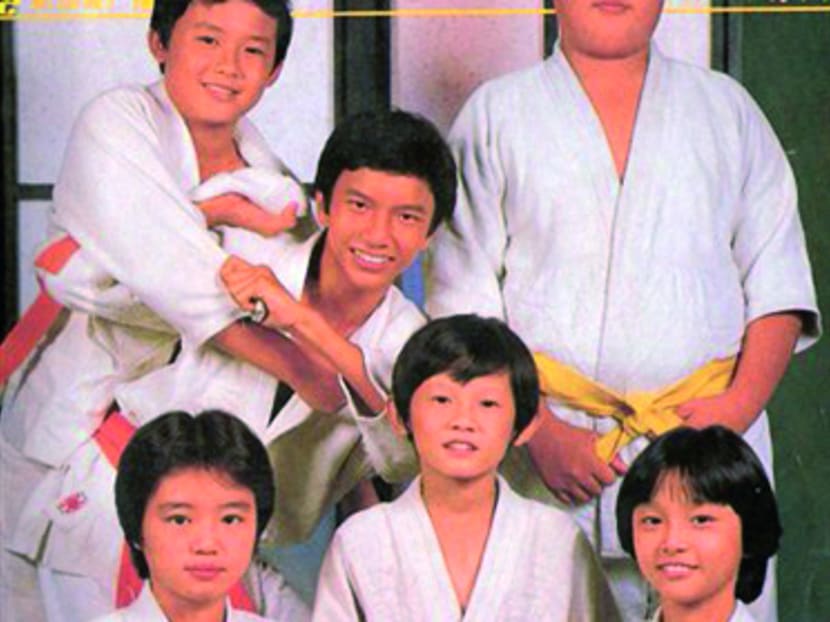
As local drama was going through its teething stages, Bryan Wong was growing up right along with it. At age seven, he was one of 24 youngsters chosen from 2,400 applicants to join the Children’s Drama Training Class, and got his start in the children’s dramas that aired on Sunday afternoons.
Wong remembers his first assignment with a mixture of amusement and chagrin. As an extra in Childhood, he and the other children were told to run out of the school gates as fast as they could when the dismissal bell sounded. “I was so into the role, I was the very first one out of the school gate, feeling very pleased with myself,” he recounted. “When the show aired, you saw snippets of those running in the middle ranks, or last. I was so fast, you couldn’t even see my shadow.”
But then he landed his first lead role in 1981’s The Ingenious Six, and subsequently became a regular Children’s Drama face. “Each episode had an individual story,” he said. For example, “One of them was called The Little Gardener and I had to dress like an English boy, with the hat and everything.”
And whilst he was already a star, Wong likes to say, Xiang Yun and Huang Wen Yong were just starting out. “Xiang Yun once acted as my domestic help, with no lines.”
CHAPTER 3: AWAKENING THE GIANT
Xiang Yun is today one of the most beloved household names, but the former clerk hesitated for a long time before deciding to become one of the first full-time artistes in 1981 for fear of “the perils of showbiz”.
In 1978, she joined the Professional Drama Performers’ Training course along with He Jie and Jack Neo. “Everyone acted part-time, after work,” she said. “We’d take the bus and walk a long way into the station. ”
One of those houses, she continued, was rented by the artistes as their “clubhouse”. “It had a huge garden,” recalled Xiang Yun — who will also be sharing anecdotes from her life in TV as she provides guided tours at 50 Years Of TV: Experience The Magic, the exhibition marking television’s golden anniversary at the National Museum Of Singapore (until Dec 21). “There were bedrooms where we could rest. The wife of Zhen Zhun Xing, a male artiste, would cook for us, and we’d pay for our meals.”
Her first drama, she said, was a detective show about a missing ink block called Gu Mo. “I played a secretary and had only one line: ‘Boss isn’t here.’ But I was terrified and messed it up many times,” she said. “People like Chen Shu Cheng and Yun Chang Cou helped me from the side-lines.
“I couldn’t act,” she said. But a little blockbuster called The Awakening (1984) changed all that. “The director, Jiang Long, taught me line by line. I found the ability to bring a character to life. I was addicted.”
The 26-episode period blockbuster, which had an impressive S$500,000-set, a cast of 30 main actors and 200 extras, and earned 822,000 viewers wasn’t just a breakthrough for Xiang Yun; it was also a breakthrough in foreign sales. The Awakening became the first SBC drama to be purchased by overseas stations.
Whilst filming, she said, “You could feel a huge surge of energy in the whole of drama. Our props men would jump into the sea to make sure it was safe for us, and climb trees crawling with ants. Everyone went all out.”
And, of course, there was her co-star, the late Huang Wenyong. “He was a very important person in TV,” Xiang Yun said. “I felt like his student, secretly learning a lot about acting. We were always friends who could share because we had similar values and problems. So, when he got sick and left us, I thought, ‘How could this person leave my team just like that?’”
She added: “He will always be my life partner in acting.”
CHAPTER 4: YOUTH IN SPACE
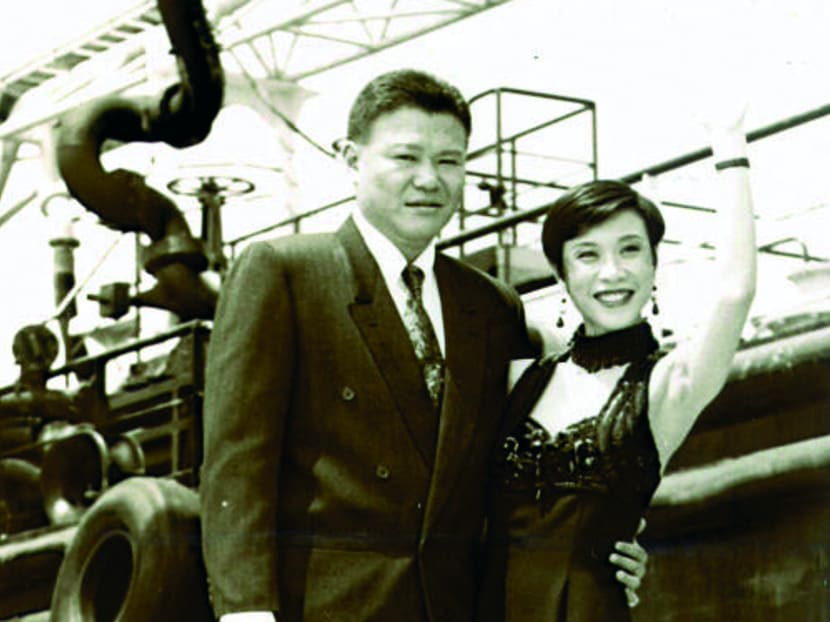
A career in show business brought romance to some, notably the marriage between Xiang Yun and fellow actor Edmund Chen. But romance and family have also caused others to leave entertainment, like Ivy Lee, Huang Biren, Lina Ng and, in 1997, Chen Xiu Huan, who bowed out at the peak of her popularity after 10 fruitful years.
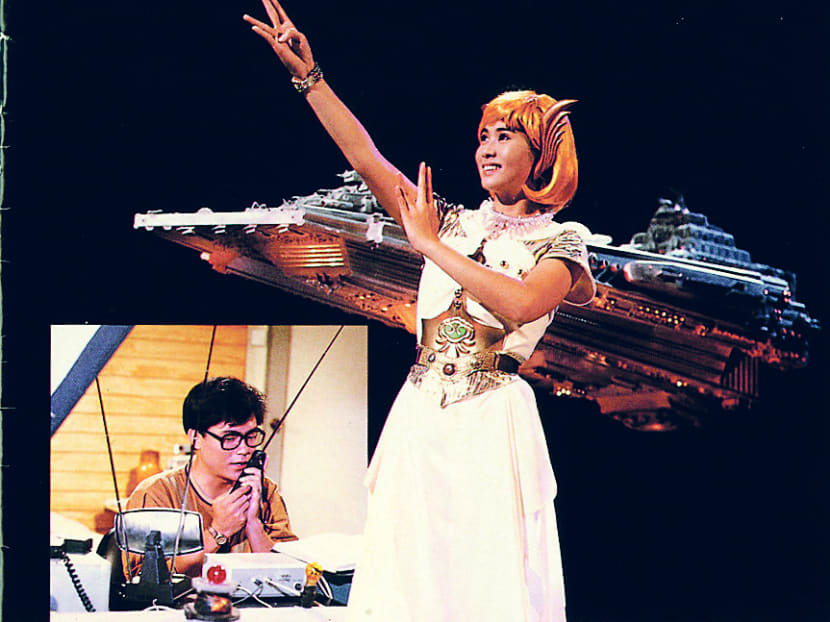
But up until today, even her daughter’s primary school teacher remembers her iconic portrayal of a lovable alien in 1987’s Star Maiden — and fans always show the actress her character’s signature hand gesture. “Edmund (Chen) and I thought up the gesture together,” she said. Star Maiden was SBC’s first attempt at a science-fiction drama, and her 150kg mother ship was also a first for the prop department.
According to Chen Xiu Huan, she started out very young and very clueless. Talent-scouted at Thompson Plaza, she was immediately asked to audition for the female lead in the swimming drama series Flying Fish — on set, at a pool, accompanied by her mother. “(Wang) Yu Qing and (Chen) Bi Feng were very famous then,” she recounted. “Yu Qing was so handsome. And I actually had to audition opposite him. I was in shock. I was only 15 and I was so shy, I couldn’t even walk when I put on a swimsuit.”
Because of that, Maggie Teng was chosen for the role instead — but Chen Xiu Huan went on to join the first full-time Training Class with Hong Hui Fang, Yang Li Bing and Wu Gui An.
It was far from smooth sailing to begin with. Looking back on her other iconic role as a volleyball player alongside Chen Liping, Chen Bifeng, Yang Libing and Sean Say in 1985’s The Happy Trio, she said: “I was too young. I was too serious and that affected my performance negatively.”
But there were people who supported her, like Hong Hui Fang. “She was always there for me. If not for her, I think, I would have given up. At one point, we had a misunderstanding, but a few years ago, she called me and said, ‘What was our quarrel about?’ I said, ‘I don’t remember.’ She said, ‘Let’s not remember. We were too young back then.’ So, now, we are good friends again.”
Recently, too, she has been surprised to learn of her own reputation. “Many people have told me, ‘You were bad-tempered, arrogant and conceited. You wouldn’t talk to anyone.’ I met some old colleagues and they said, ‘You’ve changed. You’re so happy now. You weren’t like that before.’ I was shocked because I had no idea.
“The truth was, I was terrified, so I hid myself in order to protect myself from the unknown. So, maybe, after I quit acting, I no longer felt the pressure, and I grew up.”
Now, the happy mother of three daughters is open to taking on projects, like she did with the recent series Disclosed — and, who knows? If things go well, she might even re-start her career.
CHAPTER 5: PROPPING UP THE SKY
Chen Xiu Huan may have had a bad rep, but the production crew do have their favourites. Just ask Lee Choon Hua, who started out 23 years ago as an Assistant Producer at the age of 19 and has worked her way up to Assistant Vice President, Production Support Chinese Drama, MediaCorp Studios.
Lee is the person who will tell you stories about banging on the door of Chen Liping’s house for half an hour to wake her up and crashing a razor bike while running an errand.
The favoured ones, she said, are people such as Chew Chor Meng. “You ask them to play a corpse, they play a corpse. Fann Wong: She’ll do anything you ask of her, even wirework. Being an Ah Jie back then was different — they were all very well-behaved. They were really in it to act. Not to mention people such as Zeng Hui Fen — they were always on time and kept track of their costumes themselves. Of course, now they have personal assistants and that’s helpful.”
Li Nanxing, she said, is “everybody’s favourite”. “He was such a good boy. Even though he always oversleeps and you have to give him a wake-up call, on set, he follows instructions. He is an artiste with a lot of heart — he’s very genuine and it’s not because he’s an Ah Ge. He loves cooking and eating at the kelongs. Once, we were driving past a field when he stopped the car to rescue two stray puppies and took them home to keep. Basically, he has no airs. He works alongside you. Even now, everyone loves him and helps him out.”
The production crew are the people who know the ins and outs of the industry best — and they are also the ones who, perhaps, work the hardest and reap the least rewards.
Being an Assistant Producer, said Lee, is like being “an odd job labourer”. “You have to be the earliest one up. You inform the artistes of their filming schedules. You book props. You keep track of what time the bus arrives and get everybody on the bus. You do a lot of paperwork. In your backpack, you always have masking tape, silver tape for swords, fishing line, black spraypaint and black tape.” Oh, and fake blood — which sometimes leaks out of the bottle. “I discovered once I was bleeding profusely on the bus!”
The Assistant Producer is also in charge of the little things — literally. “I remember squatting outside the make-up room catching red ants because a script called for ants in a cake. If it’s in the script, you have to make it happen. That trains you to overcome your own shortcomings. Even if the Director is stingy with his praises, you feel, ‘He wanted ants and I had ants to give him.’”
That sense of satisfaction is why Lee does what she does. “I’ve never intended to write a CV for another job. Sometimes we fight, but every day at the Drama (unit) is like at a playground.”
CHAPTER 6: FOREIGN EXCHANGE PROGRAMME
In the ’70s, SBC produced children’s dramas, but entertainment for adults came in the form of Hong Kong dramas. The problem was that Hong Kong TV stations raised their fees each year and, more importantly, these dramas, with their family feuds and social ills, did not reflect Singaporean values.
“There was a decision at the government level that we wanted to invest in local dramas,” said MediaCorp’s Doreen Neo, Managing Director, Studios. “We were beginning to develop as a nation and money wasn’t an issue.”
In November 1981, an SBC team went to Hong Kong to recruit producers and scriptwriters — and the drama scene was transformed.
Lin Ming Zhe, who famously acted in dramas including 1985’s hit The Coffee Shop, started out in 1983 as an Assistant Producer. He later debuted as an actor and has since returned to being behind the camera — as a Director. “We had to get used to a completely different culture,” he said of his Hong Kong colleagues. “They were very efficient, but your feelings were not their priority.”
While Channel 8 had help from Hong Kong, English-language Ch 5 had help from the United States. Recalling his time starring in our very first English drama, 1994’s Masters Of The Sea, Bryan Wong said: “The production team was the original people who created Dallas. We used a local crew, but the producers and storywriters were Americans.”
“People still ask me, ‘How was Masters Of The Sea?’” He joked: “It crushed me like a cockroach”.
Accents, however, were the least of your concerns if you were an actor in a Chinese drama before the ’90s.
“Back then it was all dubbed,” said Terence Cao. “It was the same voice for every drama. Edmund Chen, Desmond Sim and Li Nanxing had the same voice.” That’s because they were all voiced by top voice actor Bing Tai, who, according to Terence, looks, well, “very different from Nanxing or Desmond or Edmund”.
CHAPTER 7: COSTUMES MAKE THE ACTOR
Poh Shae Ching has been working in MediaCorp’s wardrobe department for 17 years, starting out as a costume designer and working her way up to her current position as Senior Image Director.
“When artistes tell me the costume helps them get into the role, I get a sense of achievement,” she said. For example, when Huang Biren played a gambler in 2005’s My Lucky Charm, an “uncle shirt” did the trick. “I gave her a men’s Montagut shirt. She said the moment she wore it, she was possessed. She squatted on the ground playing ‘dai di’. That’s the biggest compliment.”
Poh’s favourite show to work on was the 125-episode blockbuster Holland V, because its long run meant that she got immediate feedback while working. “Chen Liping needed oversized clothes, so I went to Holland Village and Tiong Bahru markets to buy them,” Poh said. “Even after the show started airing, we were still filming it and buying things for it.” In fact, stall owners started giving Poh discounts and bombarding her with questions about the show.
The wardrobe department has all manner of costuming equipment. Occasionally, you’ll see a fatsuit being hung out to sun — and, chances are, it’s the one Chen wore in Holland V.
Their work covers many aspects. “For variety shows, there’s a lot of modification and design work, especially charity shows where you need to make costumes. When it comes to drama, there is design work for period shows such as The Little Nyonya and The Voyage.”
There is also character imaging, where an actor has to be given a hunch or transformed into an amputee. At one point, it was trendy to have characters with buck teeth or large moles.
“Even during weekends, my mind is on my job and how to make characters look more interesting. I might be at the hawker centre eating chwee kueh, but I’m also noting the variety in the uncles’ styles. It’s an occupational hazard,” said Poh.
CHAPTER 8: CHANNEL SURFING
Channel 5 was our one and only channel when regular broadcasts began in April, 1963, with four hours of programming. In November that year, Channel 8 debuted, and a third channel, SBC12, was launched in 1984, carrying arts and cultural programmes.
Up until 1994, Channel 5 aired English and Malay programmes while Channel 8 aired Mandarin and Tamil programmes. After SBC was corporatised into TCS, RCS and TV12, Channel 12 was revamped into Prime 12 — with a sister channel, Premiere 12 — and Malay and Tamil programming found a new home there.
In 2000, Prime 12 evolved into the dedicated Malay-language channel Suria, while Premiere 12 morphed into the Central channel with three segments: Arts Central, Kids’ Central and Vasantham Central.
While Suria may technically only be 13 years old, Malay programming in Singapore has been prominent since the days when Rahimah Rahim starred in the 32-episode Pak Awang Temberang (Uncle Awang Tells Stories) in 1966; and Cultural Medallion winner Bani Buang, known as the father of modern Malay drama in Singapore, directed the first Malay TV drama, Awal dan Merah (Early And Red), about issues facing a rapidly urban society. Buang went on to produce and direct many other shows, including the 1970s hit series, Sandiwara (Play).
The first Malay drama in colour was 1980’s Prasangka (Suspicious), and thereafter came Gelombang Masa (The Waves Of Time), the sitcom Sepanjang Jalan (Memory Lane) and Asap Peluru Bunga Cinta (Gunsmoke And Love Flowers). Malay Drama Workshops were also held to discover and groom new talent.
For MediaCorp’s Zakiah A Halim, senior vice-president, Malay Broadcast, television has been an integral part of daily life. “Audiences, especially the Malay community, have grown up with us — like the cats in Mat Yoyo, woken up on Sunday mornings and been greeted with Selamat Pagi Singapura (Good Morning, Singapore), savoured the in-your-face presentation of Najip and Cik Sal in Kopi O Teh Tarik, cried with us watching heart-wrenching social dramas like Jeritan Sepi (Silent Cry), gotten into heated debates on controversial issues in Anak Metropolitan (Metropolitan Youth), and laughed with us watching TV and Radio personalities face off in the recent gameshow Te:Ra Seh!”
she said.
“It may not have been a perfect dream ride all the time, but we certainly hope that it has been as exciting a ride for our audience as it has been for the TV folks who bring these programmes to you.”
Going forward, Malay programming is embracing the digital age as media become integrated. “With the recent change of Suria, Warna and Ria coming together as the Malay Broadcast Division, our audience can look forward to more trans-media content across TV, Radio and Online,” she said.
Vasantham, too, may only be five years old — it was launched together with the children’s channel okto when Central was rebranded — but the first serialised Tamil drama aired in 1980. Ippadiayam oru Kudumbam (What A Family) was a comedy about a retiree’s family.
Another early Tamil drama project was the Legend Of Ramayana, featuring dancers from Bhasker’s Academy of Dance and Indian classical musicians like Zia Ul Hassan.
In 1997, the world’s first Tamil sitcom, Amali Thumali (Hustle and Bustle), was produced and aired on Prime 12.
In the five years that Vasantham has been dedicated to Tamil programming, it has produced hits like the cops-and-robbers series Vettai (Hunt) and Vettai 2.0; the reality blockbuster, Vasantham Star; as well as personalities like Miss Vasantham 2011, Vimala, and Mr Vasantham 2010, Viknesh.
As a timebelt, there were just 26 hours of Tamil programming a week — but with Vasantham as a full-fledged channel, there are now 67 hours of programming per week, said MediaCorp’s Dr Chitra Rajaram, senior vice-president, Indian Broadcast Division.
“As a full channel, we have introduced some winning genres: Long-form local dramas from Mondays to Thursdays, live talk shows, and entertainment programmes for all audiences. The local talent pool has grown with the channel across genres and, as a result, the Tamil production industry has also grown in the last five years. There are more production companies, scriptwriters and production crew, and some of our artistes have become full-time professionals. This augurs well for the future of the local Indian industry.” She added: “We hope to go 24-7 in the future.”
CHAPTER 9: LIGHTS! CAMERA! FISH, BANANAS, DURIAN!
Loving food is a prerequisite for being Singaporean. It’s no surprise, then, that many actors’ memorable moments involve eats.
Aileen Tan “will always remember” the scene from 1988’s My Fair Ladies in which she, Zoe Tay and Jazreel Tan had to eat durians while saying their lines. “I had to have medicated oil with me because it smelled so bad,” Tan said. “Zoe took the durian and tried to scare me by waving it in my face, and I was like, ‘Go away! Go away!’”
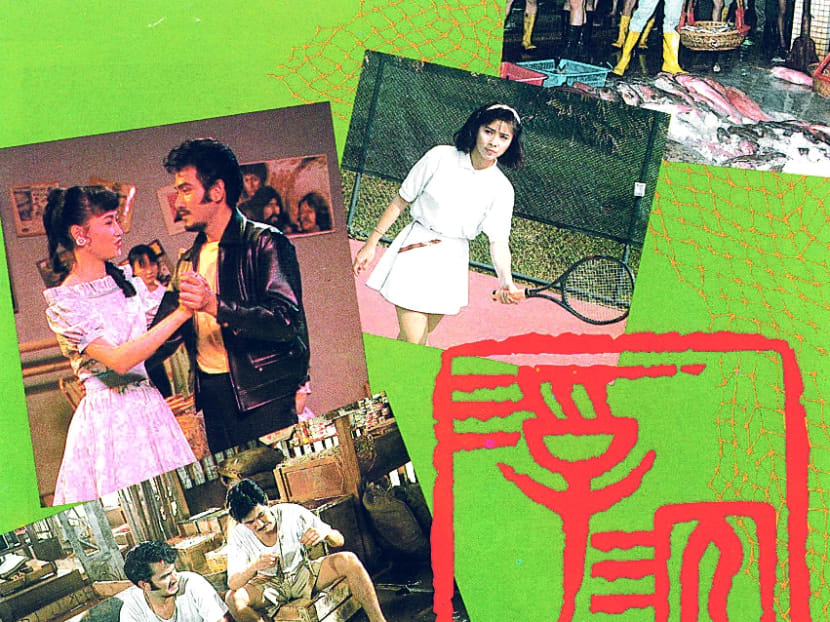
Zhu Hou Ren still loves his 1989 drama, Turn Of The Tide, about the fish business in Singapore, because it was filmed on location at a fish market in Jurong. “There were over a hundred stalls, and we filmed in one of them,” he recalled. “While they were doing business, we would be setting up our lights. I take my hat off to the people who managed to persuade the fish market to let us film there.
“Imagine how hard the assistant producers and directors had to work! Other people around you are not actors; you can’t chase them away, nor can you affect their work. You can’t ask the people next to you to be quiet — when you say your lines, you have to be one with them.”
Of course, he would drive home reeking of fish. “It was only when my family got into the car and started complaining that I realised the entire car was filled with the stench,” said Zhu.
Speaking of things that reek, the thing that first springs into Carole Lin’s mind when she recalls 1997’s historical drama The Price Of Peace is, well … banana night soil. “There was one scene in which Christopher (Lee) had to distract my mum so that I could run away with him, so he pays the guy who collects faeces to trip my mum. The whole bucket of ‘faeces’ tipped onto the ground and she sat in it,” said Lin. Not real poop, though: “They used bananas and mud. I was like, ‘Eee! It’s so real!’ It was disgusting,” she laughed.
It must have been some pretty inspiring doodie — The Price Of Peace won Lin a Best Actress Star Award.
CHAPTER 10: WILDCARD ROUND
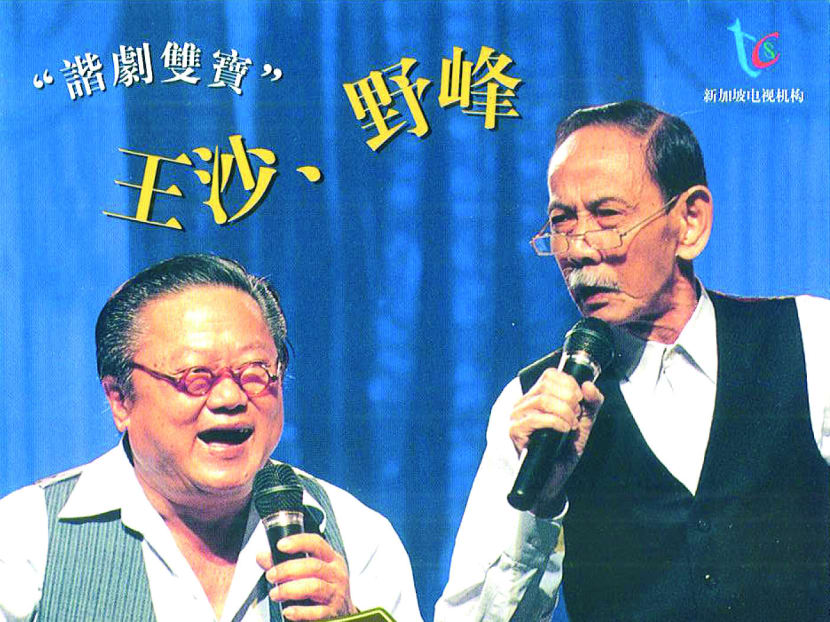
It’s hard to wrap your head around how entertainment programmes have gone from two guys talking — Chen Shu Cheng remembers crosstalk comedians Wang Sha and Ye Fung being all the rage back in the day — to teenagers weeping over Twitter about being voted out of the competition.
But before The Final 1, One Moment Of Glory or Singapore Idol, Talentime, which was held in several languages and gave us stars like Maizurah Hamzah and Lena Lim, had been there and done that all throughout the ’80s. One constant has remained, though: Judge Ken Lim.
Ivy Low, winner of Talentime ’86, famous for singing the theme song from the 1998 drama Mystery Night, and MediaCorp’s present head of Artiste Management, credits her win to that year’s “unconventional judges” Ken Lim and Dick Lee. “It was quite unusual for a female with a low voice to win,” she said.
Low recalled: “My prize money was S$8,000-worth of Panasonic and Technics products — there was no cash. And my biggest investment was a pantsuit I had tailored at Peninsula Plaza for the finals, which, at S$200, cost me a bomb. Having glamorous sponsored outfits like we do now at the Star Awards was
unheard of.”
Besides Talentime, there was 1984’s Singers And Their Songs, which featured local singers and compositions; Music-moves, New Phases, Limelight and The Entertainment Line came after. The ’80s also saw many live entertainment specials, with the New Year’s Eve special Hello 84 staged on the steps of City Hall, and the 1987 Miss Universe pageant that was broadcast from Singapore to over 50 countries.
SBC was building its pool of professional variety artistes, so Low’s Talentime win was a ticket to a full-time job. “The starting pay was S$800. We were given daily training in singing, voice projection, stage presentation and dancing,” Low said. “Often, we also sang backup for drama artistes, to ‘beautify’ their voices. My vocal trainer was S K Poon — she was huge in the region and is the original singer of Lovers’ Tears. I think there were around 20 full-time singers. We performed in the nightly live shows and major shows. In one show, I had to impersonate Anita Mui because of my low voice — she was the Hong Kong version of Lady Gaga then!
“I still remember singing the opening number for our very first Star Search, and being in awe of how glamorous Zoe, Aileen and Jazreel looked. And, yes, how time flies — more than two decades later, I’m managing the careers of artistes with whom I once shared the stage.”
CHAPTER 11: LESS-THAN-HEAVENLY HOSTS
It was only after she was chosen for the first and last Hosts’ Training Class in 1990 that the organizers realised she was not yet 18, so she was only allowed to listen in instead of participating in the lessons. “But I was thick-skinned so I barged my way in,” she giggled. “I was not an examinable student but I still handedin homework.”
Quan recounted that for their graduation examination, artistes were brought in for the trainees to interview. “As Xiang Yun was finishing up and leaving, she saw me and said, ‘Aren’t you a student? How come you didn’t do the exam?’ I explained the situation and she said, ‘That’s okay, let’s give you a chance.’ So I got to interview her one-on-one. I was so touched. Perhaps it was because Xiang Yun stopped to help her junior that I got selected.”
Out of the class, she was the only one selected to host a segment on Comedy Night. That stint lasted four seasons.
“We started out memorising scripts for live shows. Back then, we all had blank expressions and too-mature clothing,” she said, laughing. “The directors and producers were full of Cantonese vulgarities — and we had to survive under high-pressure conditions. But after you’ve been tested like that, you’re thankful that your seniors were willing to scold and teach you; to lose their temper at you,” said the 2008 Asian Television Awards winner for Best Entertainment Presenter (Guo Liang also shared the award that year).
Kym Ng, who started her hosting career in 1996 with City Beat, agreed. As a variety programme host, “you really learn and you really live”,she said.
It was sheer determination on Ng’s part that got her a full-time job. “City Beat started with Chew Chor Meng, Pan Ling Ling, Bryan Wong and He Yong Fang,” she said. “I came in because He Y went to China to film for three months. But I told myself, ‘I’m going to be in this for good’ —because I needed a job.”
Her City Beat co-star Wong can also recall moments when his job stank — cleaning portaloos for the experiential variety show Behind Every Job, for one. “The smell was like 1,000 people farting in your face,” he said. “Imagine all the clouds in Genting are farts.”
Compared to that, assignments like having to massage a very hairy man in a Turkish bathhouse for 2012’s Jobs Around The World were a piece of cake — especially since that massage has earned him a nomination for Best Entertainment Presenter at this year’s Asian Television Awards. Most important, Wong said, “With all the experiences I gained, in a certain way, I’ve lived life very fully.”
CHAPTER 12: 50 AND COUNTING
So, TV in Singapore celebrates its golden jubilee. But age is just a number, right? One lives and learns, never rests on one’s laurels, and constantly evolves so as to stay relevant.
“We moved from, in my mind, an era where we had no choice — it was just the TV box you had at home — to so many choices on pay-TV and the Internet,” said MediaCorp’s Doreen Neo, Managing Director, Studios. “We have to push ourselves in terms of standards, while keeping our own cultural nuances.”
To this end, MediaCorp Studios is making it a point to keep changing things up. “We have experimented in the last year,” Neo said. “Many of our shows are now shot in real venues and real houses because in the studio, it’s very obvious that it’s a set. Second, we made it a point for every show to have a different feel.”
This helps Singapore’s shows to become more exportable. “Malaysia and Cambodia buy everything we have,” Neo said. “In Thailand, we’ve started to make inroads since The Little Nyonya — every year they’ve bought one blockbuster show from us. Hong Kong and Korea buy our variety shows. China is a tough market, but we’re making progress. Every year, we sell about 100 to 150 hours of programming to China.”
It’s not just content production that is changing with the times. Experienced actors are already preparing to pass on the baton eventually. At a sharing session, 23-year-old Shane Pow said he has learnt from Hong Hui Fang and Zheng Geping to “listen and pay attention to the person I am acting with”. He explained: “When I first started out, I was only concerned about memorising my lines and waiting for my co-actors to finish saying theirs.”
Jayley Woo, 22, has picked up advice from established actors, including Thomas Ong, Tay Ping Hui and Zoe Tay. “Thomas taught us how to incorporate lines with actions and feelings, and that it must be through your character’s voice and not your own,” she said. “He even organised a dinner for some of the cast where we sat down and talked about our experiences and scripts.”
Woo added that these veterans also recounted their memories to her. For example, Zoe Tay shared that artistes used to chat amongst themselves in between scenes instead of playing with their phones and iPads.
The social media generation may never know the world of their seniors, but for artistes such as Xiang Yun, a life in television is all they have ever known. “This place is really my life,” the All-Time Favourite Actress Star Award recipient said. “A TV station is the spinning indicator of a country’s culture — it’s like the centre of a clock. So, being in the midst of it, I experienced Singapore’s stages; its ups and downs; its development.
“Some of my ex-classmates are housewives and they lead full lives — but my life has been a mixture of many things,” said Xiang Yun. “I’ve been very lucky and I feel I must be thankful.”
**
CREDITS
Photos: Jason Ho
Stylist: Chin (The ARM Collective)
Zhu Hou Ren: Hair and makeup by Joanna Ang (96953772) using Make Up Forever
Kym Ng: Hair and makeup by Joanna Ang (96953772) using Make Up Forever
Quan Yi Fong: Hair by Joanne Er, Monsoon Novena, using Hatsuga products
Bryan Wong: Makeup by Joanna Ang (96953772) using Make Up Forever
Aileen Tan: Hair by Chantel Siew, Monsoon Novena, using Hatsuga products. Makeup by Joanna Ang (96953772) using Make Up Forever
Chen Shu Cheng: Hair and makeup by Zennie Casann using La Biosthetique Paris
Xiang Yun: Hair by Jack Kong, Urban Hair. Makeup by Zennie Casann using La Biosthetique Paris
Chen Xiu Huan: Hair and makeup by Zennie Casann using La Biosthetique Paris
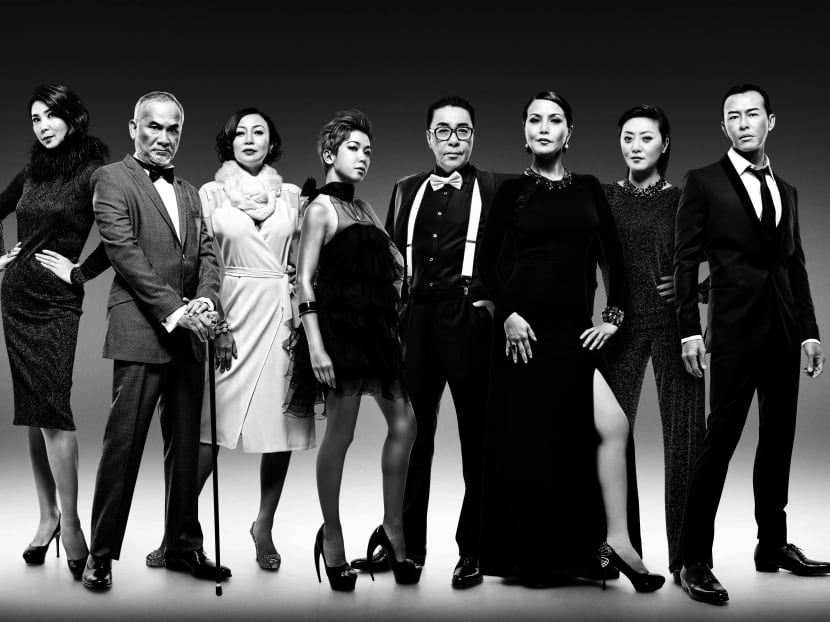
Chen Xiu Huan wears ostrich feather crown, S$250 and glitter dress, S$230 by FLYNOW; Belago bracelet, S$465; Sergio Rossi heels, S$1400.
Chen Shu Cheng wears eyewear from Frency & Mercury, S$520; black cotton shirt, S$216 by Meticulous; black wool pants, S$240 by Oscar Jacobson; white suspenders, stylist’s own; black leather shoes, S$379 by LLYR.
Aileen Tan wears black embroidery detailed dress, S$369 by Coast; earrings, S$230 and black bracelet, S$550 by Appartement a Louer; black crystal necklace, S$1488 by Dave; Sergio Rossi heels, S$1400.
Xiang Yun wears white wrap dress, S$1930 by Agnes b; white rabbit fur muffler S$180; Appartement a Louer Jem earrings, S$230; white crystal bracelet, S$95 by Salut de Miel; Sulin Serio pearl necklace/bracelet, S$1890; heels, artiste’s own.
Quan Yi Fong wears glitter jersey top and bottom, S$375 and S$395 by Agnes b; necklace, S$800 and bangle, S$550 by Appartement a Louer; Sergio Rossi heels, S$1400.
Kym Ng wears Wave Black Organza Dress, S$1790 by Agnes b; black Unicorn heels by Walter Steiger, S$1300; Gold Vintage necklace, S$190 and Black Gold Vintage Bangles, S$110 by A.P.C.
Zhu Hou Ren wears Med grey suit (pants, S$279; blazer, S$649) by Peter Werth; black bow tie and cummerbund set, S$169 by Marz Thomson; Silver with Black Onyx Ring, S$146 by Carrie K; black leather shoes, S$379 by LLYR.
Bryan Wong wears white collared cotton shirt, S$119 by TM LEWIN; black velvet pants, S$349; velvet lapelled blazer, S$869 and black silk tie, S$149 from The Kooples; black waistcoat, S$299 by Oscar Jacobson; black leather shoe, S$379 by LLYR.
LLYR, FLYNOW, APC, Carrie K, Belago, Frency & Mercury are available at FRONT ROW, #02-09, Raffles Hotel, The Arcade, 328 North Bridge Rd; TM LEWIN is available at ION Orchard.
Agnes B is available at ISETAN, LIDO Orchard; Appartement a Louer, Dave, Coast, Meticulous, Oscar Jacobson, Marz Thomson, Sulin Serio, Salut de Miel, Sergio Rossi, Walter Steiger, Peter Werth, The Kooples and the fur muffler are available at Robinsons Orchard.
Stay in the know. Anytime. Anywhere.

Subscribe to our newsletter for the top features, insights and must reads delivered straight to your inbox.
By clicking subscribe, I agree for my personal data to be used to send me TODAY newsletters, promotional offers and for research and analysis.






