
Understanding WP’s strategy for GE2015
The Workers’ Party (WP) had previously maintained that it was not looking to form the next government, but the tune may now have changed.
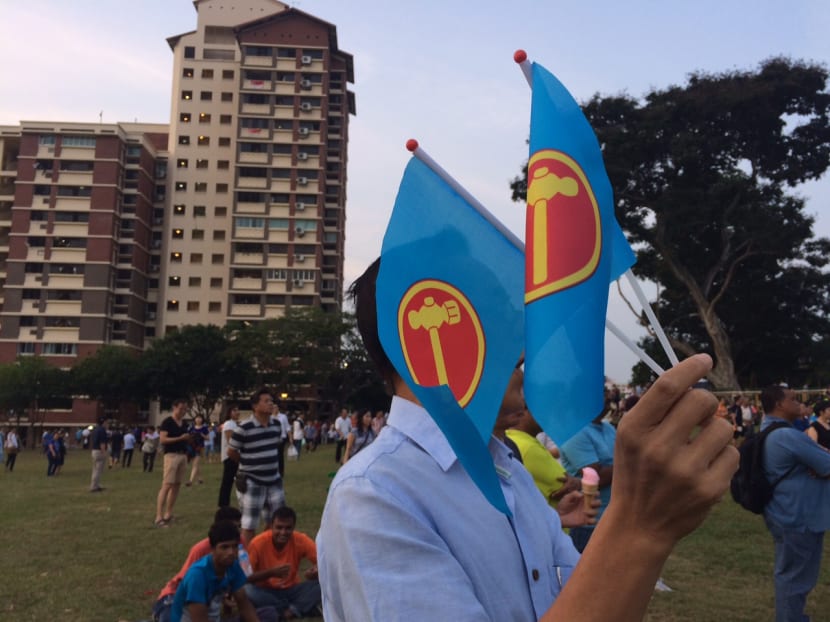
Workers’ Party supporters gathering before WP’s first rally at Hougang Central, on Sept 2, 2015. Photo: Jason Quah

The Workers’ Party (WP) had previously maintained that it was not looking to form the next government, but the tune may now have changed.
Its candidate in East Coast Group Representation Constituency (GRC), former Non-Constituency Member of Parliament (NCMP) Gerald Giam, said the party has to plan for a time when they are ready to do so.
Its candidate in neighbouring single-ward Fengshan, Mr Dennis Tan, has also said: “In the longer term, we should look to have a two-party system whereby another party must be ready to form the Government as the ruling party declines.”
To what extent does the WP’s election strategy reflect this change?
If the WP is hoping to be the second party in a two-party system, then it is building it step by step, rather than doing it by leaps and bounds — this is demonstrated by its decision to keep its two top guns, Mr Low Thia Khiang and Ms Sylvia Lim, in Aljunied Group Representation Constituency (GRC).
Should either have decided to helm the team in East Coast GRC, it may have signalled that they would make a decisive play for that in GE2015.
Of course, it may well be that Mr Low and Ms Lim are tied down in Aljunied GRC by considerations about whether there are legal ramifications arising out of the governance challenges they have faced in running the town council there over the past few years.
Nevertheless, they are now riding on the standing of their former NCMPs — Mr Yee Jenn Jong and Mr Giam — to anchor their efforts to extend influence in a more measured battle of ground-level attrition. It will also be an opportunity to initiate its fresh faces to electoral contests.
CAN WP MULTI-TASK?
However, the People’s Action Party teams in Marine Parade and East Coast GRCs are primarily seasoned incumbents, so it will not be easy to dislodge them save for the argument of the need for an Opposition voice in Parliament, or surprises in the hustings.
The Marine Parade team is also helmed by Mr Tan Chuan-Jin, one of the top catches of the GE2011 batch of candidates, who took over the mantle from Singapore’s second Prime Minister, Mr Goh Chok Tong. Mr Goh described the election as one that is centred on his party and the country’s leadership transition.
The East Coast GRC team is helmed by Mr Lim Swee Say, who received special mention from Prime Minister Lee Hsien Loong in his National Day Rally speech on Aug 23.
He said that Mr Lim had an international standing and urged voters to return folk like him to Parliament and government. His team includes two junior ministers.
Some voters may feel that the seven duly elected people’s representatives from the WP who were at the closing of the Parliamentary Session last week are sufficient.
After all, the WP has argued that their presence and policy proposals in their GE2011 manifesto have been adopted by the Government.
Others may feel that Singapore can afford even more Opposition voices in Parliament. Mr Low’s target of 20 seats to the Opposition for a more “balanced” Parliament may well be within these voters’ imagination.
In that case, it is in these two GRCs and Fengshan Single Member Constituency where the WP is likely to fight the hardest to turn voters away from the incumbents. These are where the PAP will have to make its best effort to convince voters how it has listened to concerns and suggestions from across Singapore in developing its reform agenda since May 2011, especially since the Opposition movement as a whole is focused on drawing voters’ attention to manpower policy, in spite of the important shifts and results that have been achieved.
The WP, on the other hand, will have to convince voters that they can multi-task — be the Opposition voice in Parliament, but also be effective in local governance and certainly be above suspicion in how it manages these practicalities, as town councils are still integral to the political system today.
Members of Parliament also have to be “chief social workers” and town planners as their constituents think of the MP role in those ways, too.
Singaporeans will find it difficult to envisage that two party-system or its merits otherwise.
ABOUT THE AUTHOR:
Dr Gillian Koh is a senior research fellow at the Institute of Policy Studies of the Lee Kuan Yew School of Public Policy. This commentary first appeared in IPS Commons
Stay in the know. Anytime. Anywhere.

Subscribe to our newsletter for the top features, insights and must reads delivered straight to your inbox.
By clicking subscribe, I agree for my personal data to be used to send me TODAY newsletters, promotional offers and for research and analysis.






