
WP proposes ‘phased roll-out’ of minimum wage
SINGAPORE — The Workers’ Party is proposing a “phased rollout” of a national minimum wage starting at S$1,000 a month — or around 80 per cent of the Average Household Expenditure on Basic Needs (AHEBN) for a four-person household.
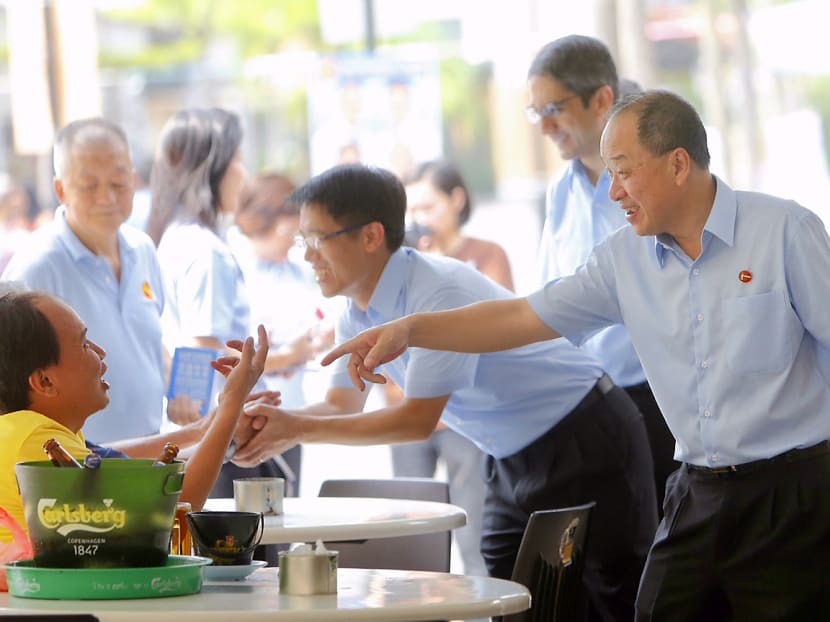
From right: The Workers’ Party’s Mr Low, Mr Perera and Mr Giam during a walkabout at New Upper Changi Road today. Mr Perera said the party is confident the minimum wage proposal will work because the level it is proposing is modest. Photo: Raj Nadarajan/TODAY

SINGAPORE — The Workers’ Party is proposing a “phased rollout” of a national minimum wage starting at S$1,000 a month — or around 80 per cent of the Average Household Expenditure on Basic Needs (AHEBN) for a four-person household.
The AHEBN is an estimate of how much households spend per month on essential needs such as food, clothing and shelter, and is based on the Household Expenditure Survey conducted every five years. The current AHEBN stands at S$1,250, according to the 2013 survey.
Under the WP’s proposal, the minimum wage will be increased gradually over “a few years” to S$1,250, said the party’s candidate for East Coast Group Representation Constituency (GRC) Leon Perera.
Video: Kelly Ng/TODAY
Speaking to the media during the party’s walkabout at New Upper Changi Road today (Sept 3), Mr Perera said a phased rollout will allow policymakers to monitor the effect of the national minimum wage on jobs creation, and ensure that no jobs are lost as a result.
“We are confident (it will work) because the level we are proposing is modest,” said Mr Perera, 44, who is the chief executive of a research and consulting firm. Having joined the WP one-and-a-half years ago, he has been involved in the party’s policy group, as well as its grassroots activities in Aljunied GRC.
Mr Perera said the bulk of people earning between S$1,000 and S$1,250 here hold jobs in the “non-tradeable” sector, which “cannot easily” be exported. On Saturday, the WP unveiled the national minimum wage as one of 130 policy ideas in its 48-page manifesto for the General Election.
WP East Coast GRC candidate Gerald Giam, who was also at the walkabout, said the Progressive Wage Model introduced by the Government is more rigid compared to a national minimum wage because it combines training with wage increments. “It imposes a lot more burden on the employers to have to not only pay a higher wage, but take (employees) out of their work to go for training and spend these hours. Some of this low-wage work requires more on-the-job training than classroom training,” said Mr Giam.
In comparison, a minimum wage will give employers more flexibility to decide how to go about improving productivity, he said. “We believe once employers are pushed to pay a higher wage, they would make choices ... so that productivity matches wage levels,” he added.
Apart from Mr Perera and Mr Giam, WP chief Low Thia Khiang and the party’s other candidates for East Coast GRC and the Fengshan single-seat ward were also present at the walkabout.
Video: Kelly Ng/TODAY
Related topics
GE2015Stay in the know. Anytime. Anywhere.

Subscribe to our newsletter for the top features, insights and must reads delivered straight to your inbox.
By clicking subscribe, I agree for my personal data to be used to send me TODAY newsletters, promotional offers and for research and analysis.






