
Being corruption-free a critical ingredient for Singapore: PM Lee
SINGAPORE — The Republic has developed a system that “eschews corruption” and must keep it that way, Prime Minister Lee Hsien Loong said as he officially opened the Corruption Reporting and Heritage Centre (CRHC) on Tuesday (June 6).
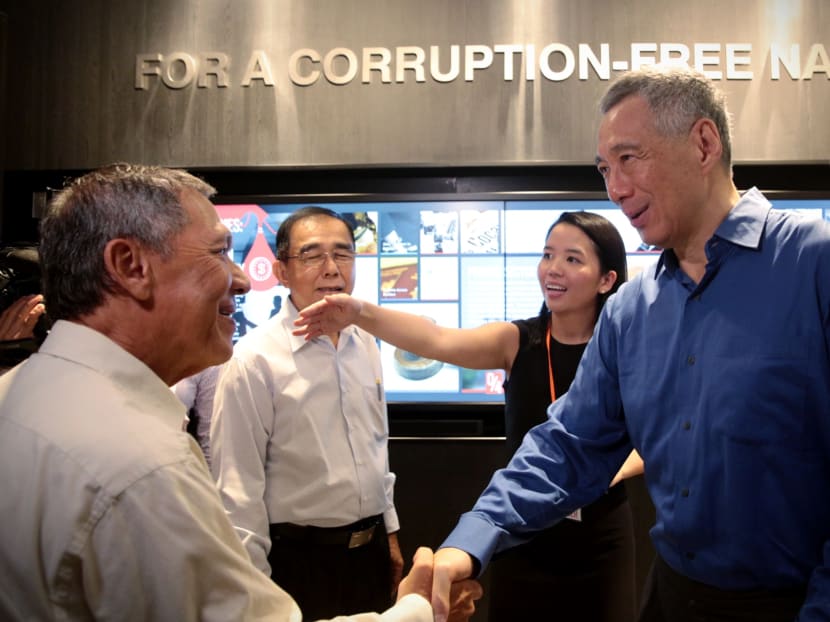
PM Lee Hsien Loong at official opening of the Corrupt Practices Reporting Centre on June 6, 2017. Photo: Jason Quah/TODAY

SINGAPORE — The Republic has developed a system that “eschews corruption” and must keep it that way, Prime Minister Lee Hsien Loong said as he officially opened the Corruption Reporting and Heritage Centre (CRHC) on Tuesday (June 6).
Stressing the important role of the public in maintaining a corruption-free country, Mr Lee said the new centre demonstrates the Government’s desire to treat each complaint seriously and transparently, and urged the public to step forward should they suspect any corrupt behaviour.
“In fact many CPIB investigations, successful ones, arise from tip-offs from the public. So we encourage members of the public who know of or suspect any corrupt behaviour, to step forward and inform the CPIB,” he added.
The setting up of the one-stop centre at Whitley Road was announced in 2015 to allow graft complaints to be made more discreetly and in a more accessible manner.
In response to queries, a Corrupt Practices Investigation Bureau (CPIB) spokesperson said there have been 22 walk-in complainants at CRHC since it started operations on Jan 9. This is nearly one-quarter (23 per cent) of the total number of walk-in complaints the CPIB has received this year.
In his speech on Tuesday, Mr Lee said Singaporeans “expect and demand a clean system” and do not condone giving or asking for “social lubricants” to get things done. People also readily report corrupt practices when they encounter them and trust that the Government will enforce the law without fear or favour, he added.
In contrast, Mr Lee said corruption has become “entrenched” in some other countries despite stiff laws, anti-corruption agencies and codes of conduct for civil servants. Graft has come to be accepted as “the natural state of things” in these countries, with people no longer outraged by corrupt officials and resigned to the way things are, because of the belief that even if one batch of corrupt leaders is kicked out, the replacements would behave the same way.
“It is entrenched, it becomes impossible to eradicate because once it’s gone into the system, without money, people cannot get elected and so clean candidates or political parties have no chance. You need money to get elected. And having got elected, you need to recoup that money and the system perpetuates itself,” he said.
In Singapore, the number of graft complaints registered for investigation fell 11 per cent to a record low last year, with the CPIB pursuing 118 cases — down from 132 in 2015. The private sector accounted for the bulk of these cases, at 85 per cent.
Complaints lodged in person are most effective as the CPIB is able to obtain further details about suspected corrupt practices more readily, said a spokesperson.
Of the 808 complaints the bureau received last year, the highest percentage that resulted in investigation were those lodged in person, followed by complaints lodged via the phone and via referrals. Only 7 per cent of complaints the CPIB received last year were lodged in person, but 26 per cent of these complaints resulted in investigation.
About one-third of the complaints received by CPIB last year were by mail/fax (35 per cent) and through its website (34 per cent), but only 9 per cent of these complaints resulted in investigation.
Another key factor to staving off graft is that public service officials must be “imbued with the right values” and paid “fair and realistic wages” benchmarked to the private sector, said Mr Lee. “That reduces the temptation for public officers to accept a bribe and makes the problem of fighting corruption manageable.”
The court, the Government, civil servants and police officers must continue to uphold the “highest levels of professionalism and integrity”. Mr Lee added: “Our founding fathers left us a clean system, built up over more than half a century. It is a legacy that we should be proud of and do our utmost to protect.”
Meanwhile, visitors to the centre’s heritage gallery can learn about how the CPIB tackled high-profile corruption cases in the past. It has received about 400 visitors, both local and foreign.
Stay in the know. Anytime. Anywhere.

Subscribe to our newsletter for the top features, insights and must reads delivered straight to your inbox.
By clicking subscribe, I agree for my personal data to be used to send me TODAY newsletters, promotional offers and for research and analysis.