
The green mile
Fuji Speedway (Japan) — In just one week, Japan was hit by three typhoons. “It’s unprecedented,” said Morio Owaki, a vice-president at Toyota Motor Asia-Pacific. “It’s due to climate change, I suppose.”
Fuji Speedway (Japan) — In just one week, Japan was hit by three typhoons. “It’s unprecedented,” said Morio Owaki, a vice-president at Toyota Motor Asia-Pacific. “It’s due to climate change, I suppose.”
That may not be the case, but Toyota has nonetheless declared war on carbon dioxide emissions.
While climate change is becoming an increasingly hot topic in the mainstream, Japan’s leading car maker has fought a battle against global warming since 1992, when it decided to pursue green technology following that year’s Earth Summit in Rio de Janeiro.
Five years later, the world’s first petrol-electric hybrid car, the Toyota Prius, was launched. Since then, its impact has been significant. It has made Toyota synonymous with hybrid vehicles, and helped it to put more than nine million hybrids on the road.
Toyota calculates that it has collectively helped to save 25 billion litres of petrol, and reduced CO2 emissions by 67 million tonnes. With more than 30 hybrid models available today, Toyota expects to add another six million units to its hybrid tally in only four years.
Nearly all car makers have dabbled with hybrid technology since the Prius, including Toyota’s domestic rivals, along with Korea’s Hyundai-Kia group. But no other manufacturer has come close to achieving Toyota’s scale of success.
The Prius itself is the king of hybrids, with sales of around 1.3 million units a year. That is more than double the entire output of a second-tier brand like Volvo.
A SLOW START
But in 1997, the company had little idea about the impact the Prius would have. It arose from a project code named G21 (for global 21st century), which had only a vague mission to change Toyota’s vehicle development methods, and become a car for the next century.
“What’s a 21st century car? It’s one that retains the usability and comfort of a normal car, with outstanding fuel economy,” said Yoshihiro Onomura, an engineer who worked on the original Prius. “We knew the environment would be a major issue.”
The initial target was for the Prius to go one-and-a-half times the distance of a comparable car on the same amount of fuel, but Onomura said his team challenged themselves to do better. “We thought we should not do just ‘what we can’, but ‘what we should’,” he said.
Eventually, the Prius achieved a fuel consumption figure of 28km/L, or double the efficiency of a conventional car.
Yet, sales were slow for the first nine years, averaging just 10,000 cars a year. “To be honest, we did not think the Prius would be this successful,” said Onomura.
“But we did believe that the technology used in hybrids would be the key technology for future vehicles. That’s why we continued to develop it.”
TOYOTA’S NEXT LAP
Toyota said that hybrid technology now provides the base for its next generation of eco cars: Plug-in hybrid electric vehicles (PHEVs), electric vehicles (EVs) and hydrogen fuel-cell vehicles (FCVs).
Those cars are part of an ambitious CO2 reduction plan; by 2050, Toyota intends to be able to look back at the cars it sold in 2010 and say that they had emitted 10 times as much carbon.
This means going beyond the Prius and its hybrid ilk, but Toyota said it has that future roughly mapped out.
Its next move is to launch its longest-range plug-in to date, called the Prius Prime. Toyota starts manufacturing them this month.
The Prime version is equipped with a bigger battery that can be charged from a power outlet so it can cover a day’s driving on only electric power. Petrol is for when you want to drive out of town, or for bursts of maximum power. “Currently, plug-in technology is a realistic solution for the next stage,” said Onomura.
But plug-ins are only an interim step, and Toyota is surprisingly late to the game. While it readies the Prius Prime for launch, BMW and Mitsubishi have already announced their intention to sell a range of PHEVs in Singapore.
BEYOND CARS
When it comes to EVs, however, Toyota is thinking beyond actual cars. The i-Road, a no-frills three-wheeler, represents its vision of the role EVs can play in society — their short range and long charging times make them better suited to car-sharing services.
Where Toyota is more aggressive is in a field that few other car makers have treaded: FCVs.
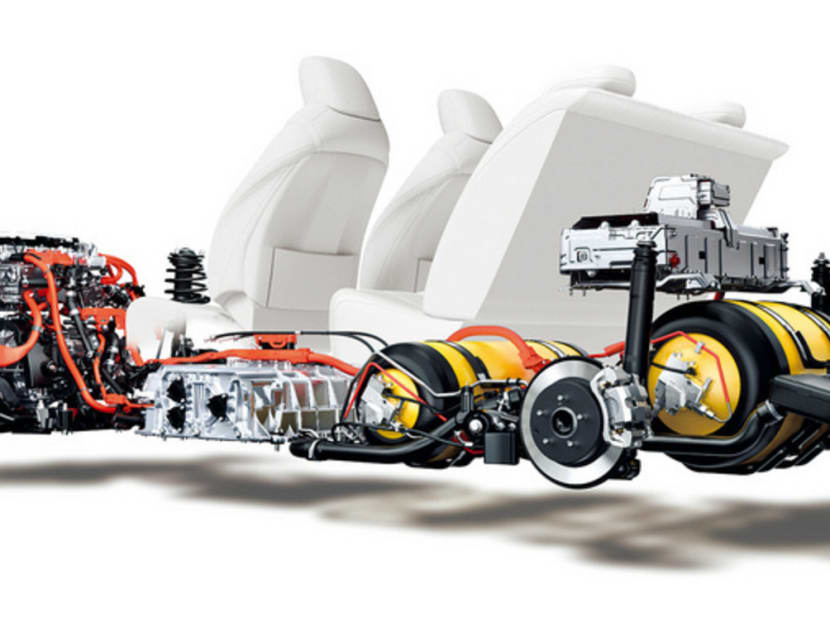
These are essentially electric cars, but use fuel cells to power their motor. The technology combines hydrogen with oxygen in a process that generates electricity.
Unlike an EV that you charge for hours, you can top up an FCV’s hydrogen tank in minutes.
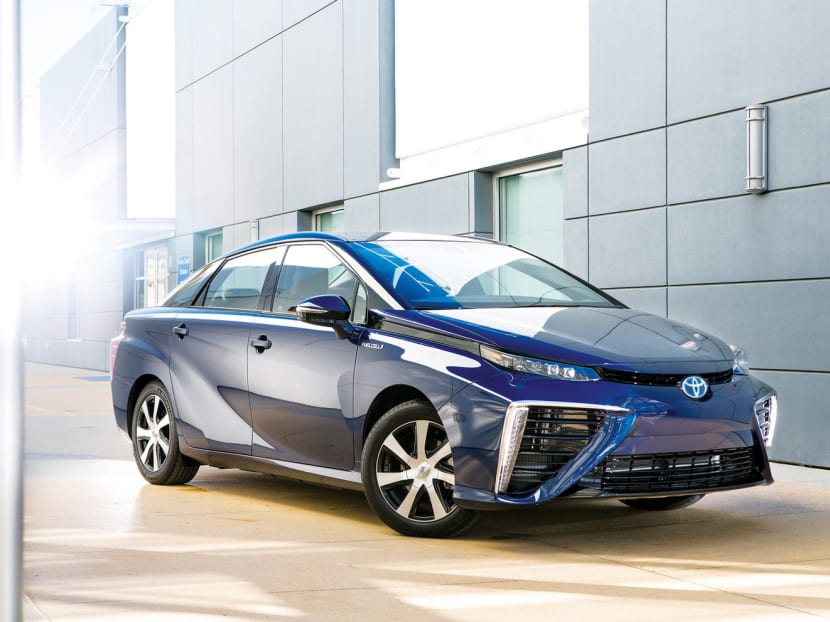
A brief spin in the Mirai on Toyota’s private track showed us that the car is a pleasure to drive, with punchy acceleration and near-silent operation.
One downside? A lack of hydrogen refuelling stations. There are only a few hundred in the world today. So why should someone buy a Toyota Mirai over say, a flashy Tesla Model S with its powerful motors, eco credentials and charging network?
“I think it’s okay that a consumer who believes in buying an environmentally friendly vehicle would buy a Tesla, but we have a long-term vision about the remote future, and I think there’s bigger potential to expand the use of FCVs in the future,” said Hisashi Nakai, a senior member of Toyota’s public affairs division. “So, rather than launching an EV, we decided to launch the Mirai.”
He said Toyota would like to see EVs and FCVs become popular, for the sake of the environment. Yet, while Tesla has collected nearly 400,000 orders for the Model 3, a car it will not be able to deliver until 2020, the Mirai has hit the market with far more modest aspirations.
This year, Toyota aims to sell just 2,000 of the futuristic FCV.
That may not sound like much, but it bided its time with the Prius. Toyota seems content now to wait for hydrogen distribution to become widespread enough to make FCV cars viable.
No sense storming into the market when there are typhoons to avoid.
Stay in the know. Anytime. Anywhere.

Subscribe to our newsletter for the top features, insights and must reads delivered straight to your inbox.
By clicking subscribe, I agree for my personal data to be used to send me TODAY newsletters, promotional offers and for research and analysis.






