
The outlook for COE prices in 2016
SINGAPORE — Stock markets weren’t the only ones to start 2016 with a slump. The year’s first auction for Certificates of Entitlement (COEs) saw a crash of sorts too.
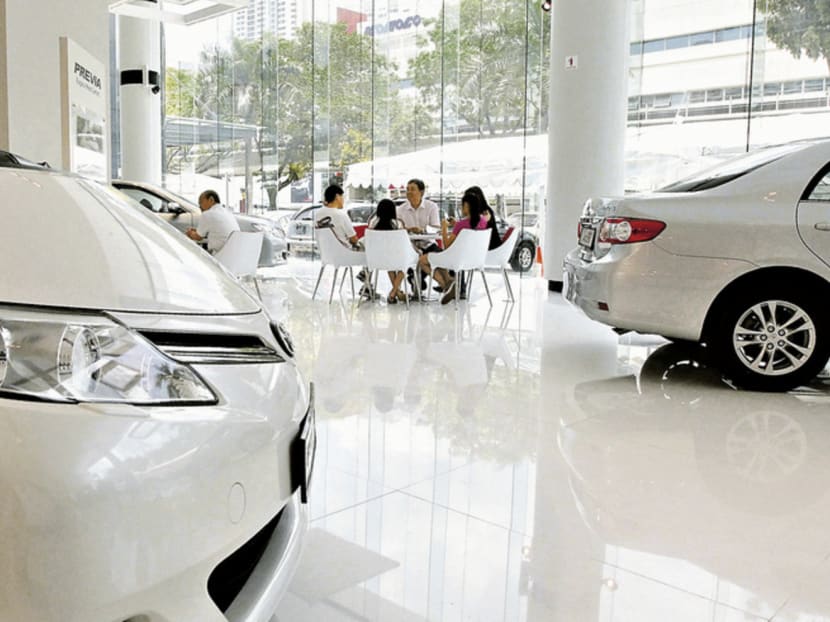
The recent drop in Category A COE prices has seen buyers back in car showrooms.
SINGAPORE — Stock markets weren’t the only ones to start 2016 with a slump. The year’s first auction for Certificates of Entitlement (COEs) saw a crash of sorts too.
The Category A COE (for cars with engines less powerful than 130hp and smaller than 1.6 litres) dropped S$9,299 to S$45,002. That made it cheaper than it’s been for nearly five years.
The price for a Category B COE (for cars with engines bigger than 1.6 litres, or more powerful than 130bhp) fell to S$54,920. That made it just S$81 less than what it cost in December, but still cheaper than at any point in 2015. Will the rest of 2016 bring softening prices and cheaper cars?
BOUND TO REBOUND
In the very short term, at least, don’t expect prices to stay low. For one thing, the Singapore Motorshow is on this week, and the car-buying interest it raises tends to keep demand for new cars and COE prices high. Over the four days of the show, car dealers typically target to collect as many orders as they do in a month. This could keep demand for COEs healthy until March, said some industry sources.
Apart from that, the market sometimes works contrary to the laws of gravity: Often with COEs, what goes down must come up.
The S$9,299 fall in Category A’s price was enough to whip up buyer interest, and car showrooms were reportedly crowded, ahead of the Singapore Motorshow.
“I’m pretty sure the price (for Category A) will go up,” said Wolfgang Huppenbauer, the president and chief executive officer of Daimler South East Asia. “The showrooms have been full since last weekend. That’s not a secret.”
It’s an observation that other car dealers have made. Many expect COE prices to recover half of last week’s drop, meaning an increase of between S$4,000 and S$5,000. If Singaporeans love one thing, it’s hunting for bargains. Yet, some patience might be in order, because the longer-term outlook for COEs is much brighter.
SUPPLIES, SUPPLIES
The second quarter of 2016 could see the S$40,000 to S$45,000 range as the new normal for COE prices, according to one chief executive officer of a multi-brand car franchise who did not wish to be named.
One reason for prices to gradually ease, he said, is that the COE quota is set to grow.
The supply of COEs is mainly determined by how many cars are de-registered (and either scrapped or re-exported thereafter); when one car leaves the road for good, it creates room for a fresh COE so that a new one can take its place.
And according to figures from the Land Transport Authority, more than 100,000 cars will turn 10 years old this year, the age at which an owner has to decide whether to deregister it or renew its COE.
The vast majority tend to choose de-registration, and that should ensure a healthy COE supply in 2016. “The COE release for passenger cars is expected to be about 85,000 to 95,000, compared to about 55,000 to 58,000 in 2015,” said the CEO we spoke to.
Throw in a bearish sentiment about the economy, he added, and you have the key ingredients for steady deflation: Shrinking demand and expanding supply.
“This means that cars would be more affordable, with more cars coming into the S$90,000 to S$120,000 band,” he said.
DIP IN THE ROAD AHEAD?
Yet, even though a large crop of COEs will mean healthy sales for the car trade as a whole in 2016, many dealers would prefer to sell fewer cars instead.
More precisely, they would prefer to see the COE supply restricted this year and next, because further down the road they can see a bumpy stretch looming.
In five years’ time, fewer than 30,000 cars will turn 10 years of age.
This means that, relative to this year, there will be far fewer de-registrations, leading to a tight COE supply. The last time COEs were that scarce, they cost around S$70,000 to S$80,000.
Worse than that, said some dealers, a sharp reduction in the COE supply in just a few years will mean job losses in the car industry.
Better to take some COEs from the big supply this year and 2017, and save them to bolster the quota in the lean years, dealers feel.
In fact, some feel strongly enough to have put their thoughts down in a White Paper.
The paper was submitted to the Ministry Of Transport and the Prime Minister’s Office by the Motor Traders Association last year, prior to the General Election.
Privately, most car dealers expect little to come of it. They will have to resign themselves to selling as many cars as they can before the famine comes.
On the flipside of things, it means that car buyers can look forward to a 2016 that kicks off a brief era of falling COE prices. Whatever stock markets do, you can expect cars to be cheaper this year than in 2015.
“It will definitely be a good year for car buyers,” said Daimler’s Huppenbauer. LEOW JU-LEN
Stay in the know. Anytime. Anywhere.

Subscribe to our newsletter for the top features, insights and must reads delivered straight to your inbox.
By clicking subscribe, I agree for my personal data to be used to send me TODAY newsletters, promotional offers and for research and analysis.






