
Dance tech revolution
SINGAPORE — Performance games and interactive dance activities have become common in dance performances and festivals in recent years, proving that technology and dance are now often inseparable.
SINGAPORE — Performance games and interactive dance activities have become common in dance performances and festivals in recent years, proving that technology and dance are now often inseparable.
At this year’s Got To Move event organised by the National Arts Council (NAC) for instance, two interactive dance activities are scheduled for the annual dance event: The MP3 Experiment and Sur-reality.
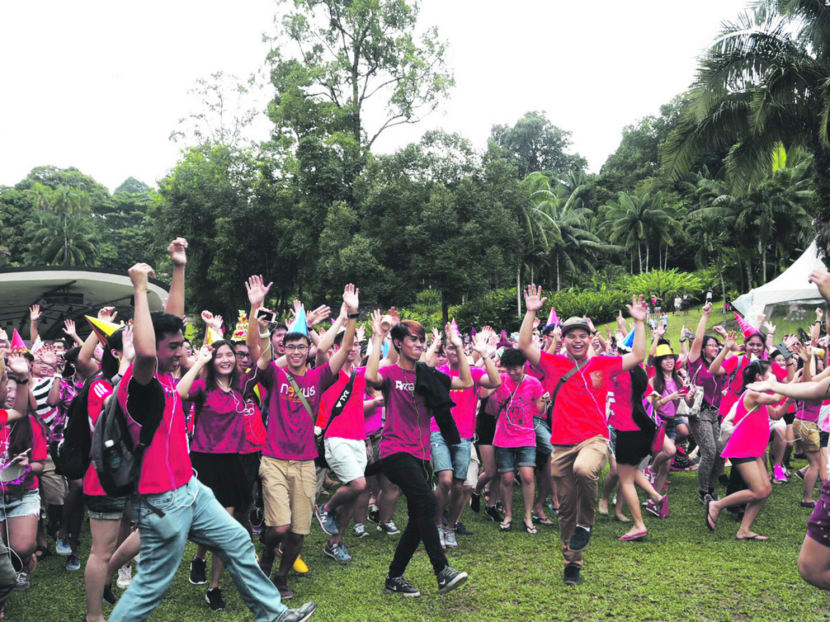
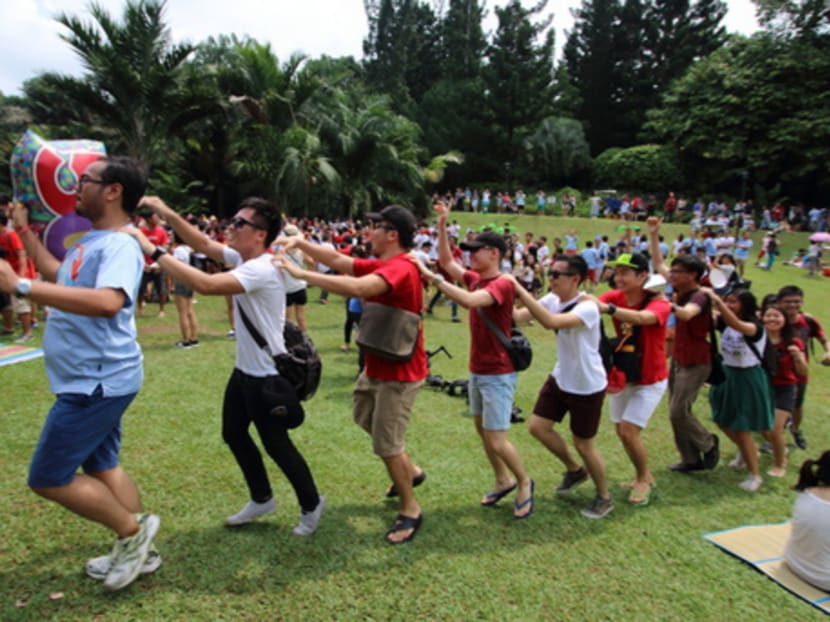
In The MP3 Experiment, which takes place tomorrow at 5pm at Clarke Quay Central and Merlion Park, participants will download an MP3 track, hit play at a pre-set time and engage in a series of dance-related challenges.
Sur-reality, an online dance project, is a series of videos that use a 360-degree-angle camera to give viewers the option to check out the performers’ view of the scene as they dance around a space.
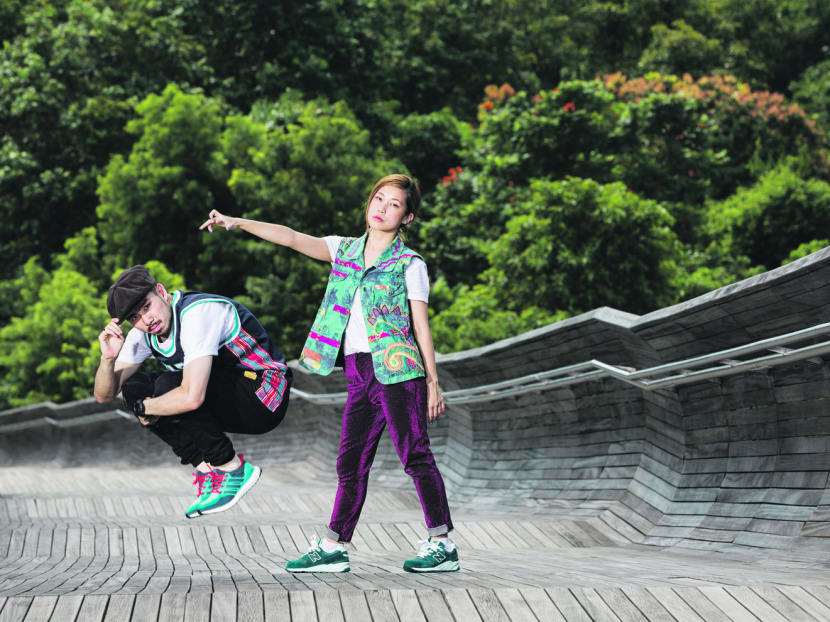
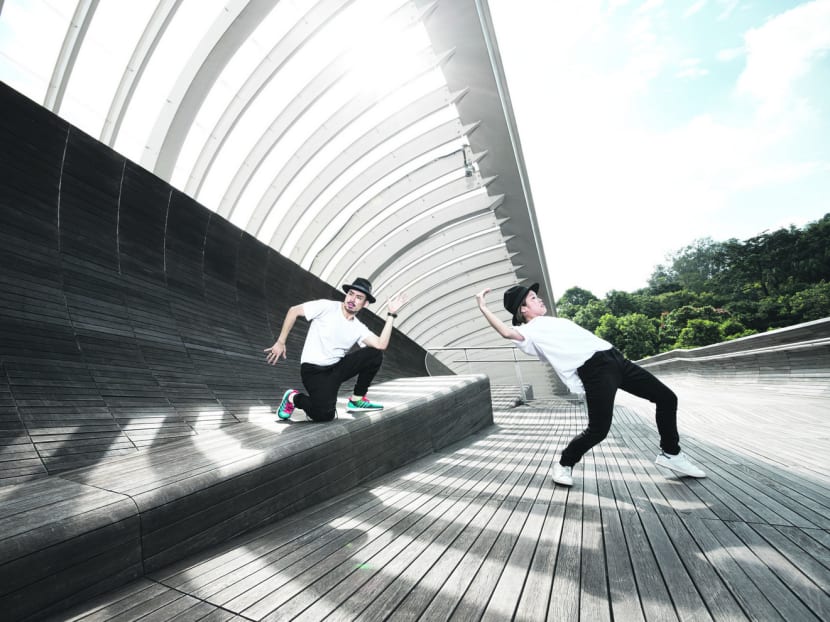
Dance teacher Rachel Lee, 27, who is part of ScRach Marcs — the street dance duo behind Sur-reality — says using the 360 degree angle camera was a chance to experiment.
“The concept was inspired by physical theatre, which is so immersive for the audience,” said Lee. “Dance videos are often seen from the usual angles — the front, the side. But with new technology like the 360-degree-angle camera, it was a chance to break that boundary for the audience.”
Sur-reality’s first video was based on the idea of play, and viewers can check out the video, which was shot at a playground, on their Facebook page (https://www.facebook.com/scrachmarcs/). The second video will be released today.
The project culminates next Friday in a live performance where 10 viewers — chosen via an online contest — will be filmed with the 360-degree-angle camera as they watch a live dance performance.
Incorporating technology and audience interactivity is not new to producers at The Esplanade. They have been incorporating those elements into its annual da:ns festival — happening now until Oct 23 — for years.
Faith Tan, one of its producers, noted that the incorporation of technology in dance has been used by artists in a wide range of ways.
She cited some examples, including Sidi Larbi Chekaoui’s large visual projections of Osamu Tezuka’s anime that dancers interacted with on stage (TeZukA, da:ns festival 2012); Choy Ka Fai’s use of electric currents to stimulate movement and choreography when running through a dancer’s body (SoftMachine, da:ns festival 2015), and Hiroaki Umeda’s solos, where energy is reflected in visual layers of digital projections that are triggered by motion sensors (Temporal Pattern & Holistic Strata, da:ns festival 2013).
While this year’s da:ns festival does not feature full-length works that incorporate visual technology as a central focus, there is a free dance event on Oct 23 that acknowledges the role of popular gaming and dance, said Tan.
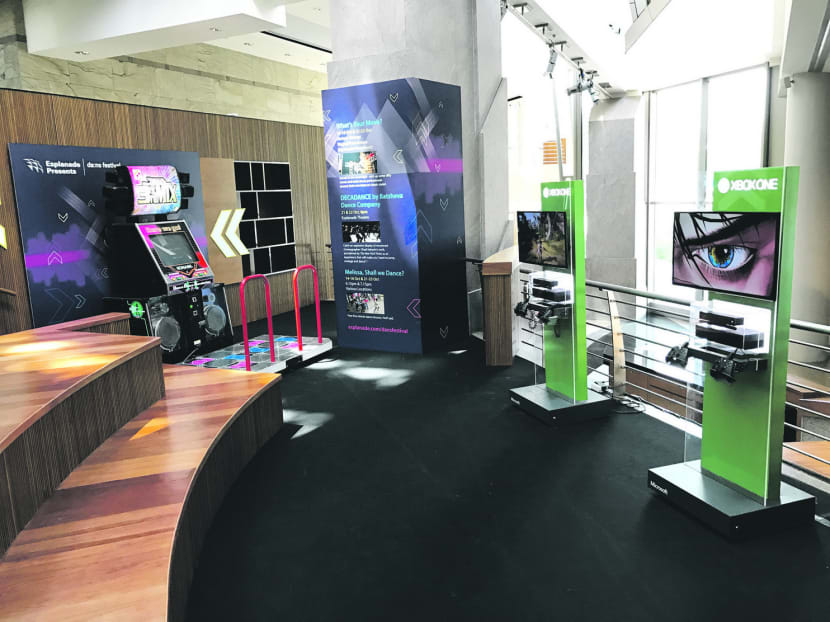
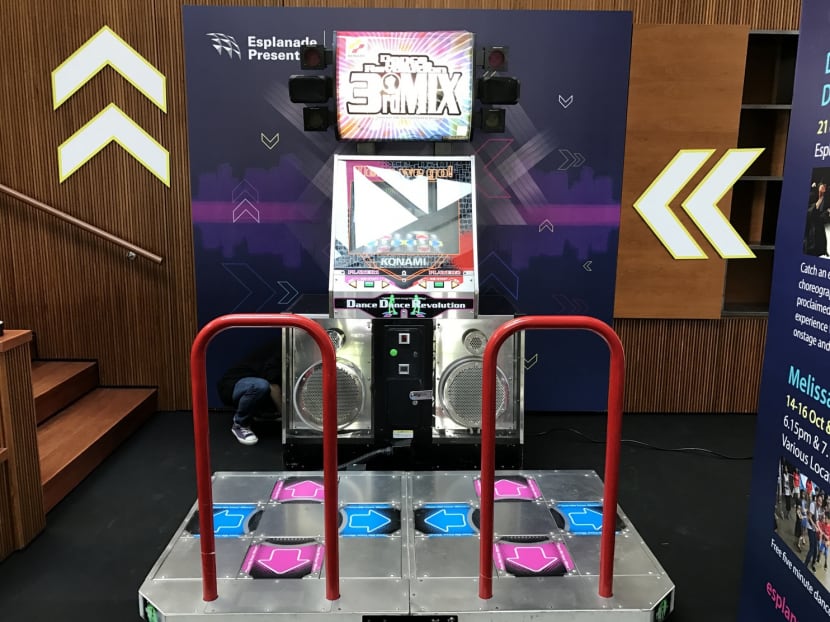
“In Mini da:ns Arcade, we’ve set up Xbox machines and an old school DDR (Dance Dance Revolution) machine that we managed to source,” she said, referring to Konami’s arcade video game machine that was popular in the 1990s. Participants can challenge their friends to dance-offs, or just enjoy moving to the beat.
For The MP3 Experiment, which is now in its fourth instalment, dance will be incorporated in a big way for the first time this year (download the track at https://www.facebook.com/mp3experimentsingapore/). The Hidden Good, the youth organisation behind the mass event, uses technology as a tool to break down barriers between people and get them to interact in positive ways.
This year, the Experiment will incorporate elements of cultural dances from the various races of Singapore, says Jiezhen Wu, director at The Hidden Good.
The idea behind this is to celebrate local culture and focus on Singapore’s heritage, she said.
“The idea is that anyone can participate,” she said of the Experiment. “You don’t have to look a certain way, move a certain way, or be on the level of a professional dancer in order to dance.”
She added that while traditional dance performances, in which one sits down and views a performance, will always have a place with audiences, technology has been a game-changer when it comes to dance and performance consumption.
“We can use technology and media as a platform that amplifies the overall experience of dance for anyone,” she noted.
The NAC, the organiser of Got To Move, certainly feels that way.
Elaine Ng, NAC’s director of sector development (traditional arts and dance), said technology is used so that everyone has the chance to deepen their appreciation and understanding of dance in the channels they are most comfortable with.
“Increasingly, the lines are blurred between what is the stage and where experiences start for the audience,” said Ng.
“Artists are constantly stretching boundaries and re-imagining spaces that can connect audiences to what they present ... By programming works such as The MP3 Experiment and other interactive dance activities, Got to Move ... aims to introduce dance to participants in a fun, non-threatening way. It also allows Singapore artists to see how they can push themselves creatively and work with dance in new formats and spaces in a bid to further interact and engage with audiences.”
Stay in the know. Anytime. Anywhere.

Subscribe to our newsletter for the top features, insights and must reads delivered straight to your inbox.
By clicking subscribe, I agree for my personal data to be used to send me TODAY newsletters, promotional offers and for research and analysis.






