
Women on top
Launched in 2008, the Singapore Woman Award (SWA) is a celebration of ordinary women who have “braved through life’s challenges, overcome business or personal difficulties and contributed selflessly to society”, and inspire others to do the same.

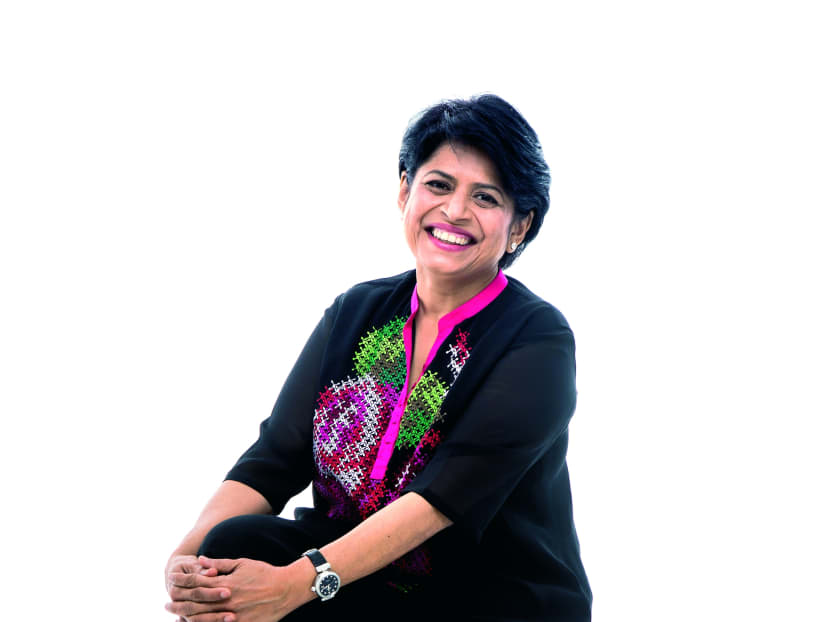




Launched in 2008, the Singapore Woman Award (SWA) is a celebration of ordinary women who have “braved through life’s challenges, overcome business or personal difficulties and contributed selflessly to society”, and inspire others to do the same.
This year, three more women have been shortlisted for the SWA. It wouldn’t be wrong to say they all deserve to be recognised.
Which is why, no matter who walks away with the award tonight, we’ll be raising a glass to these shining examples of ordinary women doing extraordinary things.
KIRTIDA MEKANI
GIVING BACK TO NATURE
A committed environmentalist to social, green and brown issues, Kirtida’s love for the environment, arts and education continues to define her life and drive the causes she passionately champions.
Among her impressive list of achievements over the years is serving as Founding Executive Director of the Singapore Environment Council. In recent years, her initiative and partnership with National Parks Board have given life to the highly successful Plant-a-Tree programme, which has seen 14,000 trees planted and helped more than 25,000 people around Singapore connect with nature.
She said: “This reaffirms my belief that small individual efforts can make a big difference to our world.”
And this belief is something that she would like to pass on to younger Singaporeans. “I believe having faith and investing in empowering the young and developing their skills are essential. I believe today’s youth will be tomorrow’s change-makers.”
Kirtida also volunteers her time as a Trustee at the UWCSEA Foundation and has served as Director, Office of Institutional Advancement at SMU. For her, education and the arts are crucial elements to life and growth. As much as trees are to nature.
Q: What challenges did you face?
A: It is sometimes difficult to get people to embrace environmental protection in a meaningful way. To overcome this, I always try to develop programmes that promote hands-on engagement. For example, if you have planted a tree through the Plant-a-Tree programme, you are literally rooting yourself to the cause and are more likely to have a lasting passion for the environment. My environmental efforts stem from my deep love for nature and a desire to give back to a country that has been a wonderful home to me. This also inspired me to create opportunities for youth in the fields of arts and education. Working with amazing people, helping youths succeed and seeing Singapore’s greenery flourish are what keep me going today — I am blessed to have gained so much more than I have given.
Q: Where would you like to go from here?
A: I want to strengthen and deepen existing programmes in the fields of the environment, arts and education. I also want to create new scalable, practical and sustainable programmes in these areas. These can start small, but will eventually grow into self-sustaining and impactful programmes. I am lucky to have had opportunities to give back to the community from a young age, and I want to help others find their cause and be able to contribute to what they believe in, too.
LILY GOH
CROSSING NEW HORIZONS
Lily Goh is certainly not letting something like deafness get in the way of achieving her dreams. For example, the Director and co-founder of ExtraOrdinary Horizons took part in the 2004 Singapore Idol competition, although she got knocked out in the third round.
“I participated to achieve my passion in music and sign language. Also, I was there to show what deaf people are capable of,” she said. “I inspired many people through my music and sign language along the way.”
With ExtraOrdinary Horizons, she has set up a social enterprise with “the mission to be an inclusive enterprise, promoting Deaf arts, culture, heritage and language”, through hiring deaf youth to produce and perform musical items. This has helped the deaf gain confidence in their capabilities and enabled them to reach out to more people.
Last year, she initiated the first Project Deaf Cambodia to empower the deaf in Cambodia through sharing knowledge and skills on entrepreneurship and performing arts.
Q: What challenges did you face?
A: The biggest challenge is the language barrier. Communication technology plays its part, such as Google iTranslate, instant messaging, email and SMS. Or we can write on paper. A sign language interpreter can be engaged in group meetings and when necessary. (Being) deaf means you need constant learning to improve literacy.
When learning music, it took a lot of patience and persistence to help teach (the youth). Through our services — courses, performances and public education — they have gained confidence in their own abilities. We also discuss issues such as employment. For example, when sending out resumes/CVs to companies, is there a need to declare deafness? Sometimes, when called for the interview, one must be honest and show what one can do for the company. It is always better to show your capabilities, not your deafness.
Q: Where would you like to go from here?
A: I hope to elevate ExtraOrdinary Horizons to greater heights by running our first annual nationwide event, Deaf Arts Festival. This would showcase artistic talents and skills to the public and allow an appreciation through interactive outreach activities. If we have a sufficient budget, we can invite one country or a few to have similar exchanges with Singapore.
QIN YUNQUAN
EMPOWERING WOMEN
Qin Yunquan is one woman you probably don’t want to mess around with. Not only is she a Kapap level 1 instructor and a certified Executive Bodyguard, she is also Chief Executive Officer of Kapap Academy. Kapap, by the way, is the original combat system of defensive tactics employed by the Israeli Defense Forces.
So why do Kapap? “I have always been conscious of my vulnerability,” she said, adding that she explored a range of other martial arts.
“After I came across Kapap taught by Master Teo (of the Kapap Academy), I was convinced this was the right system to learn. However, what inspired me the most was his personal story of how he founded the academy in memory of his brother who died from a street attack as well as his conviction in empowering people with self-defence skills.”
She added: “It was a noble mission and I wanted to do my part to help. After meeting several victims of sexual assault, I realised that many suffer for years in silence. This was an injustice I could not turn my back on and I decided to dedicate my life to the empowerment of women and children.” Qin also teaches personal protection skills regularly at ladies’ groups such as AWARE and the Girls’ Brigade.
Q: What challenges did you face?
A: The first major challenge I had to face was to overcome gender typing on what a lady should do or behave in our society. I was initially discouraged and doubted myself, but with encouragement from people who believed in me, I persevered. Another major challenge was the physical demands as a self-defence instructor and martial artist. The training was hard and it was not uncommon to suffer injuries in the process. However, I am glad that I never gave up.
Many women suffer from Post Traumatic Stress Disorder, in addition to the loss of self-worth and self-confidence, after a sexual assault. It is heartbreaking to hear these victims tell their stories and see their inner pain through their eyes. We try to help these women by first empowering them with the physical skills to fight back, as well as provide the emotional support for them to fight their inner demons.
Q: Where would you like to go from here?
A: Firstly, I am grateful to be a finalist in this prestigious event and it certainly serves to encourage me to keep on in my mission in empowering ordinary people in keeping safe. In the years to come, I hope to lead our social enterprise to operate in other countries as well. This way, we can save more lives through our empowerment programmes. To quote Martin Luther King, “Every man must decide whether he will walk in the light of creative altruism or in the darkness of destructive selfishness”.
Stay in the know. Anytime. Anywhere.

Subscribe to our newsletter for the top features, insights and must reads delivered straight to your inbox.
By clicking subscribe, I agree for my personal data to be used to send me TODAY newsletters, promotional offers and for research and analysis.






