
Explainer: Why is British PM Sunak proposing national service for the youth and will it promote national unity?
SINGAPORE — In the hope of fostering a “shared sense of purpose among our young people” and "a renewed sense of pride in our country", British Prime Minister Rishi Sunak is planning to introduce a national service scheme for 18-year-olds in the United Kingdom.
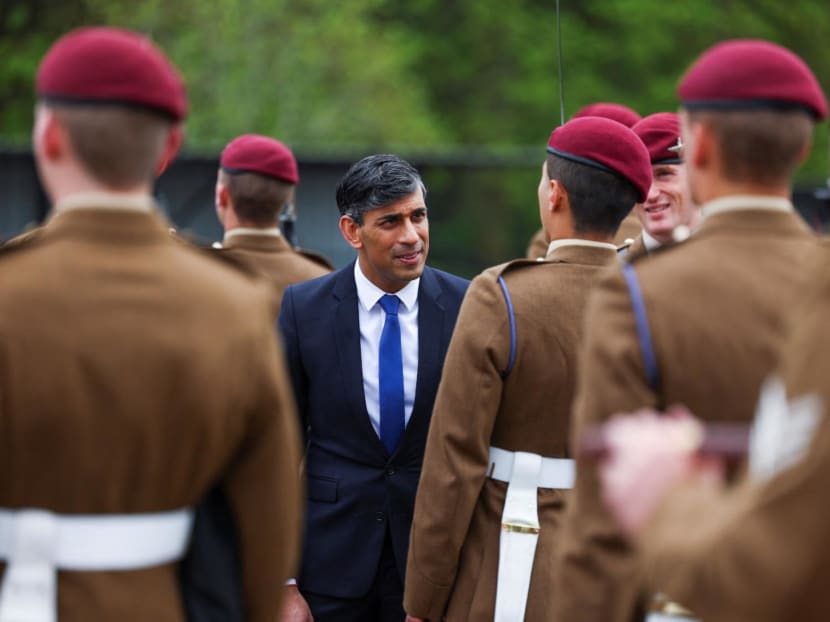
Britain’s Prime Minister Rishi Sunak (centre) inspecting a passing-out parade of the Parachute Regiment recruits during his visit to the Helles Barracks at the Catterick Garrison, a military base in North Yorkshire, Britain, May 3, 2024.

This audio is AI-generated.
- British Prime Minister Rishi Sunak has proposed that there be national service in the United Kingdom
- The aim is to foster a shared sense of purpose among young people and renew national pride
- The plan is for 18-year-olds to take up the compulsory service and choose between year-long military training or volunteering in community roles
- Political observers said that the UK government needs to minimise organisational inefficiencies to the best of their capabilities for the plan to work
- Critics in the UK, including opposition political party members, have labelled the plan as impractical and fiscally irresponsible


SINGAPORE — In the hope of fostering a “shared sense of purpose among our young people” and "a renewed sense of pride in our country", British Prime Minister Rishi Sunak is planning to introduce a national service scheme for 18-year-olds in the United Kingdom.
Under the scheme, teenagers of age there are expected to hone some skills and contribute to their community — by taking part in a "competitive, full-time military commission" or volunteering on weekends in roles within the community.
Commenting on the news, political and defence experts in Singapore said that the devil is in the details for Mr Sunak's vision because if the scheme is poorly organised, it could backfire.
As for how the UK’s Opposition (the Labour Party) and the public have reacted to the news so far, they have been saying that it is important to delve into why Mr Sunak had chosen national service as a means of fostering national unity.
As it stands, public disapproval could make the plan “incredibly hard” to implement, one researcher here said.
Most of the details have not been announced yet, but if Mr Sunak’s party (the Conservative Party) wins the general election in the UK this July, a pilot scheme is set to start in September 2025.
TODAY takes a look at what Mr Sunak has said so far about the new national service model, whether it will be effective in promoting national unity, and what the UK government needs to consider before introducing it.
WHY WAS NATIONAL SERVICE RAISED BY SUNAK?
Mr Sunak announced last Wednesday (May 22) that the UK will be having a general election on July 4.
The national service plan was his Conservative Party's first major policy proposal and a campaign promise should it win the election.
The prime minister said that this would help unite society in an “increasingly uncertain world” and that Britain faces a future that’s “more dangerous” and “more divided” today.
“There's no doubt our democratic values are under threat,” he added, calling it "a bold new model of national service for 18-year-olds".
Fellow party member James Cleverly who is Secretary of State for the Home Department told BBC news channel that the scheme would "address the fragmentation in society".
"Too many young people are living in their own bubble, whether that's a digital bubble or a social bubble.
"We want to get back to a situation where young people are mixing with people — in different areas, different economic groups, different religions — to try and find a way of addressing the kind of fragmentation that we see too much of," Mr Cleverly was quoted as saying.
WHAT IS SUNAK'S NATIONAL SERVICE MODEL FOR THE UK?
Although Mr Sunak’s proposal entails a mandatory national service, it is not considered a conscription where people are compelled by law to join the armed services such as in Singapore.
However, when a person turns 18, they will be required by law to choose either to enrol in a year-long military training scheme or volunteer in a community programme for one weekend a month or 25 days a year.
No one will be thrown into prison for not taking part, but there will be non-criminal sanctions for those who refuse, British media reports said.
Some of these roles for the youth would include delivering prescriptions and food to the sick or in search-and-rescue work.
Mr Sunak said: “This ambition benefits our country and our young people alike. Just look at Sweden, where 80 per cent of young people who completed national service say they recommend it to their friends.”
As for the punishment for not taking up this national service, Mr Cleverly told British news channel Sky News: “There's going to be no criminal sanctions. No one’s going to jail over this.”
IS IT THE BEST WAY TO FOSTER NATIONAL UNITY IN THE UK?
Despite the hopeful messaging, political watchers said that there will be factors that will determine if the scheme will achieve what it sets out to do.
One observer in Singapore said that the plan could be a “double-edged sword” if it is not done efficiently.
Dr Bernard Loo, a senior fellow at the Institute of Defence and Strategic Studies in Singapore's S Rajaratnam School of International Studies (RSIS), told TODAY: “I view (the national service scheme) as a potential positive in giving people a renewed sense of pride in their country.
“But here’s the thing: What if all you do is expose these young people to see just how badly run these various services are?”
For example, someone who decides to volunteer as a medicine deliverer for the National Health Service (NHS) in the UK realises that it takes hours for the prescriptions to be ready.
“This is just a hypothetical scenario. If anything, (such a situation) could backfire and generate a new wave of cynicism. I'd say if (the UK) wanted it to work, if it wanted to develop these positive emotions in the youth, the devil is in the details.
“It should ensure minimal organisational inefficiencies so that the young people have a positive experience and come away feeling they've not wasted their time.”
Mr Ho Shu Huang, who is co-editor of the book National Service in Singapore, said that it is important to note that Mr Sunak’s proposal encompassed roles that serve the community, not just in the military service.
In Singapore, National Service is a mandatory conscription for young men who have reached 18 years old and are citizens or permanent residents.
Mr Ho, who specialises in research of the military as an academic, said: “Most Singaporeans might associate national service with (military duties) since that is how we understand it. But that will not be the case under Sunak's proposal.
“As such, there is arguably some merit in his argument that there needs to be a shared sense of purpose and pride in the country by ‘serving’ it at the ‘national’ level in the broadest of terms.”
However, Mr Ho said that he is unclear why Mr Sunak made the proposal when, just two days before the announcement, the UK’s defence minister had declared that the government had no plans for national service in “any form” because it would do more harm than good.
“So it's really unclear what (Mr Sunak) stands to gain unless it's to appeal to older voters who feel that the youth need to be better disciplined or to show there is a way to make the UK ‘great again’, to borrow that phrase used by former American president Donald Trump (in his campaign).”
Dr Leong Chan-Hoong, a senior fellow for social cohesion research at RSIS, said that for the policy to be legitimate, it would be best for the UK to ensure conditions are the same for everyone rather than giving people the option to choose.
"If (Mr Sunak) really wants this model for nation-building, it should either be completely focused on law enforcement or community service — not a combination of both.
"Conscription, by definition, is in a law enforcement or defence military environment. You don't infuse that with community service," he added, pointing out that successful models of conscription are based on three fundamental principles, namely national security, universality and equity.
Asked what would be viable alternatives, Dr Leong said that the UK could consider looking into drafting housing and education policies that address societal fragmentation, allowing more opportunities for people of diverse backgrounds to mingle.
Likewise, Dr Felix Tan, an independent political observer here who lectures on international relations, said that Mr Sunak’s suggestion was “rather strange” if the mission is to build a sense of national pride in the country.
He explained that compulsory national service such as that in Israel, Singapore and South Korea is perhaps more for strategic and national security purposes and not predicated on developing nationalism.
“In others, such as Malaysia’s example, it is very limited and it still did not bring about national pride. So, such ideals are not always practical and realistic.”
Malaysia's National Service programme was introduced in 2004 as a three-month training programme for 18-year-olds selected at random to foster national unity, instil discipline and promote patriotism among young Malaysians.
However, it was suspended in 2015 due to budget constraints and concerns about its effectiveness. In 2018, it was permanently abolished by the new administration.
WHAT THE OPPOSITION AND THE PUBLIC SAY
Before Mr Sunak’s announcement over the weekend, other countries such as Denmark, France, Norway and Sweden had recently reintroduced national service.
The British prime minister's proposal, though, has faced significant criticism so far.
Former military leaders have called the plan "bonkers" and "electoral opportunism", arguing that it would deplete the defence budget and impose unrealistic demands on the armed forces.
The Labour Party's member of parliament Rachel Reeves said that the plan was “an expensive gimmick”.
“The Conservatives are making pledges without any idea where the money is going to come from. That is deeply irresponsible.”
In that same vein, former defence secretary Michael Portillo expressed concerns about the proposal's financial implications and lack of thorough planning, suggesting that it may damage the Conservative Party's reputation for fiscal responsibility.
Citizens interviewed by the media have expressed a range of views. Some found that the requirement's enforceability made it feel like a “punishment” and that compulsory volunteering was “contradictory”.
On the other hand, there were those who saw it as a good opportunity for the young to help with social causes and “do more” for the community.
Related topics
Rishi Sunak UK National ServiceStay in the know. Anytime. Anywhere.

Subscribe to our newsletter for the top features, insights and must reads delivered straight to your inbox.
By clicking subscribe, I agree for my personal data to be used to send me TODAY newsletters, promotional offers and for research and analysis.





