
Explainer: Trump guilty on all 34 counts in hush-money criminal trial. Can he still run for president?
SINGAPORE — After a New York jury pronounced him “guilty” for each of 34 charges of falsifying business records, Donald Trump has become the first former United States president to be tried and convicted in a criminal trial.
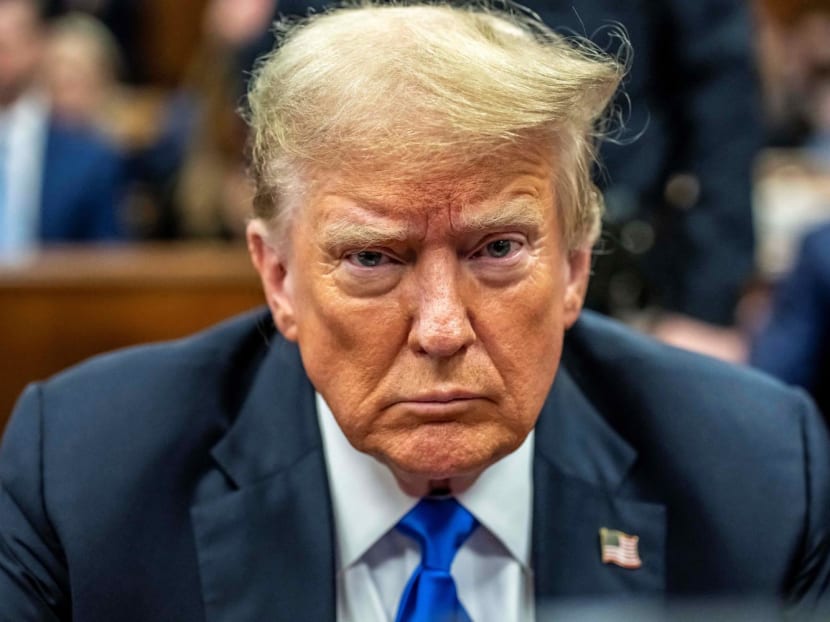
Former US President Donald Trump at his criminal trial at the Manhattan Criminal Court in New York City on May 30, 2024.

This audio is AI-generated.
- Former US president Donald Trump has been found guilty on all 34 counts in a criminal trial over hush-money payments, becoming the first ex-president convicted in court
- The charges related to Trump's involvement in making payments to a porn star to conceal a one-night 2006 sexual encounter with her before the 2016 presidential election
- Trump is set to be sentenced on July 11, and while he could face jail time, most observers believe this is unlikely. His lawyers have flagged an appeal
- Just days after the sentencing,Trump is expected to become the Republican party's candidate for the 2024 presidential election to face incumbent Joe Biden
- Under US law, as a felon, Trump is not barred from running again for the White House
- Pundits say the conviction could energise Trump's committed supporters but may undermine backing from younger and college-educated voters, especially women


SINGAPORE — After a New York jury pronounced him “guilty” for each of 34 charges of falsifying business records, Donald Trump has become the first former United States president to be tried and convicted in a criminal trial.
The history-making verdict comes a little over a year after his indictment last March for his role in making hush money payments to a porn star to cover up a sex scandal just before the 2016 presidential election, which he went on to win.
A jury of 12 New York residents delivered the verdict after deliberating for less than 12 hours.
He is due to be sentenced on July 11, just days before he is set to be nominated as the Republican candidate for the Nov 5 presidential election.
Trump could face up to four years' jail for each count, but legal observers believe he is unlikely to spend time behind bars, given his lack of prior convictions and other factors.
With Trump, 77, seeking another term in the White House, what does his guilty verdict mean for the 2024 presidential election, where he is expected to face incumbent Joe Biden again?
Can a convicted felon still run for president? The short answer is yes.
TODAY explains the significance of Trump’s criminal trial and guilty verdict, and what this means for his election bid and the Republican party.
WHAT IS TRUMP’S HUSH MONEY CASE ABOUT?
On March 30, 2023, Trump was indicted by a Manhattan grand jury, marking the first time a former US president had faced criminal charges.
This indictment was a result of a detailed investigation led by the Manhattan District Attorney's Office, focusing on Trump's involvement in a hush money payment scheme during the 2016 presidential campaign.
The indictment primarily revolves around a US$130,000 (S$175,300) payment made to porn star Stormy Daniels. It was first made by Mr Michael Cohen, who served as Trump’s lawyer and "fixer" from 2006 to 2018.
To reimburse Mr Cohen, Trump falsely recorded the reimbursements as “legal expenses”.
Mr Cohen was the key prosecution witness in the trial due to his intimate knowledge of the events and transactions at the core of the indictment.
In 2018, he was sentenced to three years’ jail for his role in making illegal hush-money payments to women to help Trump’s 2016 election campaign.
According to the prosecution, the US$130,000 payment was made shortly before the 2016 election, intended to prevent Ms Daniels from going public with claims of a sexual encounter with Trump, which Trump denies.
Evidence was presented in court that Trump was worried such a revelation could hurt his electoral prospects, especially with female voters.
WHAT WERE THE ARGUMENTS MADE BY BOTH SIDES?
Trump was charged by Manhattan district attorney Alvin Bragg — Manhattan’s first Black district attorney.
Mr Bragg and his team argued that Trump and his organisation engaged in a deliberate scheme to conceal his violation of state laws.
These laws make it a crime to promote a candidate's election through unlawful means.
They argued that the US$130,000 payment to Ms Daniels was, in effect, an illegal campaign contribution. This was because the payment, made solely to benefit Trump's 2016 campaign, far exceeded the individual contribution cap of US$2,700.
Prosecutors also said that the Trump Organization improperly recorded the payment as “legal expenses”, violating state laws.
Trump and his legal team, led by Mr Todd Blanche, had vigorously denied the allegations, framing the indictment as politically motivated.
Mr Blanche argued that there was nothing wrong with trying to influence an election because “it’s called democracy”.
In his closing argument, he said: “It doesn’t matter if there’s a conspiracy to win an election. Every campaign in this country is a conspiracy to promote a candidate, a group of people who are working together to help somebody win.”
Mr Blanche also urged the jury to put aside any personal feelings they have towards Trump, as this was “not a referendum on the ballot box”.
“Who you voted for in 2016 or 2020, who you plan on voting for in 2024… That is not what this is about.”
Trump has also long claimed that the case against him was politically motivated.
CAN TRUMP APPEAL AGAINST THE VERDICT?
After Trump is sentenced on July 11, he has the right to appeal against his conviction and sentence.
His lawyer Mr Blanche told American news channel CNN they would launch an appeal “as soon as we can”.
Reuters reported that for the appeal to succeed, Trump must be able to prove that Justice Juan Merchan made significant errors in overseeing the trial.
It also stated that Trump's lawyers would likely put forth arguments by exposing potential loopholes in Ms Daniels’ testimony.
The process could take months or years, meaning it could take a while before Trump’s sentence would take effect.
However, in addition to the Manhattan case, Trump faces three other indictments, none of which appears likely to go to trial before the Nov 5 presidential election:
- Georgia election case: An inquiry into his attempts to influence the 2020 election results in the state of Georgia. He pleaded not guilty
- 2020 election case: Trump was charged in Washington DC in August 2023 over his alleged plot to subvert the transfer of power after the election. He pleaded not guilty
- The documents case: Trump was charged in South Florida over his alleged mishandling of sensitive government records after leaving the White House and efforts to obstruct the Justice Department's investigation. He pleaded not guilty
WHAT DOES THIS MEAN FOR TRUMP’S POLITICAL FUTURE?
While the conviction could complicate Trump’s bid, it does not legally bar him from running.
Under US law, there are no specific restrictions that prevent a person with a criminal indictment or conviction from running for or holding the office of President.
Only three requirements apply to presidential candidates: They must be a natural-born US citizen, at least 35 years old, and a US resident for at least 14 years.
Trump has consistently portrayed himself as a victim of political persecution, a narrative that resonates with his base. Some pundits say the verdict could energise his supporters.
After the verdict was read, Trump said outside court that the trial was “rigged” by a “conflicted judge". “This was a rigged trial, a disgrace.”
He added: “The real verdict is going to be (on) Nov 5, by the people.”
According to ABC News, a majority of Trump supporters are expected to stick by him despite the verdict.
It ran a poll before news of the verdict, which found that 80 per cent of Trump’s supporters said they would continue to support Trump even if he was convicted of a felony in this case.
Meanwhile, 16 per cent said they would reconsider their support, while only 4 per cent said they would withdraw it.
However, a Republican advocate for women’s progress told the British news channel BBC that even a slight drop in Trump’s support would be significant “in the kind of razor-thin race this presidential contest could become”.
Ms Ariel Hill Davis, co-founder of Republican Women for Progress, said the guilty verdict could damage Trump as a presidential candidate, as younger voters and those college-educated have been concerned about Trump’s demeanour and his approach to governing.
“The guilty verdict is going to further shore up those concerns.”
As Trump awaits sentencing, his next big political appointment is on June 27, in the first of two scheduled television debates with President Biden.
Related topics
US politics Donald Trump US Presidential Election USAStay in the know. Anytime. Anywhere.

Subscribe to our newsletter for the top features, insights and must reads delivered straight to your inbox.
By clicking subscribe, I agree for my personal data to be used to send me TODAY newsletters, promotional offers and for research and analysis.