
Singapore Airlines relief flight arrives at Changi Airport after passengers, crew shaken by severe turbulence
SINGAPORE — A total of 131 passengers and 12 crew members who were aboard a Singapore Airlines (SIA) flight badly hit by turbulence arrived at Changi Airport in the early hours of Wednesday (May 22).
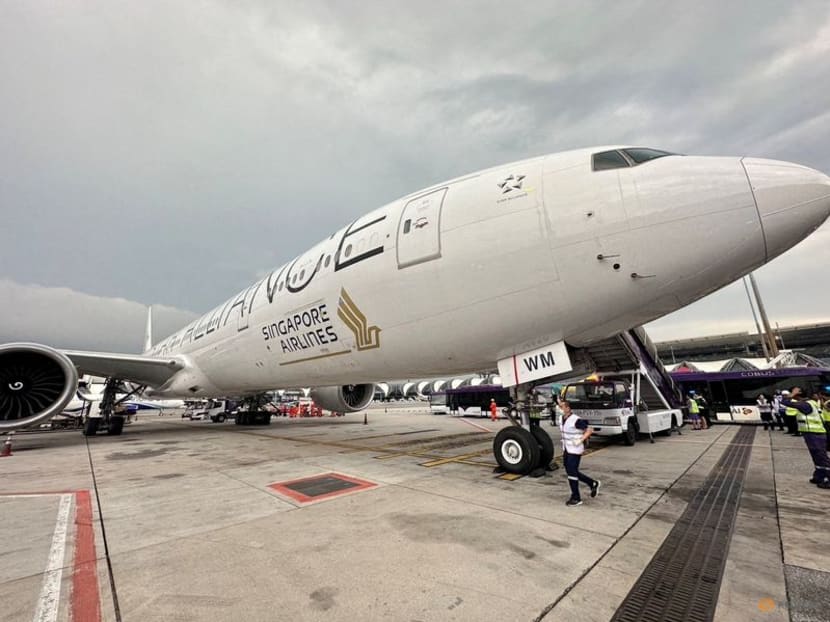
A Singapore airline aircraft is seen on tarmac after requesting an emergency landing at Bangkok's Suvarnabhumi International Airport, Thailand, May 21, 2024. Pongsak Suksi/Handout via REUTERS

This audio is AI-generated.
- 131 passengers and 12 crew members who were aboard a Singapore Airlines (SIA) flight badly hit by turbulence arrived at Changi Airport in the early hours of Wednesday
- SIA arranged transportation for passengers to their homes or hotel accommodation in Singapore
- Those with onward connections have been rebooked on alternative flights and given hotel accommodation or lounge access so they can rest until their next flight
- Passengers recounted what they saw, of fellow passengers suffering serious injuries and concussions
SINGAPORE — A total of 131 passengers and 12 crew members who were aboard a Singapore Airlines (SIA) flight badly hit by turbulence arrived at Changi Airport in the early hours of Wednesday (May 22).
The scheduled London to Singapore flight diverted to Bangkok after the plane was buffeted by turbulence that flung passengers and crew around the cabin, slamming some into the ceiling.
Photographs from the interior of the plane showed large gashes in the overhead cabin panels, gas masks and panels hanging from the ceiling and items of hand luggage strewn around.
A 73-year-old British man died of a suspected heart attack and at least 30 people were injured, some critically.
The British passenger has been named as Mr Geoff Kitchen from Thornbury, near Bristol, in South West England. It is believed he was on board the flight with his wife and headed for a six-week holiday.
SIA said in an update on Facebook on Wednesday morning that the passengers and crew of SQ321 arrived at 5.05am via a relief flight.
They were received upon their arrival at Changi Airport by Chief Executive Officer of SIA, Mr Goh Choon Phong.
“Transportation to their homes or hotel accommodation has been arranged for passengers travelling to Singapore," said the airline.
“For passengers with onward connections, we have rebooked them on alternative flights. We have also arranged hotel accommodation or lounge access for them to rest until their next flight.”
Reuters reported dozens of passengers quietly filing off a Singapore Airlines jet on Wednesday morning, mostly ignoring media awaiting their arrival.
Some responded to shouted questions, confirming they had been on the original London-Singapore trip and saying "Good flight!" when asked about the last leg from Bangkok.
"I saw people from across the aisle going completely horizontal, hitting the ceiling and landing back down in like really awkward positions. People, like, getting massive gashes in the head, concussions," Dzafran Azmir, a 28-year-old student on board the flight told Reuters after arriving in Singapore.
He had earlier recounted feeling the plane tilt upwards and begin to shake.
"Suddenly there was a very dramatic drop so everyone seated and not wearing a seatbelt was launched immediately into the ceiling, some people hit their heads on the baggage cabins overhead and dented it, they hit the places where lights and masks are and broke straight through it."
RECEIVING MEDICAL CARE
As of early Wednesday morning, another 79 passengers and six crew members from SQ321 remain in Bangkok.
This includes those receiving medical care, as well as their family members and loved ones who were on the flight, SIA said.
“A dedicated SIA team from Singapore is in Bangkok to assist our colleagues and the local authorities. We are providing all possible support to the passengers and crew from SQ321 who remain in Bangkok.”
The airline also expressed its condolences over the death of the British passenger.
“On behalf of Singapore Airlines, I would like to express my deepest condolences to the family and loved ones of the deceased passenger. We also deeply apologise for the trauma experienced by all passengers and crew members on this flight,” said Mr Goh.
“We are providing all possible assistance and support to them, along with their families and loved ones, during this difficult time. The well-being of our passengers and staff is our utmost priority.”
WHAT HAPPENED
In a video message on Wednesday morning, Mr Goh laid out the timeline of events.
Flight SQ321 encountered "sudden extreme turbulence" over the Irrawaddy Basin at an altitude of 37,000 feet about 10 hours after departure from London Heathrow.
The flight was carrying 211 passengers and 18 crew members.
The pilot declared a medical emergency and diverted the Boeing 777-300ER aircraft to Bangkok, landing at 3.45pm local time.
"Singapore Airlines swiftly dispatched a team to Bangkok last night, and they have been helping our colleagues with the support on the ground," he said.
"We are fully cooperating with the relevant authorities on the investigations."
Singapore's Transport Safety Investigation Bureau (TSIB), an arm of the Transport Ministry, is opening an investigation into what happened on SQ321.
It says it has been in contact with its Thai counterparts and will send investigators to Bangkok.
Relatives seeking information may contact the Singapore Airlines hotlines at +65 6542 3311 (Singapore), 1800-845-313 (Australia) and 080-0066-8194 (the United Kingdom).
"SCREAMING IN PAIN"
Aircraft tracking provider FlightRadar 24 said at around 3.49pm Singapore time the London-Singapore flight encountered "a rapid change in vertical rate, consistent with a sudden turbulence event".
"There were thunderstorms, some severe, in the area at the time," it said.
Turbulence has many causes, most obviously the unstable weather patterns that trigger storms, but this flight could have been affected by clear air turbulence, which is very difficult to detect.
Photos online and those sent to CNA showed food trays and items scattered on the ground. Oxygen masks were seen hanging from the scaling and parts of the plane's interior appeared damaged.
Passenger Andrew Davies said the seatbelt sign was turned on moments before the plane dropped.
"So many injured people, head lacerations, bleeding ears," he wrote on X, adding that a female passenger was screaming in pain.
Severe turbulence such as the one experienced by SQ321 is "extremely rare", analysts said, adding that turbulence does not usually cause fatalities or a large number of injuries.
Independent aviation analyst Alvin Lie said the intensity of the turbulence on the Singapore Airlines flight was likely “extreme” - the highest classification by the United States National Oceanic and Atmospheric Administration’s (NOAA) National Weather Service.
According to the agency, extreme turbulence causes a plane to toss violently about and is practically impossible to control. It may also cause structural damage.
Mr Lie told CNA’s Asia Tonight that SQ321 likely encountered clear air turbulence (CAT).
“Normally, for turbulence caused by movement of clouds, pilots will be alerted on the radar so they can avoid it or notify the crew and passengers to wear their seatbelts,” he said. “So, looking at the number of injuries, I believe that SQ321 encountered CAT, where a plane can be tossed about violently."
CAT can hit anywhere and anytime, he said, reiterating that the phenomenon is rarely severe.
“There is no way of knowing when or where CAT can happen, or the severity or intensity of it. I believe there were many other planes flying in that area at the same time as SQ321 (but were not affected). It was just hard luck.” CNA
For more stories like this, visit cna.asia.
Related topics
Singapore AirlinesStay in the know. Anytime. Anywhere.

Subscribe to our newsletter for the top features, insights and must reads delivered straight to your inbox.
By clicking subscribe, I agree for my personal data to be used to send me TODAY newsletters, promotional offers and for research and analysis.





