
S'porean photographer who won copyright case against artist partly hated herself for pursuing it but 'badly wanted justice done'
SINGAPORE — A Singaporean photographer who successfully sued a Luxembourg artist for copying her work has said "part of me hated myself" for pursuing the lawsuit, but "badly wanted to see justice done".
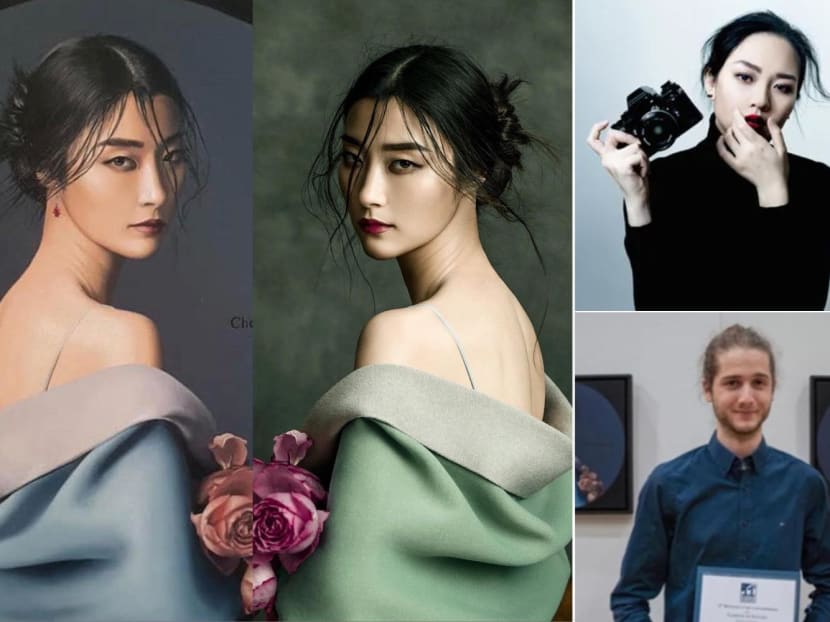
Singaporean photographer Zhang Jingna (top right) accused Mr Jeff Dieschburg (bottom right), a Luxembourg artist, of copying her work. Ms Zhang posted on Instagram a side-by-side comparison of her photo (centre) and part of an artwork (left) by Mr Dieschburg.

This audio is AI-generated.
- A Singaporean photographer who won copyright case against a European artist says she "hated (herself) for pursuing the lawsuit — I badly wanted to see justice done"
- In an emailed response to TODAY, Zhang Jingna, 36, wrote of the physical and mental effects of the case
- The two-year legal saga took its toll on Ms Zhang's career, cutting off her income and affecting her plans
- She hopes that her lawsuit is a "meaningful case" that will help other artists in similar circumstances
SINGAPORE — A Singaporean photographer who successfully sued a Luxembourg artist for copying her work has said "part of me hated myself" for pursuing the lawsuit, but "badly wanted to see justice done".
In an emailed response to TODAY's queries on Saturday (May 18), 36-year-old Zhang Jingna said she had to sacrifice her work, sleep and mental health, during the two-year ordeal.
“Due to the anxiety and stress, I couldn't sleep much during the day. So for a few weeks I barely got any sleep.”
In 2017, Ms Zhang photographed South Korean model Ji Hye Park for Harper’s Bazaar Vietnam’s November issue.
Then in 2022, Luxembourg artist Jeff Dieschburg won a cash prize of 1,500 euros (S$2,200) for his painting “Turandot”.
The painting bore striking similarities with Ms Zhang’s photograph.
It was also displayed at the Contemporary Art Biennale in Strassen, Luxembourg, where it was being sold for 6,500 euros.
SUCCESSFUL APPEAL
In June 2022, Ms Zhang posted a side-by-side comparison of her photo and Turandot on Instagram.
She wrote in the caption: "To see someone... claiming credit despite copying so much of another's person work... the audacity and utter disrespect."
Mr Dieschburg hired a lawyer in response to Ms Zhang's allegations, further escalating the dispute.
It turned into court action when Strassen's Art Biennale refused to condemn the painting as plagiarism.
In December 2022, the Luxembourg district court ruled in Mr Dieschburg favour.
Then, Ms Zhang successfully appealed against the ruling, with her legal victory announced on May 8, 2024.
The court ruled that Mr Dieschburg had violated copyright laws by using her work as a template without her consent.
Mr Dieschburg is required to compensate Ms Zhang with 1,500 euros in "procedural damages" for each of the two court hearings, she told TODAY.
He is also banned from displaying the painting in public.
If he does, he faces a fine of 1,000 euros per day up to a maximum of 100,000 euros.
Ms Zhang was not in Luxembourg when the verdict was announced, but learnt of her victory through media reports.
Still, she said that she believed it only when she received a confirmation from her lawyer Vincent Wellens.
“It was such a huge, unbelievable weight off my chest. I cried into my pillow for a good while,” she wrote.
'ONE OF THE MOST PAINFUL PERIODS OF MY LIFE'
It was not Ms Zhang's intention for her social media post to develop into a court case.
Speaking to TODAY in 2022, Ms Zhang said: "I had no intention of taking legal actions.”
She had hoped to “talk some sense” into Mr Dieschburg but instead became the target of online bullying.
In June 2023, Ms Zhang took to Instagram to share some of the derogatory remarks that she had received.
Attacks were made based on her gender and race.
“I had to deal with a constant onslaught of harassment and poor sleep and mental state.”
The court case also dealt a major blow to Ms Zhang's career.
Without an income, she could not confidently carry on with her plans and had to call off major collaborations.
Before the lawsuit, Ms Zhang had gained recognition for her photograph of Hollywood star, Malaysia's Michelle Yeoh for The Hollywood Reporter.
She was seeing an increase in work requests.
However, the mental and physical toll of the case made it impossible for Ms Zhang to keep up with incoming enquiries.
Ms Zhang felt that it was “unfair” that her career had been disrupted by the court case.
“Part of me hated myself for pursuing the lawsuit — I badly wanted to see justice done, and I never wanted to give it up”.
“But the cost was my income and a career that I'd spent two decades building.”
GETTING BACK ON TRACK
In the aftermath, Ms Zhang hopes that her case will raise public awareness about the need for obtaining consent when it comes to digital content.
She also hopes that the lawsuit will help smaller artists in similar situations.
Currently, Ms Zhang is finishing up her anime and manga inspired photobook — which was disrupted by the lawsuit.
Ms Zhang has also joined the campaign against Artificial Intelligence (AI) stealing the work of creatives.
She is working on Cara.app, a social media platform for artists and art lovers.
It is aimed at “(filtering) out generative AI images” to ensure the legitimacy of the artwork.
It will also allow artists to protect their work by implementing Glaze — “a filter that protects an artist’s style from mimicry by AI models”.
After her two-year absence from photography, Ms Zhang is also looking forward to future collaborations with other artists.
She said the case had been “one of the most painful periods of my life” but added: “It is what it is and I don't regret anything”.
Related topics
copyrightStay in the know. Anytime. Anywhere.

Subscribe to our newsletter for the top features, insights and must reads delivered straight to your inbox.
By clicking subscribe, I agree for my personal data to be used to send me TODAY newsletters, promotional offers and for research and analysis.





