
10 suspects in S$2.8b money laundering case not on Interpol list; other S'poreans, PRs being probed: Josephine Teo
SINGAPORE — The 10 people who have been arrested and charged in relation to a multi-billion dollar money laundering probe all hold either employment passes or dependent’s passes in Singapore, and none had been on Interpol’s list of Red Notices at the time of their application for these passes, Second Minister for Home Affairs Josephine Teo said on Tuesday (Oct 3).
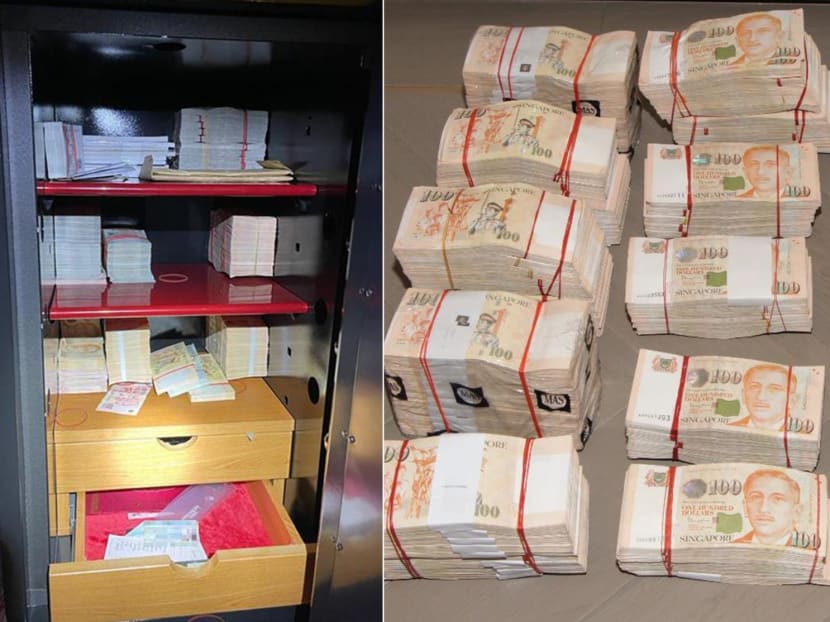
Photos of cash that was seized by the police on Aug 15, 2023.

- The 10 foreigners who have been arrested and charged in relation to a S$2.8 billion money laundering case hold employment and dependent’s passes in Singapore
- At the time of their application for these passes, none of them were on Interpol’s Red Notices, Parliament heard
- These notices warn worldwide authorities about wanted criminals and fugitives
- More individuals, including Singaporeans, permanent residents and those holding various immigration passes, are being investigated in relation to the same case
- Mrs Josephine Teo, Second Minister for Home Affairs, said that major financial hubs such as Singapore are particularly attractive to money launderers
SINGAPORE — The 10 people who have been arrested and charged in relation to a multi-billion dollar money laundering probe all hold either employment passes or dependent’s passes in Singapore. None had been on Interpol’s list of Red Notices at the time of their application for these passes, Mrs Josephine Teo, Second Minister for Home Affairs, said.
Interpol, an international police body, issues Red Notices to ask law enforcement officials around the world to locate and provisionally arrest a person, pending extradition, surrender or similar legal action.
Mrs Teo, who is also Minister for Communication and Information, was on Tuesday (Oct 3) delivering a ministerial statement in response to questions from Members of Parliament (MPs), some of which related to how the 10 suspects had entered Singapore and obtained immigration passes.
The MPs' questions were largely focused on how Singapore scrutinises applications for these passes and how the authorities could step up checks on high-risk individuals, including those with criminal records or who are wanted in foreign jurisdictions, or who may have used false identities.
The 10 suspects, who are aged between 31 and 44, hold passports from various countries.
Investigations are ongoing into many more people, including Singaporeans, permanent residents and individuals on various types of immigration passes here, Parliament heard on Tuesday.
When the police first announced the arrest on Aug 15, they said that another 12 people were assisting with investigations and eight others were wanted by the police.
Mrs Teo noted that one question raised by MPs was whether Singapore works with foreign governments to verify the information provided by applicants for immigration passes.
Where the agencies have suspicions, they do so, she said, but given the volume of applications, it is not possible to conduct verification checks for all applications.
No screening process is foolproof, she added, saying that the Government will review how to tighten verification checks at various points.
"At the same time, we should be sensible. Most people are not illegal money launderers or criminals. If we make the rules too tight, then it is the vast majority of innocent applicants who will be unnecessarily penalised. The crooks will still try to find a way around the rules," she said.
"Our task is to minimise the risks, and increase our ability to catch these persons, without affecting the majority of proper, legal transactions."
The 10 people who have been charged have all been denied bail, with prosecutors saying that the suspects have high flight risks and could collude to contaminate evidence.
In her speech, Mrs Teo also updated Parliament on the latest details of the case, saying that the total value of assets seized or issued with prohibition of disposal orders by the police now stands at more than S$2.8 billion.
This is nearly three times the S$1 billion that was announced by the police when the case broke in August, before the police updated on Sept 20 that the amount had grown to more than S$2.4 billion.
FINANCIAL HUBS MORE VULNERABLE TO MONEY LAUNDERING
On Tuesday, Mrs Teo made the point that it is Singapore’s status as a major financial hub that makes it an attractive target to money launderers.
The finance sector contributes about 14 per cent of the country's economy and employs about 200,000 people, making it an important industry here.
"When we open for business — and we have to be — criminals will also try to exploit the same economic openness and our strong reputation for rule of law, to launder their illicit funds, and create the appearance of legitimacy," she said.
Singapore handles massive volumes of transactions every day and this sheer volume provides "easy camouflage" for illicit activities, she added.
She outlined just how often suspicious transactions are flagged here as a result: The Suspicious Transaction Reporting Office, a body under the Singapore Police Force that focuses on financial intelligence, received an average of 43,000 suspicious transaction reports yearly from 2020 to 2022, or more than 150 every working day.
Financial institutions filed 80 per cent of these reports.
In the same period, at least 240 people were convicted of money laundering offences, largely related to laundering domestic scam proceeds, and some S$1.2 billion worth of assets were seized.
“All major financial hubs, not just Singapore, are vulnerable,” Mrs Teo said. “The same characteristics that make them attractive as financial hubs also make them a target for money laundering.”
She pointed to two other major money laundering probes that Singapore undertook, which resulted in serious enforcement action.
One is the 1MDB case, which resulted in the seizure or prohibition of assets amounting to more than S$240 million, the conviction of four bankers, including one who was sentenced to more than four years of imprisonment, and the shutting down of two private banks.
The other is the Wirecard case. Following a probe into irregularities in the German company's financial statements — which involved Singapore-based individuals and entities — three banks and an insurer here were issued penalties amounting to S$3.8 million, seven individuals were charged and three of them have been convicted for offences including money laundering.
“These examples leave no doubt that Singapore takes money laundering seriously,” Mrs Teo said.
“When there is reasonable suspicion to investigate, we do not hesitate to do so. We do not turn a blind eye to any risks, when we become aware of them.”
She also said that if no cases were to be reported, that is not necessarily a sign that there are no money laundering offences occurring in the system.
“We must also not fool ourselves into thinking that no news is good news,” she added. “Instead, we must have the capability to detect wrongdoings and when we do, have the resolve to act decisively and robustly.”
Related topics
money laundering ParliamentStay in the know. Anytime. Anywhere.

Subscribe to our newsletter for the top features, insights and must reads delivered straight to your inbox.
By clicking subscribe, I agree for my personal data to be used to send me TODAY newsletters, promotional offers and for research and analysis.






