
Days hotter than 35°C almost all year round within this century: 5 key takeaways from Singapore's new climate study
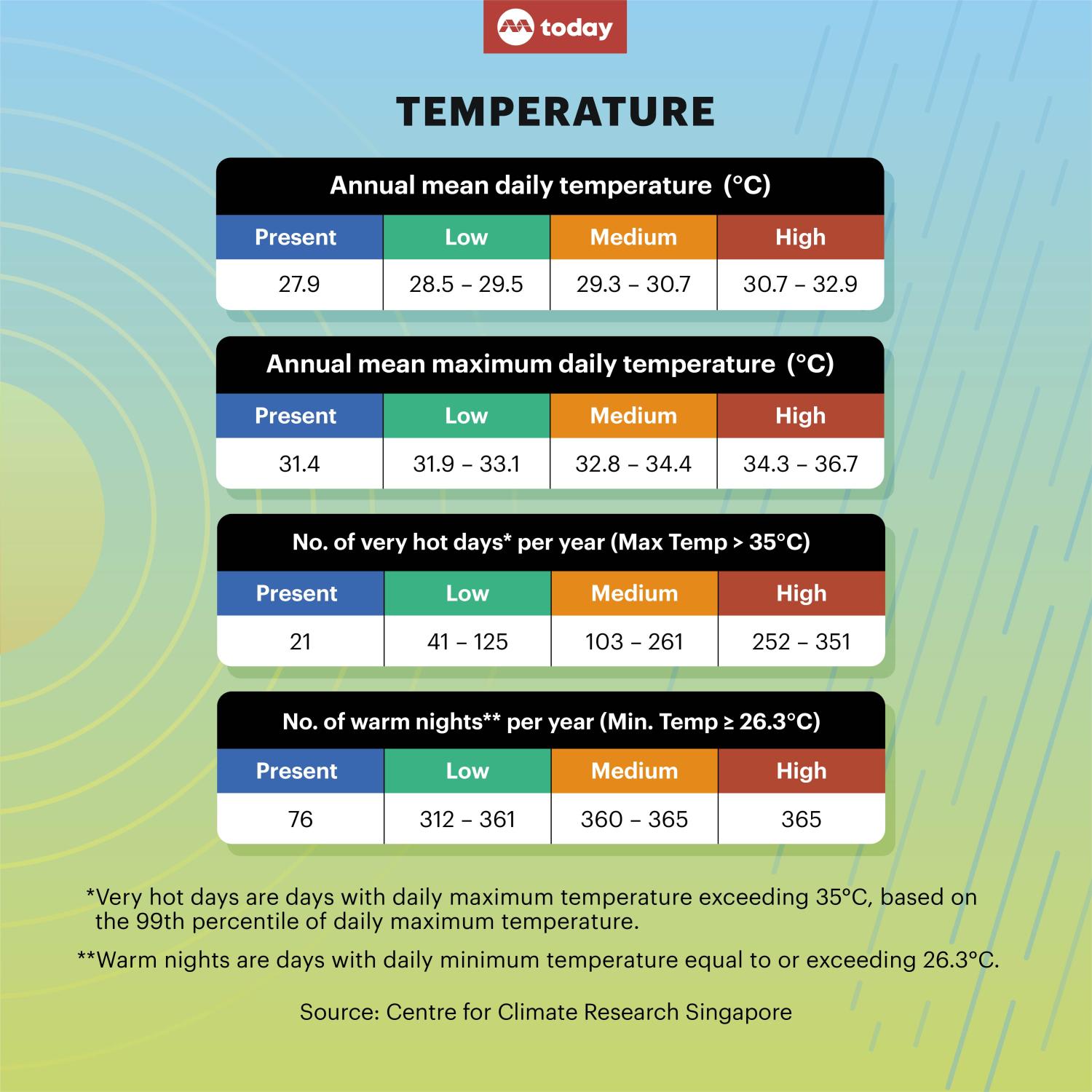
SINGAPORE — By the end of the century, Singapore could possibly face very hot days of temperatures exceeding 35°C for up to 351 days in a year.
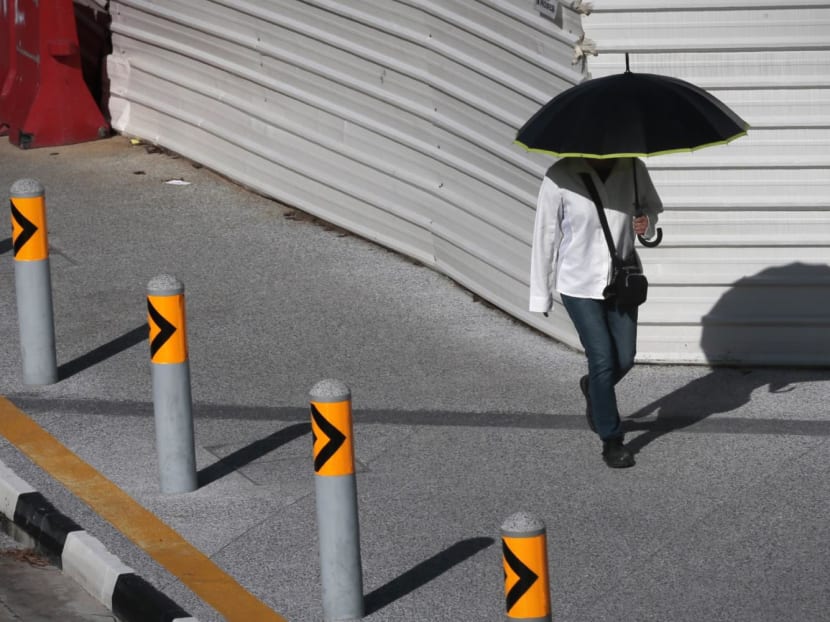

- By 2100, Singapore could possibly face very hot days, where daily maximum temperatures exceed 35°C, for up to 351 days in a year
- It could also experience longer and more frequent dry spells and intense rainfalls
- These were among the latest climate projections mapped out by the Centre for Climate Research Singapore
- The projections will be used to help the Government plan how to protect Singapore from the effects of climate change


SINGAPORE — By the end of the century, Singapore could possibly face very hot days of temperatures exceeding 35°C for up to 351 days in a year.
There may also be more frequent and longer-lasting dry spells.
These are a couple of the latest projected climate scenarios mapped out by the Centre for Climate Research Singapore, which issued a report on Friday (Jan 5) on the findings from its third national climate change study, also known as V3.
The centre, which sits under the National Environment Agency’s Meteorological Service Singapore, last issued projections in 2015 with its V2 report.
Compared to V2, the V3 study is based on expanded and improved data sets, and so gives a more accurate simulation of the regional climate, the centre said in a media release on Friday.
Here are five key takeaways from the report:
WEATHER EXTREMES WILL BECOME THE NORM
The study forecasts an intensification of weather phenomena across all climate metrics by the end of the 21st century, including mean sea level, mean daily temperature, number of “very hot” days exceeding 35°C, warm nights and annual average rainfall.
In the worst-case scenario, by the year 2100, Singapore may eventually have only 14 days a year where the temperature drops below 35°C.
The outlook is also rather dire in the nearer future: By mid-century, the island may experience between 47 and 189 “very hot” days, more than double the current average of 21 such days yearly.
By 2050, average daily mean temperatures could increase by between 0.6°C and 2.2°C, depending on whether the world can cut carbon emissions or continues to burn ever more fossil fuels.
This would bring mid-century temperatures up to between 28.5°C and 30.1°C, from the current mean of 27.9°C.
By the end of the century, average daily mean temperatures could increase by between 0.6°C and 5°C, the study predicted.
This means that by 2100, Singapore’s future average daily mean temperature will be between 28.5°C and 32.9°C, up from its current mean of 27.9°C.
Historically dry seasons in the year could become even drier, while extreme daily rainfall is projected to increase across all seasons and scenarios, for example, by about 6 to 92 per cent in the inter-monsoon months of April and May.
By 2100, seasonal rainfall in the dry months of June, July and August could fall significantly below the historical low of 314mm, recorded in 1997, around once every three years.
The study also projected that mean sea levels may rise by between 0.23m and 1.15m by 2100 and by up to around 2m by 2150, depending on whether and by how much the world can reduce carbon emissions.
In the worst-case scenario, wind speeds could increase by up to 20 per cent during the monsoon seasons, and by up to 11 per cent in the inter-monsoon months of April and May.
MORE DETAILED LOOK THAN PAST REPORTS
A refresh of its predecessor, the V3 study offers a more granular look at Singapore and Southeast Asia’s projected climate in the century ahead, by downscaling global models and predictions for temperatures, rainfall, wind speeds and sea levels.
The climate change projections done by the United Nation's Intergovernmental Panel on Climate Change (IPCC) typically offer a more big-picture look at global and large-scale climate change.
These projections lack the granularity necessary for assessing climate change at the regional and domestic level to guide national planning.
To bridge this gap, the V3 study downscaled a selected set of global climate models from the IPCC’s reports to a more concentrated area — of 8km over Southeast Asia and 2km over Singapore — to provide more granular and focused projections.
SINGAPORE PLANNING FOR THE WORST
The Centre for Climate Research Singapore said: “The Government will take into account the range of possible climate outcomes, including the high emissions pathway, in Singapore’s adaptation plans to ensure that we remain climate-resilient.”
The “high emissions pathway” refers to a scenario driven by the continuation of energy-intensive, fossil fuel-based development across the world.
The Singapore Government has already announced several long-term plans and initiatives to shield the island from the most extreme effects of climate change, such as the development of Long Island to protect the coastlines and guard against rising sea levels.
Based on the findings of the V3, the Government would also review Singapore’s building codes and the structural integrity of its infrastructure, to ensure that buildings on the island can withstand the projected changes in the climate, such as higher temperatures and increased wind speeds.
INDIVIDUALS CAN PLAY A PART
Government action alone would not be enough to combat the effects of climate change, the Centre for Climate Research Singapore said, adding that everyone, including consumers and businesses, have a role to play.
People could raise their air-conditioner's temperature by 1°C or reduce their shower times by two minutes to reduce energy and water consumption.
Consumers may opt to buy more domestic produce and groceries, which have a lower carbon footprint than imported items.
For businesses, they may adopt carbon-friendly practices such as using energy-efficient appliances at work or applying for the SG Eco Fund to organise environmentally friendly work events.
The $50 million SG Eco Fund was set up in 2020 to support projects that advance environmental sustainability and involve the community.
STILL TIME FOR THE WORLD TO ACT
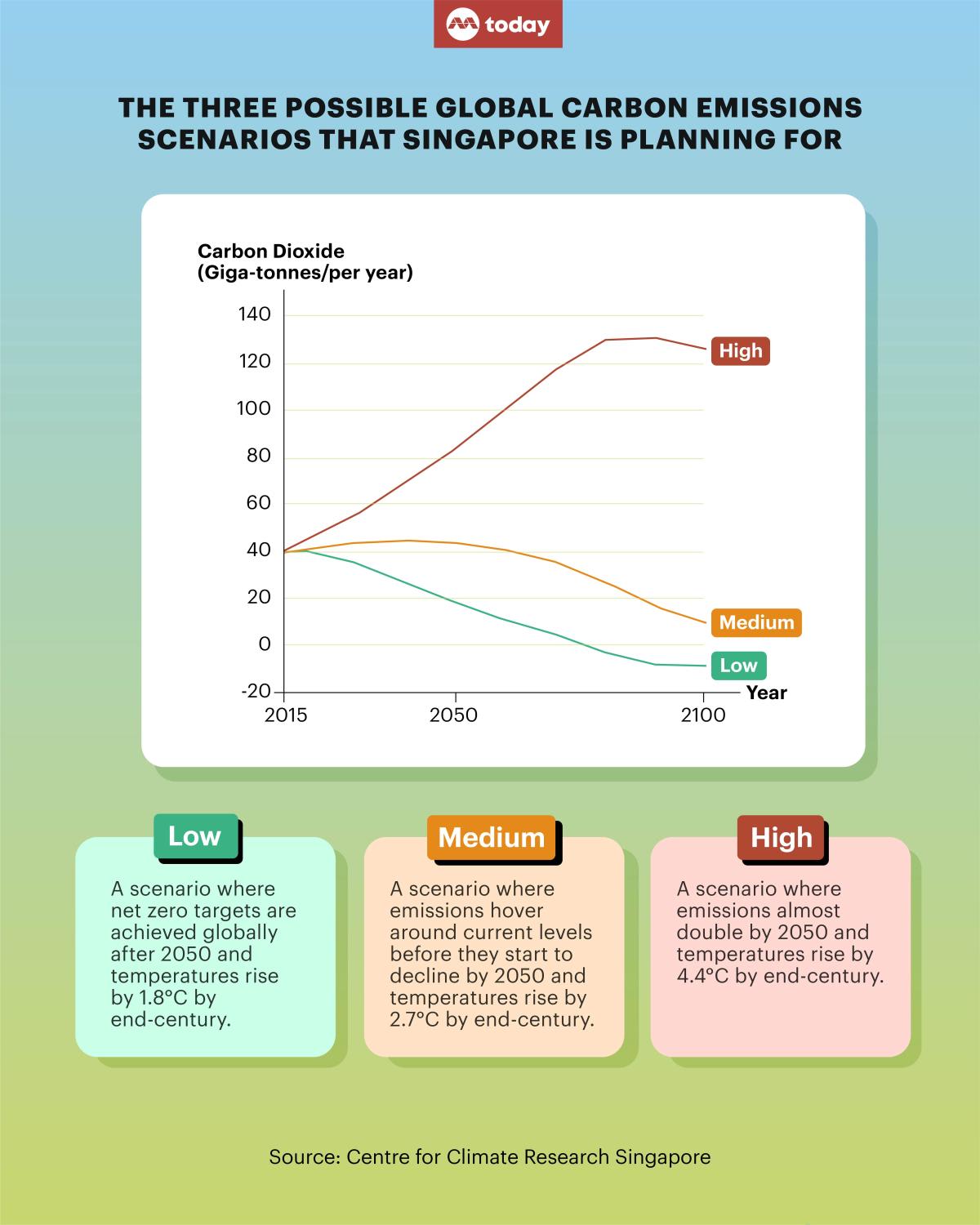
The study maps out different climate change projections for Singapore and Southeast Asia, based on three projected global pathways that would lead to varying greenhouse gas emission levels, and thus a range of possible climate outcomes for Singapore and the region by the end of the century.
These three projected pathways correspond to the ones used by IPCC, which regularly issues global climate change forecasts.
The V3 report provides climate projections for:
- A low emissions scenario, which assumes a shift to sustainable development pathways with net zero targets achieved after 2050
- A medium emissions scenario, which takes a middle-of-the-road pathway, where historical patterns of development continue throughout this century
- A high emissions scenario driven by the continuation of energy-intensive, fossil fuel-based development
So, how countries act from here on out has a direct bearing on the world’s future climate, and the extent of this impact will depend on how much they are able to cut carbon emissions.
While there is still scope to change which projection plays out, countries must act collectively and urgently to fulfil their net-zero emission commitments to avert a worst-case scenario.
To learn more ways to fight climate change, interested members of the public may go to the Ministry of Sustainability and the Environment’s website.
Related topics
climate climate change rising sea levels global warmingStay in the know. Anytime. Anywhere.

Subscribe to our newsletter for the top features, insights and must reads delivered straight to your inbox.
By clicking subscribe, I agree for my personal data to be used to send me TODAY newsletters, promotional offers and for research and analysis.