
Asean 'cautiously encouraged' by developments on Korean peninsula: PM Lee
SYDNEY ― The Association of South-east Asian Nations (Asean) is “cautiously encouraged” by recent developments on the Korean peninsula, including reports of North Korea’s commitment to denuclearisation, said Prime Minister Lee Hsien Loong on Sunday (March 185).
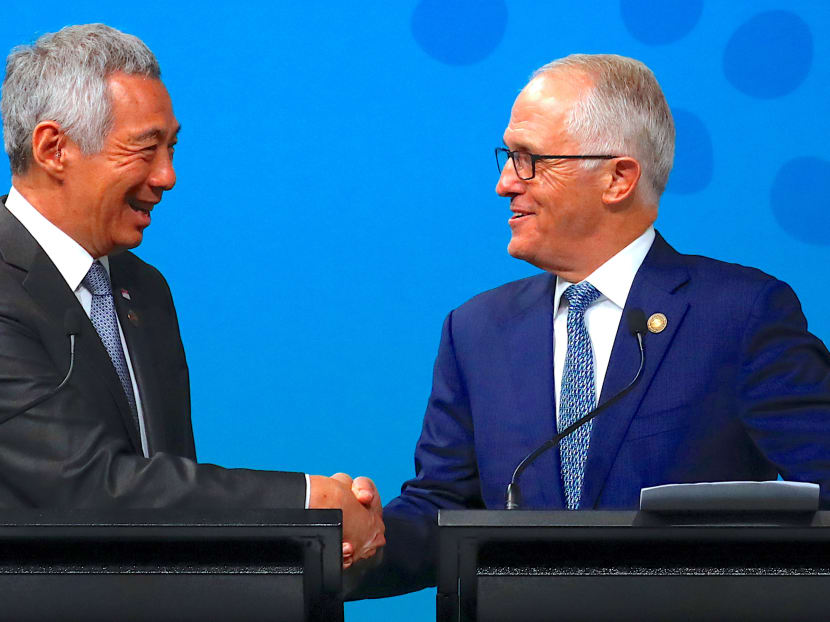
Singapore's Prime Minister Lee Hsien Loong and Australian Prime Minister Malcolm Turnbull shaking hands during their media conference during the one-off summit of the 10-member Asean in Sydney, Australia on March 18, 2018. Photo: Reuters



SYDNEY ― The Association of South-east Asian Nations (Asean) is “cautiously encouraged” by recent developments on the Korean peninsula, including reports of North Korea’s commitment to denuclearisation, said Prime Minister Lee Hsien Loong on Sunday (March 18).
“The situation on the Korean Peninsula is a complicated problem, which will take time to resolve,” Mr Lee said during a joint press conference with Australian Prime Minister Malcolm Turnbull at the conclusion of an Asean-Australia special summit. The press conference also touched on the South China Sea and the Rakhine issue.
“We have noted reports of North Korea’s commitment to denuclearisation and its pledge to refrain from further nuclear and missile tests during this period,” said Mr Lee, who was speaking as rotating chair of the regional grouping this year.
Referring to earlier reports that President Donald Trump was set to meet North Korean leader Kim Jong-un for the first US-North Korea Summit in the near future, Mr Lee said: “We are cautiously encouraged by these developments.”
“We hope these recent steps will contribute towards lasting peace and stability,” he added.
On his part, Mr Turnbull said Asean and Australia reaffirmed their commitment to respond strongly and resolutely in the face of their “grave concerns” over the reclusive state’s “reckless and illegal nuclear-missile programmes”.
Earlier in the day, Asean and Australia said in a joint statement that they held grave concerns about escalating tensions caused by North Korea’s nuclear and missile programmes, while calling for irreversible denuclearisation.
On Sunday, Mr Lee wrapped up a four-day visit to Sydney after attending a string of bilateral and regional meetings, including the Asean-Australia Special Summit over the weekend.
He said the regional meeting, which wrapped up with several key deliverables including a landmark agreement to fight terrorism in the region as well as an A$30 million (S$30.5 million) investment in an Asean-Australia initiative on smart and sustainable cities, was a “very successful” one that has achieved its purpose.
Turning to the disputed South China Sea, Mr Lee noted during the joint press conference that Asean and Australia have reiterated their support for a rules-based regional order to resolve disputes peacefully in accordance with international law, including the 1982 United Nations Convention on the Law of the Sea.
All regional countries have a fundamental interest in freedom of navigation and overflight in the South China Sea and more broadly in the peace and stability of the region, he said.
“We therefore look forward to the early conclusion of negotiations on a code of conduct in the South China Sea.”
China asserts sovereignty over much of the South China Sea, amid competing claims from several South-east Asian nations ― including four Asean members Malaysia, Brunei, Vietnam and the Philippines. Tensions have eased somewhat in the past year, amid regular exchanges between Asean and China. The two parties have also begun negotiations on a code of conduct in the strategic seaway.
When asked what concrete actions Australia and Asean will take to address China’s conduct in the disputed waterway, Mr Lee noted that the South China Sea is an issue for specific Asean countries which are claimant states.
“It’s an issue for the rest of the Asean countries too because this is a security and stability question in South-east Asia which will affect all Asean countries if it goes wrong,” he said.
“This is an issue which we can manage, which we can help to prevent from escalating but it is not an issue which can in a definitive way be solved in any short period of time.”
He added: “We have to accept that and work together in good faith and to the utmost ability.”
Mr Lee and Mr Turnbull also touched on the Rohingya issue in Myanmar.
Hundreds of thousands of Rohingya in the western Rakhine state have fled the Buddhist-majority country to Bangladesh since militant attacks last August sparked a brutal crackdown by security forces.
Mr Lee said that Asean, though concerned, cannot intervene to force an outcome. “But we are working together in consultation with Myanmar to provide humanitarian assistance so that the affected communities can rebuild their lives,” said Mr Lee.
Mr Lee said Asean will be “anxious” if instability or trouble brews in any of its member countries. “We are also concerned, as human beings, if there is a humanitarian situation which has developed and people’s welfare and lives and safety are at stake.”
Earlier on Sunday, Asean and Australian leaders discussed the situation with Myanmar State Counsellor Aung San Suu Kyi, who sought support from Asean and other nations to provide help in terms of humanitarian assistance and capacity building.
“Our goal is to support a peaceful and speedy resolution,” said Mr Turnbull.
One leader was notably absent from the weekend summit. Philippine President Rodrigo Duterte said he would skip the summit, after asserting that he would not cooperate with investigators from the United Nations probing alleged extrajudicial killings in his anti-drug war, which has claimed thousands of lives. Manila was represented by foreign affairs secretary Alan Peter Cayetano.
Asked whether the Filipino leader’s absence affected discussions on terrorism, particularly when southern Philippines remains a hotspot for such activity, Mr Turnbull said: “President Duterte was never coming to the summit. He made that clear. But (Mr) Cayetano was here and made a really very, very valuable, constructive (and) informed contribution.”
Mr Lee departed Sydney for Singapore on Sunday.
Stay in the know. Anytime. Anywhere.

Subscribe to our newsletter for the top features, insights and must reads delivered straight to your inbox.
By clicking subscribe, I agree for my personal data to be used to send me TODAY newsletters, promotional offers and for research and analysis.






