
Back to basics: Singaporeans rediscover their love for writing through their fountain pens
SINGAPORE — Every morning, 56-year-old Rick Ho spends three hours improving his handwriting. With his fountain pen, he copies his favourite passages or quotes from books in cursive script.

Mr James Lim, who carries his fountain pens on his travels, sketches Beijing Capital International Airport during his trip there in 2018.



SINGAPORE — Every morning, 56-year-old Rick Ho spends three hours improving his handwriting. With his fountain pen, he copies his favourite passages or quotes from books in cursive script.
Describing his mornings as “soothing for the soul”, Mr Ho, who is semi-retired, said that his love for pens, specifically fountain pens, is far-removed from his primary school days when he had to contend with ink blots on his uniform.
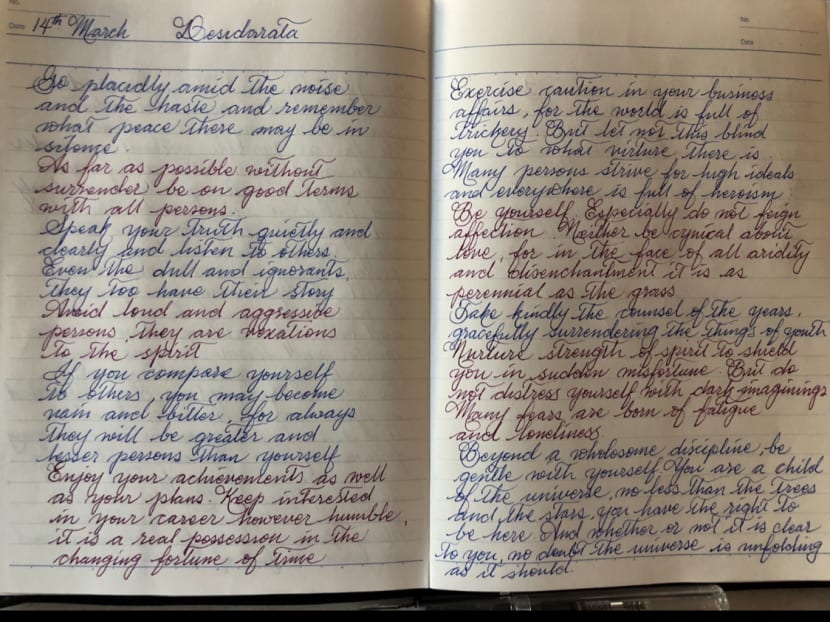
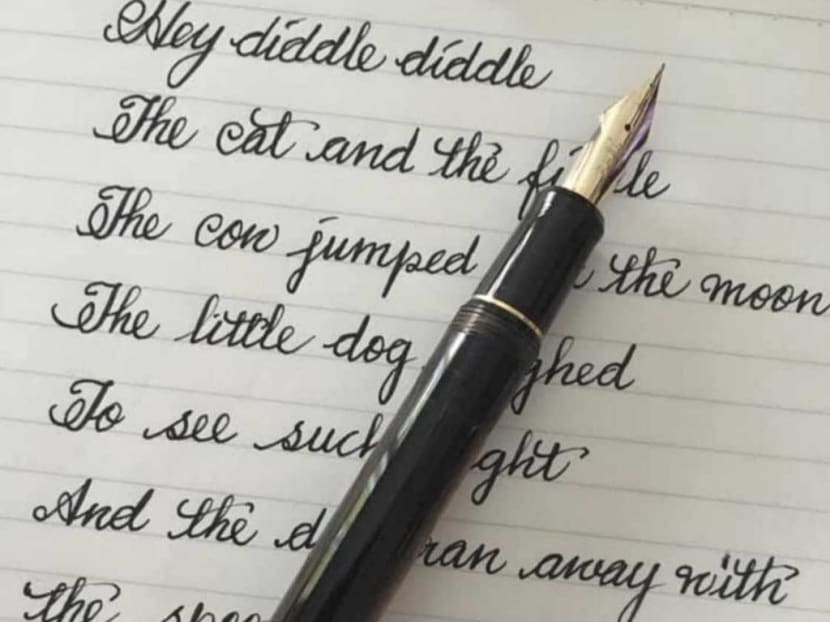
Describing himself as being part of the generation that “went from the ballpoint pen, to the typewriter to the keyboard”, Mr Ho said that his attitude towards fountain pens changed when he bought one similar to his late father’s Parker in 2013.
“Something happened when I tried the pen. It was so smooth. I was amazed and wanted to find out more about pens,” he recounted.
Since then, Mr Ho’s collection of fountain pens has grown to 30, with his most expensive — a Japanese-made Sailor — costing S$2,000.
Mr Ho is part of a burgeoning group of fountain-pen enthusiasts who champion the joy of handwriting in an age when digital communication has become the norm.
Within Singapore, several people have banded together to share their love for handwriting.
One such group is the Singapore Fountain Pen Lovers Facebook group, which boasts 5,500 members, and has come a long way from the 200 or so members it had in the early 2010s.

Publicist and screenwriter Olivia Loh-Ing, who joined the group in 2015, said that she used to think that collecting pens was a solitary hobby. She would visit stationery shops on her own and seek out pens that she liked. However, since joining the Facebook group, she has come to be part of a community of people from diverse backgrounds and a range of ages.
Every month, the group organises a meet-up for its members at The Tea Party Cafe in Pasir Panjang. Up to 100 people attend the event, which is usually sponsored by a Singapore pen vendor. Members get together to show off their collections, exchange tips on how to write better or simply to make friends. The group has become big enough for the committee to organise a full-day pen show next month featuring 23 Singapore and overseas pen vendors at the Marina Mandarin Hotel.
AS CHEAP AS FIVE DOLLARS
The budding interest in fountain pens, typically seen as an elite writing instrument, reflects the growing market for luxury pens.
The luxury pen market is expected to generate more than US$2.8 billion (S$3.8 billion) by 2021, market research company Technavio said. Of this, the fountain pen segment will account for the major market share of fine pens.
Technavio attributed the growth to consumers from the United States and China who like to buy fountain pens as gifts.
Mrs Ing agreed that fountain pens were rising as a “status symbol” globally, but she said that collecting fountain pens was also a hobby that catered to people of any skill or budget.
“There are no barriers to entry. There are cheap and good fountain pens available at even S$5. It’s all about your own time and target…Writing with a fountain pen will give you some contemplative space to be in and lets you connect with your more creative and artistic side.”
Mr Ho said that people collect fountain pens for various reasons.
For those who valued its aesthetic, it was the design on the pen’s barrel that mattered, with some barrels changing colour based on the heat from a user’s hand.
For others such as himself who are concerned about handwriting, the nib of the pen matters more. Nibs can range from extra fine all the way to broad broach, affecting the thickness of a font’s stroke, and come in materials such as stainless steel, titanium or even gold.
For Mrs Ing, the pens are a symbolic way for her to commemorate important events in her life. When her husband survived a major surgery two years ago, she engraved two of her favourite Faber-Castell pens with the phrases “gratitude” and “relief” in Latin, along with the date.
PRACTICAL TOOLS FOR THEIR PASSION
For others, the fountain pen is a practical tool for pursuing their interests. Mr Clement Huang, who works in the oil and gas industry, decided to use a fountain pen to explore his interest in Chinese calligraphy because the usual brush and ink requires a lot of clean-up and is not as portable.
“I wanted to find something that still allows you to participate in the creative process (of calligraphy), but is available more easily in our daily lives.”
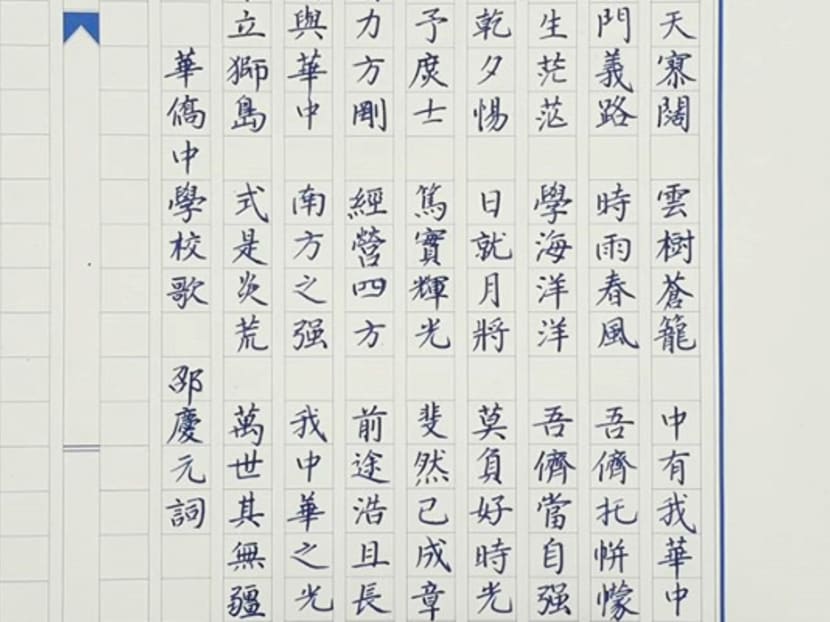
The 36-year-old, who taught himself calligraphy through videos, said that while people perceived the brush as necessary to pursuing the ancient art, using a pen does not present many limitations.
“The concept is similar to using a brush, just that instead of using something soft, you are using something with a hard tip. You must be sensitive to the angle of the pen, the force of contact with the paper and the speed of the (writing) movement, just as you would with a brush.”
Unlike Mr Huang whose artistic pursuits began with the fountain pen, 33-year-old designer James Lim first started sketching with colour pencils and paintbrushes before discovering the versatility of pens.
“Aside from the fact that a fountain pen feels good, certain pens with soft nibs give various kinds of boldness and thickness in the stroke where normal pens cannot… It adds more character to the painting,” he explained.
Mr Lim manages the Cafe Sketchers SG group and organises monthly urban-sketching meet-ups.
He travels around the world with his fountain pens, and said that there was a more personal value to owning a fountain pen.
“It’s like having a signature tool by default, which allows you to perform smoothly with your drawing style. It’s also easier and faster to ‘capture’ a scene on paper with a pen.”
NO ESCAPING TECHNOLOGY
Despite the growing interest in fountain pens, it appears that plenty of people see no option but digital technology when it comes to communication.
Mrs Ing said that she regularly writes letters and thank-you notes to people in the hope that they will respond in kind. However, while people are cheered up by her efforts and thank her via WhatsApp, she lamented that she had yet to receive a written note in return.
Like Mrs Ing, Mr Ho regularly writes stylistic festive greetings for his friends with his pens. However, he continues to send them through digital means — via WhatsApp photos of his writing.
However, unlike Mrs Ing, Mr Ho is contented to receive compliments from his friends: “I’m just delighted to know that my handwriting has gone from atrocious to eye-catching after all the practice with my pens.”
Related topics
fountain penStay in the know. Anytime. Anywhere.

Subscribe to our newsletter for the top features, insights and must reads delivered straight to your inbox.
By clicking subscribe, I agree for my personal data to be used to send me TODAY newsletters, promotional offers and for research and analysis.






