
Backgrounder on Singapore's elected presidency system
SINGAPORE — Prime Minister Lee Hsien Loong, in an ongoing speech in Parliament, also addressed the Elected President (EP) system. Here’s a backgrounder on the idea, which was first mooted in 1984 by then PM-Lee Kuan Yew.
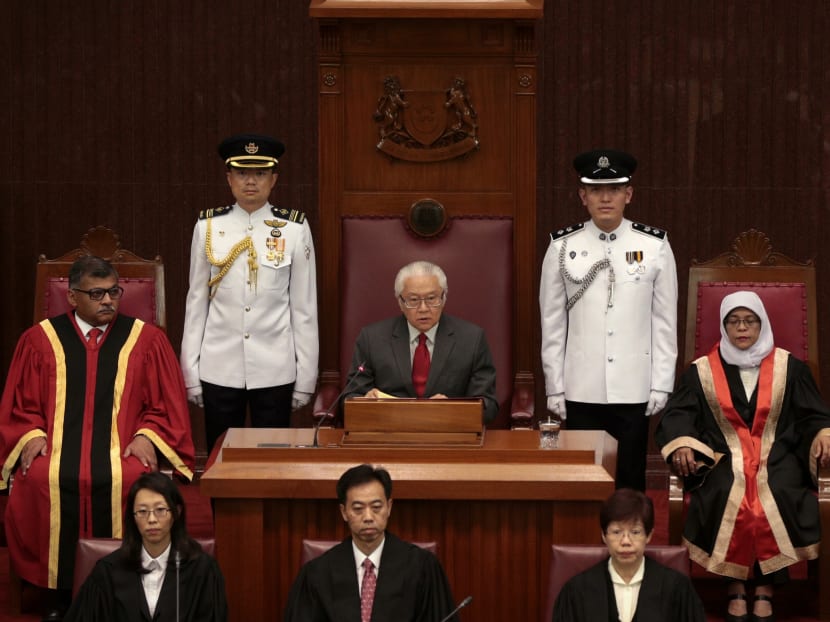
President Tony Tan speaks at the opening of the 13th Parliament of Singapore on Jan 15, 2016. Photo: Jason Quah/TODAY

SINGAPORE — Prime Minister Lee Hsien Loong, in an ongoing speech in Parliament, also addressed the Elected President (EP) system. Here’s a backgrounder on the idea, which was first mooted in 1984 by then PM-Lee Kuan Yew.
The idea for Singapore to have an elected president to help safeguard the financial reserves was first mooted by then-Prime Minister Lee Kuan Yew in April 1984. Four months later, Mr Lee raised the topic again in his National Day Rally speech that year.
In July 1988, then-Deputy Prime Minister Goh Chok Tong tabled the first White Paper on the Elected President in Parliament. The White Paper described proposals to amend the Constitution and stated the rationale for the proposals.
By March 1990, the Government decided that it would go ahead with the legislation on the expanded powers of the elected president.
A second White Paper was put up in August 1990, with three additional safeguard roles added for the President regarding the Internal Security Act, Maintenance of Religious Harmony Act and Corrupt Practices Investigation Bureau probes.
The proposals sparked lengthy debates in Parliament. A Select Committee comprising 12 members including cabinet ministers and one opposition member was appointed to look into the issues and make recommendations. The Select Committee’s report was presented to Parliament in December 1990. The following month, the Bill to amend the Constitution was passed into law and the changes came into effect on Feb 1, 1991.
Under the amended constitution, the person who is to be elected as President should be a Singapore citizen, at least 45 years old with at least three years experience as Minister, Chief Justice, Speaker of Parliament, Judge or Judicial Commissioner of the Supreme Court, Auditor-General, Accountant-General, Chairman of the Public Service Commission or Permanent Secretary, Chairman or Chief Executive Officer of a company with paid-up capital of at least S$100 million.
The Elected President has a six-year term and has veto powers over the spending of national reserves and monetary policies as well as over the appointments of key positions in the Civil Service, government companies and statutory boards.
The amendments which gave the President powers to safeguard the reserves and integrity of the public services came into effect on Nov 30, 1991.
Mr Wee Kim Wee, who was the president at that time, exercised the new powers until Sept 1, 1993. Singapore’s first elected President, Mr Ong Teng Cheong, was voted in on Aug 28, 1993 and sworn in on Sept 1, 1993.
The most recent Presidential Election (PE) held in 2011 drew four candidates - making it the most keenly contested PE to date. Former Cabinet Minister Tony Tan won with 35.2 per cent of the vote, ahead of former PAP Member of Parliament Tan Cheng Bock (34.9 per cent), former-civil-servant-turned-Opposition-politician Tan Jee Say (25 per cent) and former NTUC Income CEO Tan Kin Lian (4.9 per cent).
Stay in the know. Anytime. Anywhere.

Subscribe to our newsletter for the top features, insights and must reads delivered straight to your inbox.
By clicking subscribe, I agree for my personal data to be used to send me TODAY newsletters, promotional offers and for research and analysis.






