
The Big Read: For opposition parties, leadership succession looms large
SINGAPORE — Half a century after Singapore’s independence, the Opposition scene has become a lively one where participation is concerned.

SINGAPORE — Half a century after Singapore’s independence, the Opposition scene has become a lively one where participation is concerned.
With increasingly fewer walkovers in the last three polls — all 89 seats were contested in the General Election (GE) last year — the signs are clear: Gone are the days when the Opposition struggled to attract enough candidates to stage a contest.
But even as a fresh crop of individuals joins the ranks of the Opposition, perennial issues dog these parties. Not all parties attract quality candidates, and when they do, retaining the talent, and handing over the leadership baton to the next generation, continue to be a hit-and-miss affair, as shown by the recent challenge for power in the Workers’ Party (WP).
Other parties have no clear succession plans at all, with promising candidates that made a splash in one election gone by the next.
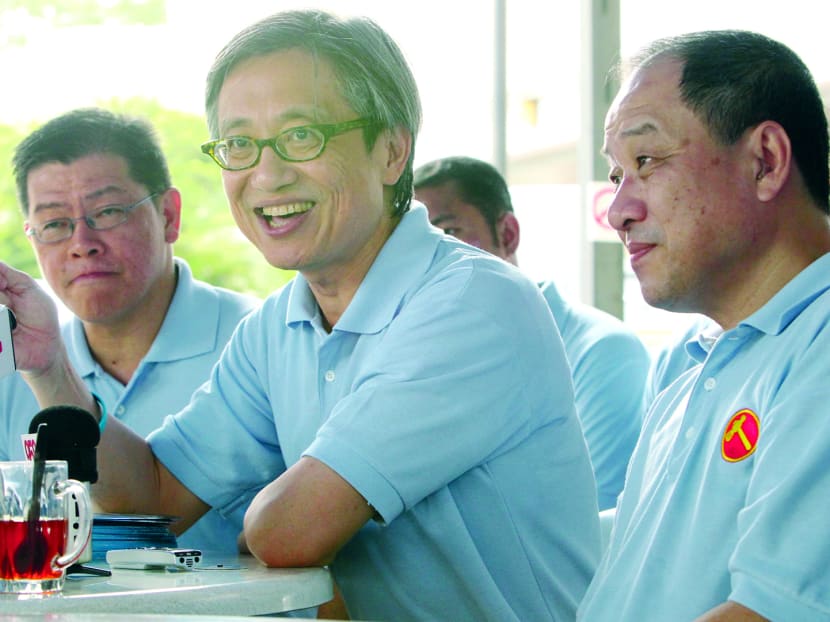
While the WP shrugged off the contest for the secretary-general post in its latest Central Executive Council (CEC) elections as part of the democratic process, political analysts were divided over the significance of the mounted challenge, which ended with party chief Low Thia Khiang retaining the post with 61 votes to fellow Aljunied GRC Member of Parliament Chen Show Mao’s 45 votes.
Amid criticism of Mr Low’s leadership style, the party reinstated the role of assistant secretary-general, with the position — once held by Mr Low — going to Aljunied GRC MP Pritam Singh.
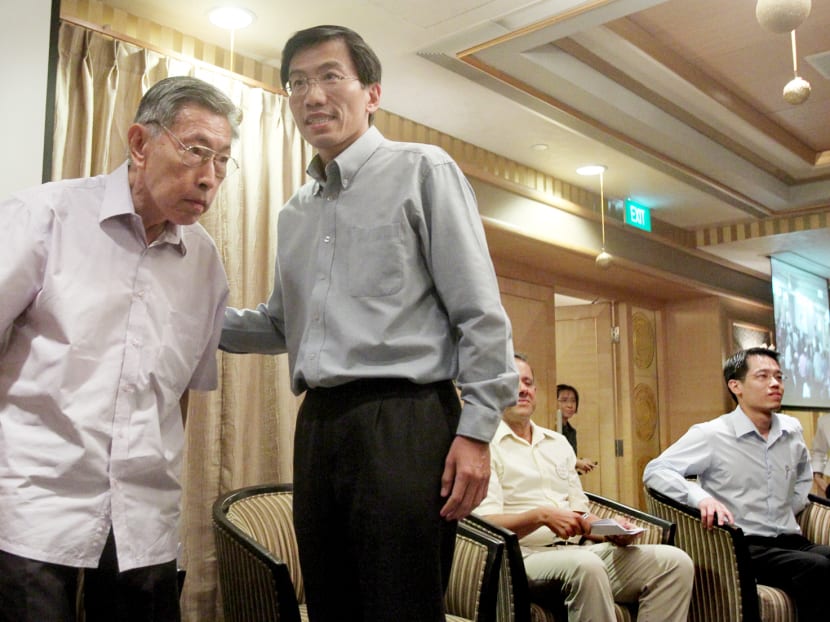
The Opposition has a “sorry history” of in-fighting, noted Associate Professor Alan Chong from the S Rajaratnam School of International Studies (RSIS). Two decades on, the public fall-out between veteran politician Chiam See Tong and his then protege Chee Soon Juan, which resulted in Mr Chiam leaving the Singapore Democratic Party (SDP), continues to be a sore spot. It resurfaced during the polls last year and in the Bukit Batok by-election last month, both of which Dr Chee stood in.
Beyond the WP, other parties have yet to show their hand in terms of renewal and succession plans, said political watchers.
Too much focus has been placed on short-term goals, such as winning a seat, and this has hampered the nurturing of next-generation leaders, said Singapore Management University law don Eugene Tan.
Political commentator Derek da Cunha said “minor alternative parties” find it difficult to attract well-qualified people or personalities “who can excite the voters”.
“Even the SDP can really only showcase their one high-credentialed member and GE2015 election candidate, Dr Paul Tambyah, who seems to be trotted out by the party every so often,” he said, referring to the respected infectious disease expert and professor of medicine at the National University of Singapore.
Further tripping up the leadership renewal is the predominance of personality politics, which are commonplace in parties lacking the institutional development of the ruling People’s Action Party (PAP), analysts observed.
The PAP has come a long way since its early days, when power struggles were rampant, until a left-leaning faction was expelled and went on to form the now-defunct Barisan Sosialis in 1961. Subsequently, the PAP’s leaders approached renewal with a “team-based” ideology, with internal institutions and processes to facilitate transition.
In the same way, said Assistant Professor Woo Jun Jie, from Nanyang Technological University’s (NTU) School of Humanities and Social Sciences, even as internal struggles are part of a party’s development, Opposition parties need to move beyond personality politics and divert power from key figures to institutions.
A NEW ERA, DESPITE LINGERING FEARS
At 47, blogger Ravi Philemon decided to take the plunge and contest a single-seat ward, Hong Kah North, on the Singapore People’s Party (SPP) ticket last year. Months before, he left the National Solidarity Party (NSP), together with former secretary-general Jeannette Chong-Aruldoss, to breathe new life into the SPP, a party long dominated by its leader, Mr Chiam.
“I resigned from my last job (as director of a voluntary welfare organisation). I was at a different stage in my life — my children were older, my wife is working. There were certain risks that I could take, which others at a different station in their life might not have been able to take,” said Mr Philemon. He ended up clinching about one in four votes (25.24 per cent), losing to the PAP’s Amy Khor.
Mr Philemon, now lead editor of socio-political website The Independent Singapore, said he personally knew of young people who contemplated running in the last GE, but held back for fear of ending up jobless.
He felt that the stigma of being associated with the Opposition has not diminished over the years. “The fear is always there, but it’s not so much of being arrested or bankrupted. It’s more of the fear of losing opportunities and offending people from the establishment,” he said.
People’s Power Party (PPP) chief Goh Meng Seng, who founded the party after leaving the NSP, has a contrary view: The tide turned for the Opposition after the 2011 polls.
That year, WP’s Low gathered an “A-team” to stand in Aljunied Group Representation Constituency (GRC), a team comprising, among others, party chairman Sylvia Lim as well as then new face Chen Show Mao, a top corporate lawyer touted by the party as their star candidate. They triumphed over the PAP team led by then Foreign Minister George Yeo, with 54.72 per cent of the vote share, and swept into Parliament.
“With the success of the WP in Aljunied, they’ve instilled more hope and excitement in the talented people. They’re willing to come out,” said the PPP’s Mr Goh.
SMU’s Associate Professor Tan said Opposition parties have started to find it easier to attract promising talent compared with a decade ago. “This is borne out of the quality of candidates fielded by the Opposition in the past two General Elections; they are not necessarily the riff-raff that Lee Kuan Yew had once described,” he added, referring to a term used by the late Mr Lee during the 2006 polls to describe the calibre of the Opposition candidates.
Fast forward to 2015, the WP fielded sociology lecturer Daniel Goh, consultancy firm chief executive Leon Perera and shipping lawyer Dennis Tan. All lost in the respective wards they contested in, but entered Parliament as Non-Constituency MPs (NCMPs).
Meanwhile, the SDP fielded Dr Tambyah alongside Dr Chee for a contest in Holland-Bukit Timah GRC. In 2011, the SDP also made waves with Mr Tan Jee Say, a former principal private secretary to then Deputy Prime Minister Goh Chok Tong, while the NSP had “star catches” of their own: Former high-flying civil servants Tony Tan Lay Thiam, who was a Singapore Armed Forces scholar, and Hazel Poa, who had worked at the Ministry of Finance, among other roles.
RSIS’ Dr Chong said Singapore is a maturing society, where more people are willing to “roll the dice”. While previously people aired their views in the safety of their homes, the elections have morphed into a “participatory sport” over the years. This was evident from the sheer number of volunteers milling around during Opposition election rallies, helping to distribute flyers and sell merchandise, he added.
But the hard truth remains: Wannabe politicians gravitate towards more recognisable parties. In Mr Philemon’s view, this includes the WP, SDP and SPP “only because of the Chiams”.
“Fringe Opposition parties find it difficult to recruit any kind of membership. They are perceived to be creating noise just for the sake of doing so,” he said.
BEYOND THE FRENZY, THE LONG HAUL
Within the Opposition, some stars have also burnt out fast.
Case in point: The NSP’s Nicole Seah captured the imagination of Marine Parade voters with her eloquence, despite being the youngest candidate during the 2011 polls. Two years later, she was appointed second assistant secretary-general of the party. But Ms Seah eventually had what she described as a meltdown, and left the party in 2014.
Another rising star that crashed out of the political scene was business analyst Yaw Shin Leong, who caused a scandal when he had to step down as Hougang MP over an alleged extramarital affair.
Once seen as Mr Low’s successor, Mr Yaw joined the WP in 2001, and led the party’s “suicide squad” of young political newcomers against Prime Minister Lee Hsien Loong’s PAP team in Ang Mo Kio GRC in GE2006, securing about one-third of the votes.
In 2011, he was chosen to defend the WP’s hold on Hougang when Mr Low moved to contest in Aljunied GRC, and succeeded, winning 64.8 per cent of the vote. But his downfall came barely a year later, when the WP expelled him amid rumours of his indiscretions.
“Efforts at grooming new talent within Opposition parties have been pretty much a case of ‘hit and miss’,” said NTU’s Assistant Professor Woo. “In all cases, there is a conflict between party goals and personal dispositions that render such new talent less than suitable for political life.”
These premature departures raise questions as to whether potential members are effectively screened or in tune with party ideologies, he added.
When approached for comments, the WP’s Mr Perera, Dr Goh and Mr Dennis Tan declined to respond.
Even when budding politicians stay in the game, their loyalties may change, leading to a merry-go-round as they hop from one party to another, and putting a dent in grooming and succession plans.
For example, Mr Benjamin Pwee, secretary-general of the Democratic Progressive Party (DPP), was a former civil servant touted as a promising catch for the SPP in 2011, when he ran alongside Mr Chiam See Tong in his bid to capture Bishan-Toa Payoh GRC. But months after their defeat, a bitter split saw Mr Pwee leave with several SPP members to join the DPP.
Another example is Mr Tan Jee Say, who left the SDP after 2011 to form the Singaporeans First party in 2014.
“Very often, politicians go on to form new parties when they find that existing parties cannot accommodate them,” said SMU’s Assoc Prof Tan. “We’re not seeing talent congregating in a few Opposition parties; instead, they are all scattered throughout more parties, more marginal than central players in Singapore politics.”
The fragmentation comes at a time when the Opposition ought to be building on Singaporeans’ receptivity to political competition and diversity, he added.
Former NSP secretary-general Tan Lam Siong said the nature of politics is such that it attracts individuals with strong personalities.
“They tend not to be so open and forthright with one another. There is a lot of suspicion and divided loyalties ... and it is not uncommon to see members leaving one party and joining the next and the next,” said Mr Tan, who quit the NSP last year.
He added: “When you finally think that there is someone who has the necessary attributes, you begin to worry about their commitment and whether they will deviate from your chosen path. That’s human nature.” Plans to groom successors also may result in internal friction, and derail without transparency and endorsement from cadres, he pointed out.
For those who do stay the course, parties have their own ways of grooming them.
The SDP’s Dr Tambyah pointed out that his party, and “most serious political parties”, offer members training sessions in leadership, communications and other skills “essential” for success in politics.
“In reality, however, the best preparation for politics come from walking the ground. The SDP has continued our house visits and community visits, and these are essential for budding politicians to see how well they can connect with residents, understand the issues and work with volunteers,” he said.
Singapore Democratic Alliance chief Desmond Lim spent 14 years as a consultant at Potong Pasir Town Council, under Mr Chiam, who served as the MP there. “I never say I wasted my time there, because I learnt something — how to organise community activities, how to engage with the people,” he said.
These were core skills needed by every politician, but Mr Lim felt that newcomers prefer to see results quickly, be it rising within their party or making a splash at the polls.
Former WP treasurer Eric Tan agreed that aspiring politicians should be taught more practical skills — for instance, shadowing the party’s MPs during Meet-the-People sessions or having town council management programmes.
Institute of Policy Studies deputy director (research) Gillian Koh said that the WP was keen to give “good people” exposure. One clear sign was their nomination of new names for the NCMP posts last year, instead of seeking a second term for former NCMP Gerald Giam.
“It’s quite clear they want to give other new people a chance. They’re not selfish about it,” said Dr Koh. The party’s line-up of office bearers, announced earlier this week, signalled an intent to groom younger members, she added.
NUS sociologist Tan Ern Ser said: “I see the WP giving its new talent exposure in terms of party positions, election candidates and as NCMPs.”
At the end of the day, the best way for politicians to prove themselves is through their work, said the WP’s Yee Jenn Jong, a former NCMP. “There are always opportunities for those willing to commit their time to serving and then let leaders emerge though proving themselves through the political work that they do,” he said.
NEW GENERATION OF LEADERS NEEDED
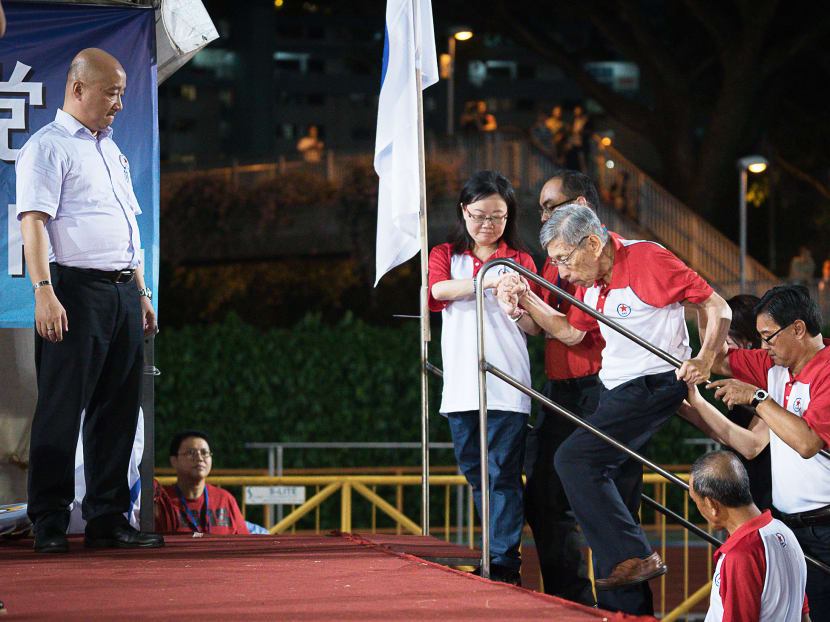
The pressing need for self-renewal has never been more real, especially for parties with ageing chiefs. Despite getting on in years, the SPP’s Mr Chiam, 81, has yet to name a successor to head the SPP.
And while the WP’s Mr Low, who turns 60 this year, has identified the three NCMPs as the “future leadership core” of his party, the party chief has remained tight-lipped about his successor.
Refreshing leadership is an integral step, stressed SPP founder Sin Kek Tong.
“The younger generation, with good education and rationality, know what it means to do renewal. How is Mr Chiam going to renew now, when he hasn’t done so for many years?”
Former NSP secretary-general Tan Lam Siong pointed out that Opposition parties are generally weak in terms of manpower and finances, and only someone with a “deep and strong affiliation” with the party would willingly shoulder the burden of running it.
“He or she would have invested and sacrificed a great deal of personal time, energy and money in the party over the years. The party gradually evolves into his or her alter ego and it is not difficult to see why the process of leadership renewal can never be an easy thing,” he said.
The entrenchment of a party chief ends up becoming a double-edged sword, as RSIS’ Dr Chong puts it. A charismatic leader is needed to unite the party, and clamp down on discordant voices. But too much control can easily tip the scales, as “people will see that this is not what they signed up for”, he said.
Added NTU’s Asst Prof Woo: “This is typical of political parties that are not as institutionally developed, and hence require the presence of a charismatic leader in order to garner support.”
What does renewal constitute? A steady stream of talent and ample opportunities to shine were givens, but analysts and politicians also warned of a danger to avoid: Rigging the process of renewal to entrench oneself.
Said the PPP’s Mr Goh: “Renewal is a very sexy word to use. In the process of renewal, there’s a lot of politicking — replacing veterans with younger ones who are more supportive to maintain their power base.”
One way to prevent this would be to modify the cadre system, he suggested. Instead of having the CECs appoint cadres, the cadres themselves could be given the power to expand their ranks.
At 46, the PPP’s Mr Goh is one of the youngest party chiefs around, but he is already making plans for succession.
“It takes about one to two elections for new people to be experienced in running a party. If you are 60, and still cannot find anyone to take over, you are in a position of short notice.”
Asked whether the next generation of politicians were ready to take the Opposition to the next level, Mr Goh said no. Mr Yaw Shin Leong had the “best shot”, with charisma, organisational skills and a clear grasp of policies. “Charisma is something that you can’t teach. Now I don’t see any suitable replacement and it‘s a really worrying sight,” he said.
Other analysts were hard pressed to name up-and-coming young politicians, but recurring names included the WP’s Mr Perera and Dr Goh.
Asst Prof Woo pointed to the example of the PAP, which, as a more mature party, had set up “strong internal institutions and processes” to facilitate the transfer of power.
“It is also less dependent on the role of any particular politician and takes a team-based approach instead, hence diluting the potential for personality-driven politics,” he said. “Indeed, a move from individuals to institutions is necessary for political development at any level of politics.”
Former WP treasurer Eric Tan added: “At the end of the day, the party must be bigger than the leader. Cadres and members must be able to grow the party to the next stage.”
Stay in the know. Anytime. Anywhere.

Subscribe to our newsletter for the top features, insights and must reads delivered straight to your inbox.
By clicking subscribe, I agree for my personal data to be used to send me TODAY newsletters, promotional offers and for research and analysis.






