
Biggest success may lie in nurturing habit to speak up, listen
Inclusiveness is one of the most important qualities of public deliberation. As a national-level public engagement exercise, the Our Singapore Conversation (OSC) needs to be a space where as many representative voices as possible are heard, taken seriously and engaged with openly. This gives the people of Singapore a basis for regarding its discussions and decisions as legitimate.
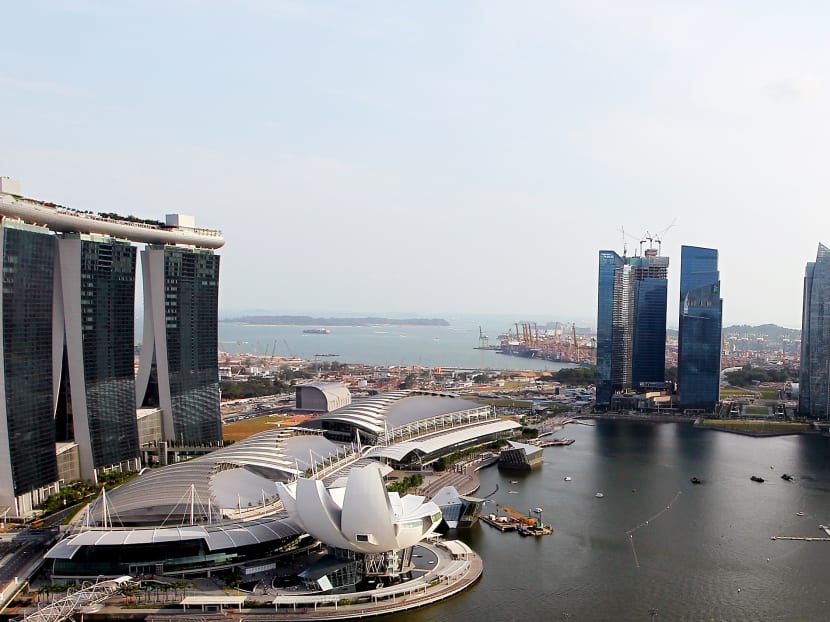
Archive: Singapore Business Park, Marina Bay sands. MBS, Singapore skyline..Photo: Ernest Chua. August 2011.

Inclusiveness is one of the most important qualities of public deliberation. As a national-level public engagement exercise, the Our Singapore Conversation (OSC) needs to be a space where as many representative voices as possible are heard, taken seriously and engaged with openly. This gives the people of Singapore a basis for regarding its discussions and decisions as legitimate.
When I was first introduced to the OSC, I thought that it had begun on the wrong foot. Its claim to inclusiveness was compromised, at least in terms of the composition of its committee, by the unmistakable exclusion of opposition politicians, prominent activists and public intellectuals known for their more controversial views.
Nevertheless, I accepted the invitation to volunteer on its committee with the hope of contributing positively to a process that was, even with the best of intentions, bound to be complicated for political as much as practical reasons.
I later understood that the OSC’s idea of “inclusiveness” was actually tied to its efforts to engage with Singapore’s “silent majority”, a borrowed term that originates from the ideologically partisan world of American politics.
THE INVENTED ‘SILENT MAJORITY’
On one level, the silent majority is a romanticised construct. Projected onto the political landscape, it is an imaginary image of a mass of people whose views, interests and values are somehow authentic, moderate and conservative, but whose voices remain unheard. Lacking the motivation, the ability or the courage to speak in the public sphere, the silent majority is unable, maybe just unwilling, to raise its voice above the more articulate, often agitated, and sometimes shrill tones of a “vocal minority”.
On another level, the silent majority and vocal minority are ideological constructs, an invented dualism that enables politicians to assume moral authority by claiming to protect the “moderate” interests of a majority against the “extremism” of sectarian interests. Politicians around the world have often taken the liberty of speaking on behalf of the so-called silent majority. Through tokenistic gestures, some politicians have invited the participation of acceptable people they claim to be representative of this silent majority.
An invented silent majority can thus become a useful ideological resource for justifying resistance to pressures for change, while maintaining political paternalism without sacrificing democratic credentials.
It is therefore hardly surprising that the notion of the silent majority should emerge in Singapore as a counterpose to the recent rise of anti-establishment views expressed especially well in the alternative media.
But if it seeks to engage the silent majority while visibly excluding the so-called vocal minority, the OSC runs the risk of becoming an ideological instrument of the political establishment. Given the sharpened critical sensibilities of the public today, this will not go unmissed. In the worst case, it will lead, at the end of the year-long process, to cynicism, political divisiveness, and an erosion of public trust and social capital.
REMOVE BARRIERS TO ENTRY
So rather than target an imaginary group of Singaporeans, a less divisive approach might be to focus on removing barriers to entry and enriching the quality of public engagement when it happens.
While structured citizen dialogues and sharing sessions may be among the most efficient modes of engaging Singaporeans and extracting information and insights from each conversation, the formal nature of these activities may actually turn off those who communicate better in a vernacularised and less directed way. They could also be intimidating for people who are not used to standing up to make an argument, supporting it and then defending it against the criticisms of others.
It is clear to me that the organisers have been extremely mindful of this challenging problem and have creatively employed a range of devices to stimulate dialogue and imagination, for instance, by introducing the element of “play” in the design and facilitation of these discussions.
And yet, Singaporeans can also be a very practical people impatient for results. They might prefer to get to the point in a more results-driven discussion. If the OSC does not efficiently record their concerns and yield the best ideas for policy-making, participants may disengage, convinced that the whole exercise is a waste of time.
But what we really need, beyond organising a mechanism for collective decision-making, is to enrich the quality of public life, impoverished by decades of political paternalism and the kind of political apathy that is said to have resulted from material success and affluence.
To do this, we need to create new spaces, practices and even rituals for public engagement and citizen activity — spaces that are non-intimidating, authentic to the diverse groups of Singaporeans, whose identities and interests are increasingly complex, and motivated as much by citizens themselves as they are by centralised committees.
Instituting the habit of public participation and nurturing the skills to do this well are, in my view, a more important contribution of the OSC than recording the aspirations that will feature in the final report. The enrichment of public life helps us build social capital. With more social capital, we can better build on Singapore’s successes and transcend the worst forms of polarisation and the excesses of populism.
This is not to say, of course, that we should be blindly conformist in our individual contributions to the common good. But rather than get entangled in deliberative knots, public discourse should rise above conventional wisdoms and platitudes that can emerge from both the establishment and anti-establishment. The success of the OSC, far beyond the technical achievements of its final report, will partly be defined by this.
ABOUT THE AUTHOR:
Kenneth Paul Tan, an OSC committee member, is Associate Professor and Vice-Dean (Academic Affairs) at the National University of Singapore’s Lee Kuan Yew School of Public Policy. This commentary first appeared in the OSC publication, Reflections.
Related topics
OSCStay in the know. Anytime. Anywhere.

Subscribe to our newsletter for the top features, insights and must reads delivered straight to your inbox.
By clicking subscribe, I agree for my personal data to be used to send me TODAY newsletters, promotional offers and for research and analysis.






