
Bone tissue scaffolds make their way into dental clinics
SINGAPORE — Small in size, a tiny bone tissue scaffold is taking on a bigger role in dental procedures here. The bio-scaffold, made of biocompatible polymers, is placed into the gap left by tooth extractions, which then helps the bone to grow back.
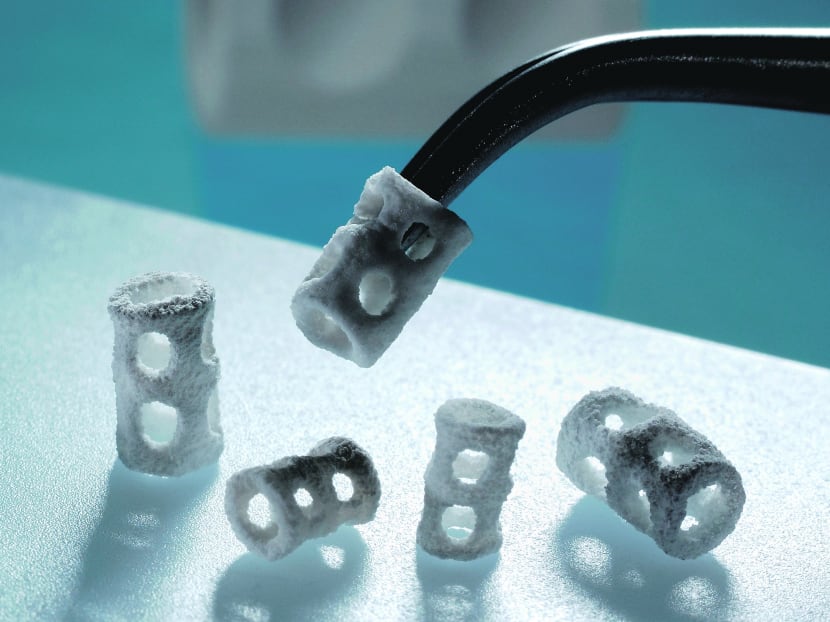
The bio-scaffold, which resembles a tiny cylinder with holes, allows natural bone formation within the tooth socket and will dissolve in the body within two to six months. Photo: A*STAR

SINGAPORE — Small in size, a tiny bone tissue scaffold is taking on a bigger role in dental procedures here. The bio-scaffold, made of biocompatible polymers, is placed into the gap left by tooth extractions, which then helps the bone to grow back.
About 123 dental clinics in Singapore are now active users of these bio-scaffolds, which are smaller than the size of a tooth. They are currently available in Taiwan and the United Kingdom, with plans to introduce them to India this year and Europe by next year.
The Bio-Scaffold International (BSI), a biomedical technology company incorporated in Singapore in 1999, collaborated with the Singapore Institute of Manufacturing Technology (SIMTech) and the National University of Singapore to design and develop the scaffold, called Bioscaff Alvelac, for dental application. SIMTech is a research arm under the Agency for Science, Technology and Research.
The bio-scaffolds, which were printed with 3D printing technology, were brought up by Prime Minister Lee Hsien Loong during the National Day Rally on Sunday as an example of how “technology will transform our lives”.
“We have 3D printing, a machine which can print spare parts, print models, print toys, print pistols, print body parts, organs; print things which can make a difference to our lives,” he said.
Earlier this year, the Government had announced that it will invest S$500 million over five years to boost Singapore’s advanced manufacturing technologies, which include those for the 3D printing industry.
A spokesperson with the Economic Development Board added: “With 3D printing technologies, manufacturing plants may be able to produce complex and unique products, which would not be possible through conventional means.”
The porous bio-scaffold, which resembles a tiny cylinder with holes, is placed snugly in the tooth socket after tooth extraction. It allows natural bone formation within the socket and will dissolve in the body within two to six months.
Proper bone growth is important for tooth implants in later stages as implants need a bone base to hold the tooth steady.
According to the BSI, the bio-scaffolds were launched for “market testing and feedback” in 2009 to 2010 and were launched commercially in April this year after strengthening the scaffold, among other changes. Each scaffold costs around S$40 and is sold directly to dentists, who then recommend it to their patients.
Beyond dental implants, BSI said it is looking to expand this technology to cosmetology and orthopaedics “by leveraging on the strengths of its partner research institutes and academia”.
Meanwhile, SIMTech said it is “now building capabilities in 3D printing of ceramic and titanium scaffolds”.
Stay in the know. Anytime. Anywhere.

Subscribe to our newsletter for the top features, insights and must reads delivered straight to your inbox.
By clicking subscribe, I agree for my personal data to be used to send me TODAY newsletters, promotional offers and for research and analysis.






