
Bucking industry trend, electric taxi operator HDT plans to bump up fleet
SINGAPORE — Amid rapid developments in the taxi industry causing most players to shrink their fleet in the last few months, electric taxi operator HDT is going the other direction by eyeing a multifold expansion in the next four years.
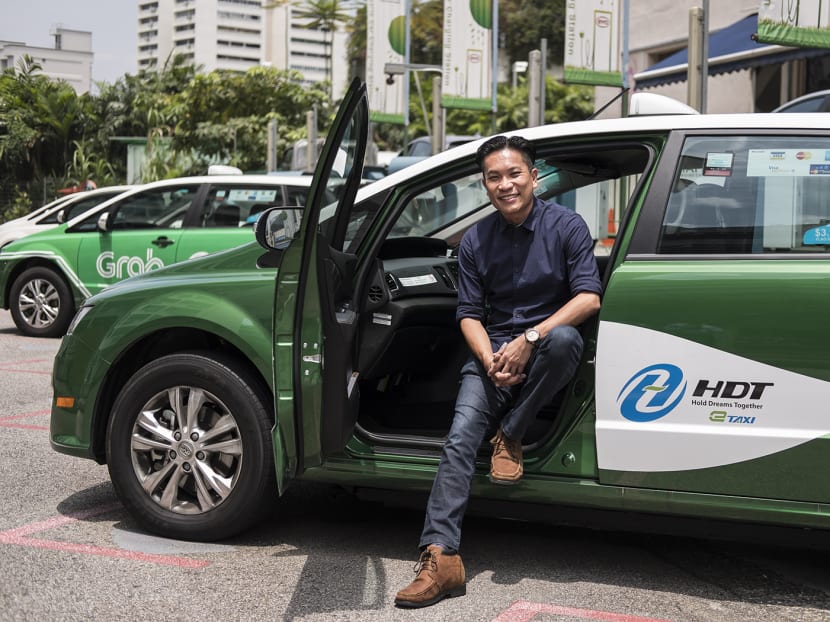
HDT intends to add 800 taxis to its 100 on the streets so as to achieve economies of scale, said Mr James Ng, the managing director of HDT Singapore Holding, the parent company of the taxi arm. Photo: Nuria Ling/TODAY



SINGAPORE — Amid rapid developments in the taxi industry causing most players to shrink their fleet in the last few months, electric taxi operator HDT is going the other direction by eyeing a multifold expansion in the next four years.
The company, which started operations last year, intends to add 800 taxis to its 100 on the streets so as to achieve economies of scale, said Mr James Ng, the managing director of HDT Singapore Holding, the parent company of the taxi arm.
But it will first have to secure a taxi service operator licence from the Land Transport Authority; it aims to file papers by the end of the year. The 100 cabs it currently has are operating under a special licence as part of an eight-year government test-bed looking into the viability of electric-vehicle business models.
Noting that its present 100-strong fleet was “too small”, Mr Ng, 45, said the company needs to expand to be sustainable, given the infrastructure costs involved. It has 67 charging stations islandwide and is looking to add more, including several in western and central Singapore.
Mr Ng said demand for point-to-point transport is outstripping supply and continues to grow — also on the company’s books are 30 private-hire electric vehicles.
Today, 60 to 70 per cent of its drivers’ takings come from Grab rides. Street hails and corporate bookings make up the rest but flagdowns have tumbled by as much as 30 to 40 per cent since last year, Mr Ng told TODAY.
When asked how the company plans to recruit drivers if its application to expand is approved, Mr Ng said it would continue outreach to prospective cabbies at the Singapore Taxi Academy, such as those undergoing refresher courses. Referrals from its drivers also help, he added.
The company will have to add nearly 300 charging stations to accommodate the 800 extra taxis, so that drivers will find a charging point within a 4km to 5km radius, down from 10km now, he said.
HDT’s electric taxis can travel nearly 400km after a full charge, which takes one-and-a-half hours.
The downtime remains a concern among drivers, said Mr Ng, but arranging a charge around a driver’s mealtimes and breaks have helped minimise this.
Mr Ng noted that enquiries about its taxis remain strong, with about 15 cabbies on its waitlist.
Unlike other taxi operators, which rent taxis to drivers, HDT is the first taxi operator here to offer its drivers, who do not pay rent, a basic salary of S$1,600 with benefits, such as Central Provident Fund (CPF) contributions and annual leave. With overtime pay, drivers can earn up to S$2,800.
On top of that, drivers who reach certain revenue targets will earn bonuses. Good performers are eligible for “revenue-sharing” — for instance, those who bring in between S$7,500 and S$8,500 will take home S$450, before CPF.
Earnings go to HDT, but the company allows drivers to retain incentives dished out by ride-hailing app Grab.
Last month, the company rolled out schemes for relief drivers and part-time employment to ease the strain on cabbies who drive less, but also keep up revenues for the firm.
These “win-win” schemes could come in handy when it enlarges its fleet, said Mr Ng.
In August, there were 24,863 taxis in Singapore — the lowest in more than seven years. Every taxi operator except Premier Taxis saw its fleet shrink since January.
Despite the downward trend in the industry, National University of Singapore transport researcher Lee Der-Horng noted several factors that could work in HDT’s favour.
For one, partnering with Grab, which gives its drivers a steady stream of riders, allows HDT to ride on the reach of the ride-hailing company.
An alliance with China-based BYD, which manufactures its taxis, also means HDT most likely gets its vehicles at a “very competitive” price, added Prof Lee.
Compared with diesel, running cabs on electricity could also bring down operating costs, said Prof Lee. Mr Ng told TODAY the cost of running a taxi on electricity is about half that of operating a diesel cab.
Prof Lee said HDT’s business model could also be a “game-changer”. As drivers are assured a baseline wage, they should be “adequately inspired” to hit the roads to keep revenue flows going.
Transport economist Walter Theseira of the Singapore University of Social Sciences noted that the lack of drivers, amid an oversupply of vehicles, was a limiting factor for taxi and private-hire car firms.
However, it boils down to how operators woo drivers.
“It does appear that offering a regular wage could help make the taxi-driving job more attractive to people who don’t want the risk of having an irregular income,” he said.
Stay in the know. Anytime. Anywhere.

Subscribe to our newsletter for the top features, insights and must reads delivered straight to your inbox.
By clicking subscribe, I agree for my personal data to be used to send me TODAY newsletters, promotional offers and for research and analysis.






