
Bus drivers can now opt for shorter shifts
SINGAPORE — In a bid to draw more Singaporeans and Permanent Residents (PRs) into the starved stable of public bus drivers here, SMRT has introduced a new scheme allowing drivers to opt for shorter shifts.
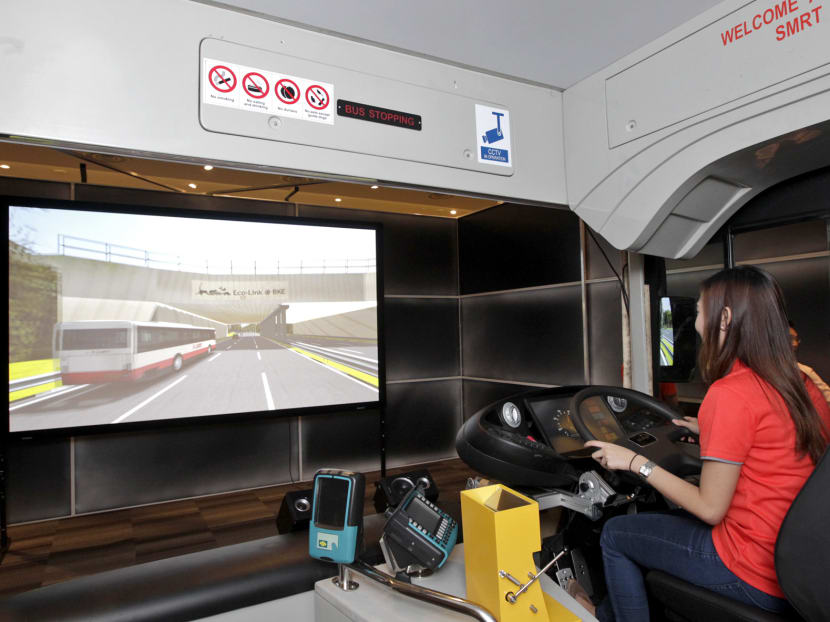
General public trying out the Integrated Driving and Service Control simulator on Sept 12, 2014. Photo: Wee Teck Hian

SINGAPORE — In a bid to draw more Singaporeans and Permanent Residents (PRs) into the starved stable of public bus drivers here, SMRT has introduced a new scheme allowing drivers to opt for shorter shifts.
Besides removing the long-standing grouse of the long, hard hours on the road, which have kept locals away from the industry, the public transport operator also hopes to spruce up the appeal of a bus driver’s career through the flexi-work arrangement.
Under a new partnership that SMRT penned with the Employment and Employability Institute (e2i), a first-ever bus career development centre will be established by the second quarter next year, which will allow recruits to try their hands at different roles as they climb the career ladder, such as service controllers, whose job is to plan and deploy bus services.
SMRT runs a quarter of the public bus services in Singapore, while SBS Transit runs the rest. Currently, SMRT has 1,200 buses in its fleet, while SBS has more than 3,300 buses.
Noting that “onerous“ working hours has made it difficult to recruit new drivers, SMRT president and chief executive officer Mr Desmond Kuek said the scheme will allow the organisation to “tap into a larger resource base in the population”.
“The bus captain career is a physically challenging one and we do have a shortage of bus captains to meet the growing demand for public buses. We hope that those who are not keen to work a full day, but are willing to take on part-time driving arrangements, will come and join us,” said Mr Kuek.
Under the flexi-work scheme, employees who are Singaporean and PRs can choose to work for four to five hours either in the morning or night, or only work on weekends, but for eight to nine hours. TODAY understands that SBS Transit does not have a similar scheme.
Bus drivers TODAY spoke to welcomed the move, but noted that the appropriate salary is important.
School-bus driver Ng Ee Peen said he will consider the scheme as part of his “retirement plan”. “I might take it up in a few years’ time, when my sons are older and I can take a break from full-time driving — if the timings and payouts are good,” said the 52-year-old, who works from 5am to 7.30pm on weekdays.
Mr Anilan, director of private bus service Bus Hub, said flexible working hours will appeal to retirees. “Not many want to do this on a full-time basis anymore because you have to start very early in the morning.”
At the bus career development centre, which is housed in e2i’s Devan Nair campus in Jurong and is open to both public and private operators, there will also be eight life-size driving simulators where trainees can practise driving along different bus routes in Singapore. Settings can be changed to allow them to experience challenging scenarios such as traffic jams and unpleasant weather conditions.
Currently, bus drivers are trained on the roads, but have little cross-training on different bus types and few opportunities to drive under varied road conditions. SMRT chief executive Mr Kuek said this technology will help drive the industry “towards better safety and bus service reliability for all commuters”.
The centre will also chart the different career progression pathways for bus drivers, such as in management and operation.
To that end, the centre will have two desktop control stations for service controllers to hone their skills in planning and deploying bus services, and one station to train prospective instructors.
Stay in the know. Anytime. Anywhere.

Subscribe to our newsletter for the top features, insights and must reads delivered straight to your inbox.
By clicking subscribe, I agree for my personal data to be used to send me TODAY newsletters, promotional offers and for research and analysis.






