
Bus service reliability scheme off to a good start
SINGAPORE — The two-year pilot scheme to improve bus reliability got off to a smooth start today (Feb 3), with commuters whom TODAY spoke to generally observing less “bunching” — multiple buses arriving at the same time — at the bus stops.
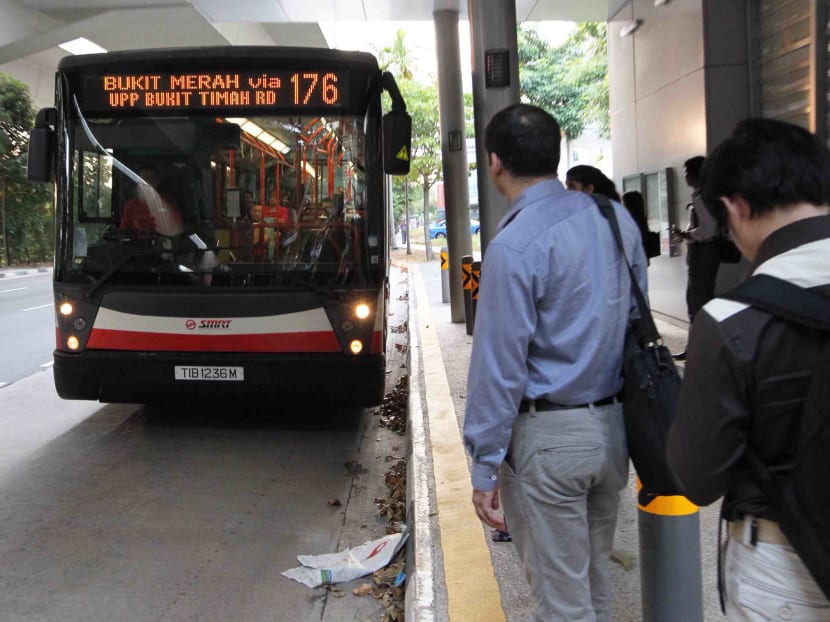
Commuters say they observe less “bunching” at bus stops on the first day of a pilot scheme to improve bus reliability. Photo: Ooi Boon Keong


SINGAPORE — The two-year pilot scheme to improve bus reliability got off to a smooth start today (Feb 3), with commuters whom TODAY spoke to generally observing less “bunching” — multiple buses arriving at the same time — at the bus stops.
But they also observed slower bus speeds and longer travelling times on some of the services involved in the scheme, such as 188 and 176 — which could be due to the drivers trying to stick closely to their designated arrival times.
Commuter Chua Yeng Hian, who was at Pasir Panjang Road this morning, told TODAY that service 188 experienced no bunching — a common occurrence previously, especially during peak hours.
Recalling his past experience, Mr Chua, 27, said: “For certain bus stops, there were quite a lot of people who got on the bus. Subsequently, a whole train of buses will be stuck at the same bus stop.”
The buses’ arrival times, however, still appeared to be irregular: Between 8.40am to 9.50am, service 188 arrived in 2 to 10-minute intervals at bus stops near Mapletree Business City and PSA Building, while service 176 buses arrived at the same bus stops at 8 to 16-minute intervals.
At one point, two service 188 buses were seen less than one bus stop apart. The bus behind, however, drove slowly enough to avoid bunching at the bus stop outside PSA Building.
The Bus Service Reliability Framework (BSRF) is aimed at improving the reliability of bus services and tackling a common commuter complaint: Long and irregular waiting times at bus stops.
The scheme, which started today with seven SMRT buses, will eventually involve 22 bus services from both SMRT and SBS Transit by the first half of the year.
It assesses the regularity of a bus service through the Excess Wait Time (EWT) — the gap between actual and scheduled wait times.
Monetary incentives and penalties are in place to get public bus operators to ensure that their buses arrive on time. Under the framework, the operators stand to gain up to S$6,000 for every 0.1 minute reduced from previously recorded waiting times of 22 bus services.
For each 0.1-minute deviation from their scheduled arrivals at the bus stop, they will be fined up to S$4,000. The incentives and penalties will apply only from June, to give the operators time to adapt.
As part of the BSRF, bus operators could give guidance to their drivers, even while they are on the road, in order to regulate travelling speeds and reduce long gaps in waiting times between consecutive buses.
Entrepreneur Christian Ihre, 46, was one of those who noticed slower bus speeds. He was on service 188 to One Fullerton when he decided to alight outside Mapletree Business City.
“It was driving so slowly I thought it would take forever — I better take the MRT,” said Mr Ihre, who has been taking the same bus regularly for the past four months.
Transport Minister Lui Tuck Yew told Parliament last month that the BSRF is intended to get buses to arrive at bus stops at more regular intervals and is unlikely to encourage unsafe driving behaviour.
He said the onus on meeting standards will fall on back-end operations staff as they have to monitor the situation on the ground, direct the bus captains and decide whether to inject more buses when necessary.
Mr Lui also explained that the problem of bus bunching will be alleviated by having buses slow down to even out arrival times, instead of speeding up.
Bus drivers are notified via computer screens installed in the buses, which provide information such as the extent to which they are behind or ahead of schedule.
One 37-year-old driver, who has been driving for nine years, felt that the framework makes driving safer. With advice given by the operations staff, he can avoid speeding up too much when he falls behind schedule during peak-hour traffic.
However, two other drivers told TODAY that the arrival schedules are difficult to meet during peak hours when roads are clogged with vehicles.
Long boarding and alighting times of commuting crowds, heavy traffic and road works slow down bus speeds, they said. One driver added that despite slowing down and running behind schedule, his bus could still end up bunching with the one ahead of him.
The 40-year-old driver said: “During peak hours, bunching is common. It is not that drivers purposely want to be late. Sometimes, it can’t be helped.”
Stay in the know. Anytime. Anywhere.

Subscribe to our newsletter for the top features, insights and must reads delivered straight to your inbox.
By clicking subscribe, I agree for my personal data to be used to send me TODAY newsletters, promotional offers and for research and analysis.






