
Challenger’s delisting faces roadblock as minority shareholder group puts up fight
SINGAPORE — IT retailer Challenger looks to be facing an uphill battle in its privatisation deal, as a faction of shareholders has come out to say it is poised to block the move in a critical vote later this month.
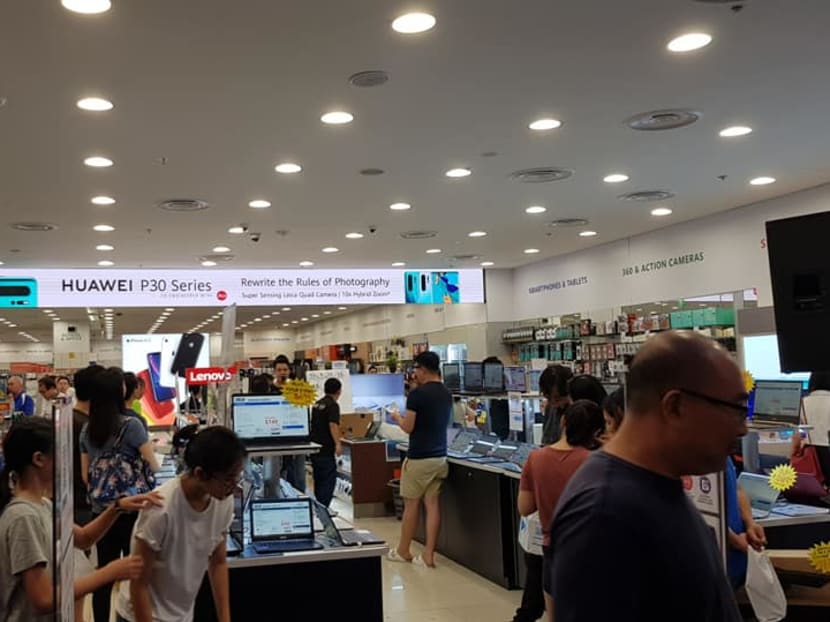
IT retailer Challenger plans to delist from the Singapore Exchange but a group of minority shareholders has come out to say it is poised to block the move when it comes to a vote on June 27.



SINGAPORE — IT retailer Challenger looks to be facing an uphill battle in its privatisation deal, as a faction of shareholders has come out to say it is poised to block the move in a critical vote later this month.
On Wednesday (June 12), the homegrown company announced that it has received a final cash exit offer by Digileap — a partnership between the Loo family that founded Challenger and Dymon Asia Private Equity — at 56 cents apiece, equal to a net offer of 54 cents after dividends are paid out.
This price is final, said Digileap in a statement to the media. Challenger, in a separate filing to the Singapore Exchange (SGX) the same day, also called for shareholders to vote yes to the buyout at an extraordinary general meeting on June 27.
But they face a hurdle: A breakaway bloc of minority shareholders, led by Pangolin Investment Management, have argued that a fair valuation for the share buyback should come at S$1.15, more than twice the offer price.
With the votes more than two weeks away, the battle lines have already been drawn.
The Loo family and majority shareholder Ng Leong Hai, who want to delist, hold 78.64 per cent of the company’s total shares.
Collectively, the opposing group only holds 9.8 per cent, Pangolin’s director James Hay told TODAY.
But he believes there will be enough to block the deal eventually. At least 75 per cent of shareholding must approve the delisting and not more than 10 per cent of shareholding can oppose it in order for the company to return to private hands.
“Ten per cent is enough to formally reject this offer and we’ll easily get this. Digileap are wasting time and money proceeding at 54 cents,” said Mr Hay, a Briton.
WHY DELIST, AND AT WHAT PRICE
On March 20, Challenger announced its intention to delist from the Singapore bourse. Among the reasons given:
The stock has hardly moved in recent years. Between 2018 and 2019, only about 38,501 Challenger shares were traded on average each day — just 0.011 per cent of the total number of Challenger shares on the market.
Challenger has not carried out any exercise to raise cash funding since 2007, and does not need to access Singapore’s capital market to do so in the foreseeable future.
A listing on SGX will incur compliance costs, and the company wants to make better use of its funds.
That same day, Digileap offered to buy Challenger at 56 cents per share. Challenger’s shares are currently trading at around 55 cents. A third party appointed by Challenger — Deloitte & Touche Corporate Finance — said 56 cents is a “fair and reasonable” offer.
Deloitte & Touche’s report, released on Wednesday, concluded that:
The 56 cents offer exceeded the highest closing price of the shares since May 2014.
The offer is 8.5 per cent higher than Challenger’s average share price in the past month, and 15.1 per cent higher han its average price over the past year.
The deal also represents an “attractive premium” of 101.2 per cent over Challenger’s latest publicly available net asset value at March 31.
However, Pangolin believes that Challenger is undervalued. It said that a fair value for Challenger is S$1.15, based on the company’s cash flow to shareholders and dividend payouts in previous years.
It released a report shortly after Challenger’s March announcement that slammed the low price as a raw deal for minority shareholders.
Pangolin senior analyst Kok Chiew Sia told TODAY on Wednesday: “Based on the cash returns to shareholders, we had worked out that the company’s shares should be valued above S$1, not 54 cents, which is barely half of what we calculated."
Mr Hay added: “If it goes through at such a derisory low price and in the light of our research and recommendations, (the move) will benefit (the Loo family) and Dymon and not the minorities who have supported Challenger over the years.”
THE INTRIGUE BEHIND THE DELISTING DEAL
But Challenger chief executive Loo Leong Thye said that Pangolin had, in 2017, offered to sell its stake in the IT retailer at just 43.5 cents a share.
“I began exploring the possibility of a delisting after receiving two unsolicited offers from minority shareholder Pangolin Investment Management to sell its stake — the first offer was received in October 2017 wherein Pangolin offered to sell its stake at S$0.435 per share, and the second offer was received in March 2018 and did not state the price at which Pangolin would be willing to sell its shares,” said Mr Loo in a statement.
The Digileap director also said that rather than transact with Pangolin alone, he wanted to make an offer to all shareholders and began looking for a partner to start this process.
But Pangolin said they were only “pondering the exit of our investment” in 2017 and had wanted to sound out the company on whether they had a buyer.
“The pondering was a result of frustration, not with the operational running of the business, but the drag on shareholder returns as a result of the company holding too much cash and non-core investments. The value has always been apparent within Challenger, as was the case then and as is the case now,” said Mr Hay.
Ms Kok said that when Pangolin made its offer in October, it assumed that if the sale were to proceed, it would be at the prevailing market value of 43.5 cents per share.
Sometime in end-2017, they realised that Mr Loo had started to buy up Challenger shares on the open market, said Ms Kok. So Pangolin reached out to Mr Loo, to ask if he wanted theirs, but received no reply.
This was what Mr Loo perceived as a second offer, which was simply untrue, she added. TODAY has reached out to Digileap to respond to Pangolin’s claims.
Eventually, Challenger announced its intention to delist at 56 cents a share and Pangolin went public with its disapproval. Several minority shareholders responded to its call to vote no to the delisting resolution.
While Pangolin owns only a 2.94 per cent stake of Challenger, its camp now represents a 9.8 per cent bloc within the company, with some shareholders buying new shares on the open market to increase the bloc’s voting power.
Digileap has not been idle too, purchasing a 1 per cent stake in the company — or 3,427,100 shares — at 56 cents each from March 21 to April 12.
If the delisting vote fails, Digileap said the exit offer will lapse and it will not be able to make another offer for a year.
But in a year’s time, the battle lines could change, said Ms Kok. The Singapore Exchange Regulation (SGX RegCo) will likely be changing the delisting rules and removing the 10 per cent block provision, which could mean that any opposition by those holding over 10 per cent of total issued shares will no longer matter.
On the other hand, offerors and concert parties -- such as Digileap in this case -- may not longer be allowed to vote too.
“We have a strong hand in voting down the delisting at the extraordinary general meeting now,” she said.
Related topics
Challenger delisting SGXStay in the know. Anytime. Anywhere.

Subscribe to our newsletter for the top features, insights and must reads delivered straight to your inbox.
By clicking subscribe, I agree for my personal data to be used to send me TODAY newsletters, promotional offers and for research and analysis.






