
Changi Airport’s ground handlers can take up to 375,000 tonnes of temperature-sensitive cargo yearly, including Covid-19 vaccines
SINGAPORE — After some months of work at Changi Airport, the air cargo hub said on Tuesday (Dec 8) that it is now ready to distribute Covid-19 vaccines into Singapore and to the region once the vaccines are approved.
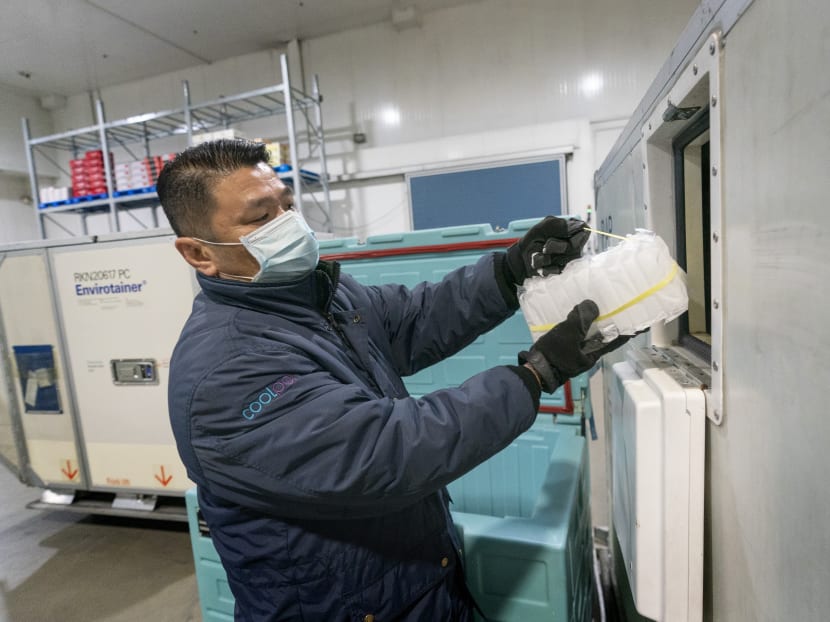
An employee from airport ground handler Sats' Coolport packing dry ice slabs into temperature-controlled containers as secondary packaging.



- A task force was set up to look at potential problems transporting Covid-19 vaccines
- Some of these vaccines must be kept in ultra-cold temperatures
- Changi Airport ground handlers have the ability to keep vaccines cold through transit
- The airport is confident that capacity will not be an issue
SINGAPORE — After some months of work at Changi Airport, the air cargo hub said on Tuesday (Dec 8) that it is now ready to distribute Covid-19 vaccines into Singapore and to the region once the vaccines are approved.
Mr Ho Yuen Sang, director of aviation industry at the Civil Aviation Authority of Singapore (CAAS) and co-lead of the Changi Ready Taskforce, said: “We have good cold chain handling infrastructure and capabilities.
“With our strong air connectivity and SIA’s (Singapore Airlines’) fleet of more than 200 passenger aircraft, we can deliver vaccines to multiple destinations according to demand.”
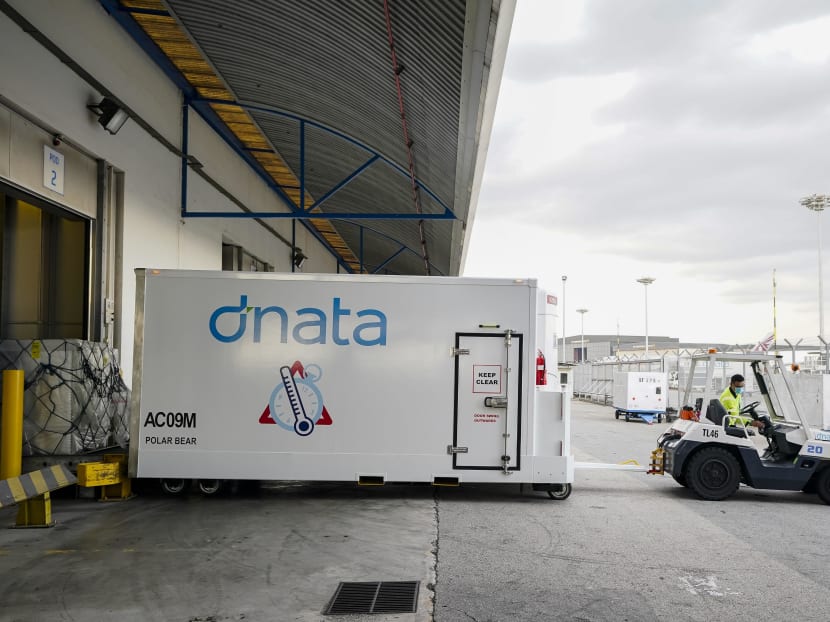
The two ground handlers at the airport, Dnata and Sats, can together handle up to 375,000 tonnes of temperature-sensitive goods a year and have the capability to monitor and ensure the security of these shipments.
The Changi Ready Taskforce, co-led by CAAS and Changi Airport Group (CAG), was set up about two months ago to identify and address potential challenges faced in transporting the vaccines against a coronavirus that has killed more than 1.5 million worldwide.
It brought together various players including logistic partners, airport ground handlers, SIA and government agencies to work out the processes needed, which is proving to be a tricky logistical challenge.
Mr Lim Ching Kiat, CAG’s managing director for air hub development, said that work into transporting vaccines had already begun in the last few years, even before the pandemic.
“Changi Airport has, especially in the recent years, become the key preferred hub for pharmaceutical shipments,” Mr Lim said at a media briefing on Tuesday. He is the second co-lead of the Changi Ready Taskforce.
With its network to more than 80 destinations including to Europe and the United States where many of the vaccine manufacturing sites are located, the airport hopes to be able to transport the vaccine into Singapore and to other regions in Southeast Asia and Australia.
LOGISTICAL PREPARATIONS
The announcement comes on the day Britain became the first Western country to start inoculating its general population with a vaccine developed by pharmaceutical companies Pfizer and BioNTech.
The vaccine needs to be stored at -70°C.
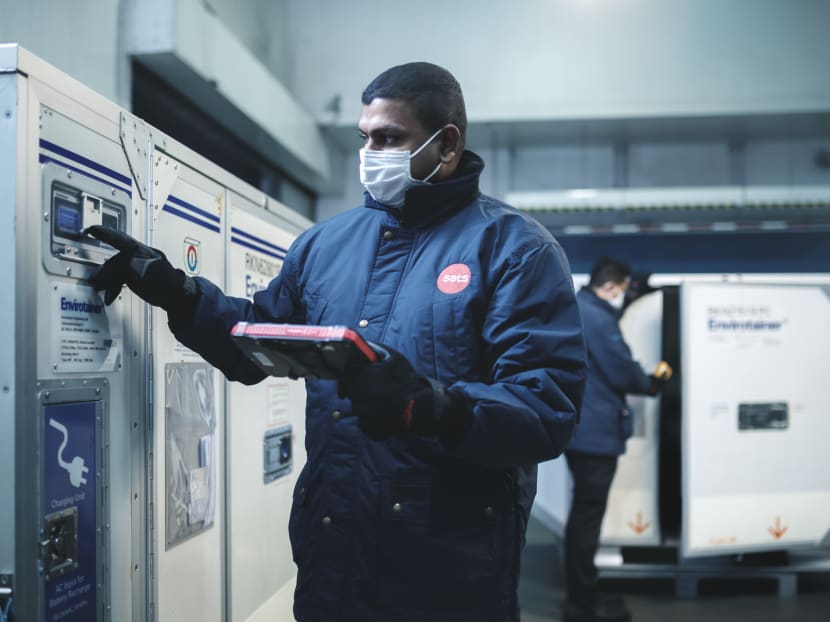
One of the challenges that infectious disease experts have repeatedly emphasised is having to preserve vaccines in the tropical heat for countries within Southeast Asia, so ground handlers had to invest in ways to keep the “cold chain’ intact by ensuring the cargo remains cold in transport.
American pharmaceutical firm Moderna is another frontrunner in developing a vaccine, which requires -20°C for storage but keeps for a month at refrigerator temperatures.
These requirements have pushed cargo handlers here to improve their ability to handle temperature-sensitive goods.
In recent months, Changi Airport’s ground handlers have invested in cool dollies, which are temperature-controlled containers used to store and carry shipment from the aircraft to warehouses.
Dnata’s and Sats’ warehouses, which together cover more than 9,000 sqm, can go down to -25°C.
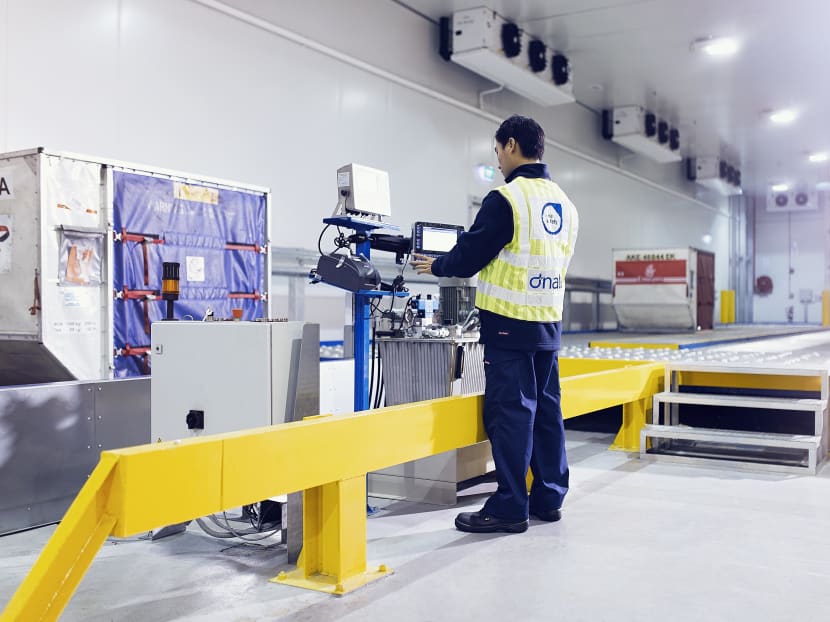
Mr Nazri Othman, senior vice-president of cargo services at Sats, said that the journey from aircraft to warehouse takes less than half an hour and consignees should already be ready to collect the cargo from the warehouses even before the aircraft has landed.
HUMANITARIAN SUPPORT
SIA’s senior vice-president for cargo Chin Yau Seng said that the airline is well-positioned to capture the demand for vaccines. “We also recognise the need for humanitarian support.”
When asked whether SIA will still fly out the vaccines if it incurs losses for the airline, he said: “We are still a commercial entity, we do need to cover our cost. Having said that, we think we will be able to do this in the right conditions.”
SIA said on Saturday that it has gotten seven Boeing 747-400 freighters ready and is making necessary arrangements for its passenger aircraft fleet to be deployed on cargo operations.
Mr Dirk Goovaerts, Dnata’s regional chief executive officer for the Asia-Pacific region, said that with the rush for vaccines, there might be a slowdown in delivery of other temperature-sensitive goods such as fresh produce and other medical products.
“We have to make sure that the vaccine is the priority,” he added. “It’s just about prioritising more than diverting (supply).”
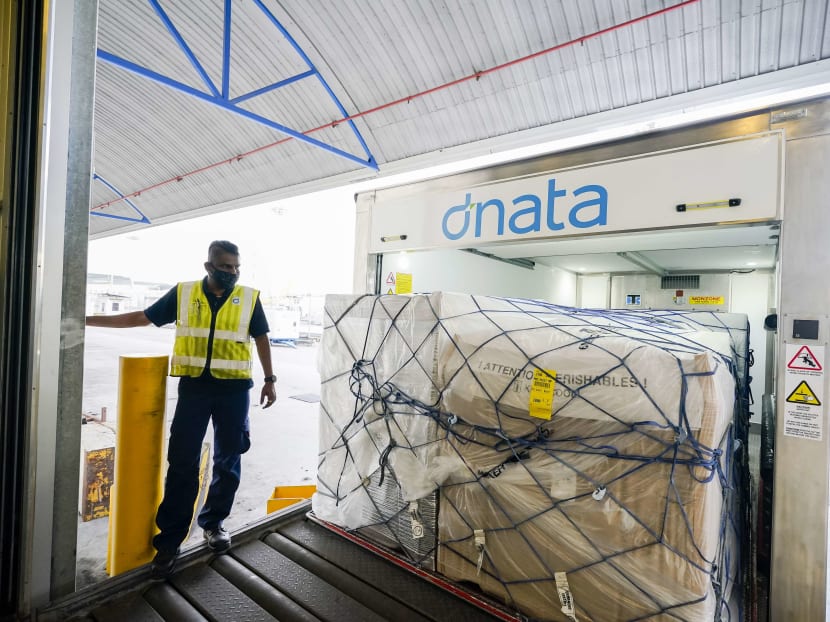
The Changi Ready Taskforce was unable to give estimates for the volume of Covid-19 vaccines that can be handled by the airport daily at this point of time.
However, Mr Lim is certain that the demand for vaccines can be met in Singapore and in the region.
“We are sufficiently confident that the air hub capacity won’t be a constraint. The constraint may emerge upstream in other parts, (such as) for manufacturers getting their shipment ready,” he told TODAY.
“But we can always do better. What Covid-19 has taught us is that we stay humble and that there can always be unforeseen (circumstances).”
Related topics
air cargo hub Covid-19 coronavirus vaccine coronavirus Changi AirportStay in the know. Anytime. Anywhere.

Subscribe to our newsletter for the top features, insights and must reads delivered straight to your inbox.
By clicking subscribe, I agree for my personal data to be used to send me TODAY newsletters, promotional offers and for research and analysis.






