
China’s e-commerce titans prepare for Singles Day battle
HONG KONG — Alibaba and JD.com are taking the battle for shoppers’ wallets to everything from the seasonal delicacy hairy crabs to luxury labels as China’s e-commerce titans prepare to face off on Singles Day. The brainchild of Alibaba, Singles Day turned the anti-Valentine’s Day on November 11 into the biggest frenzy of consumption in the retail calendar. It worked: last year consumers spent US$18 billion (S$24.5 billion), triple the US$5.9 billion spent on Black Friday, Cyber Monday and Thanksgiving combined in the United States. “It has tremendous staying power,” says Alibaba vendor John McPheters, co-founder and chief executive of streetwear retailer Stadium Goods. “I think we’ll see much more 11.11 Singles Day activity in the US as it continues to grow.” The day is one of the biggest engines in China’s economy. Shoppers spent US$750 billion online last year, roughly equivalent to the annual economic output of the Netherlands. Goldman Sachs reckons that will double to US$1.7 trillion by 2020. Chinese consumers are responsible for almost half of all online shopping, according to research consultancy eMarketer. JD.com has sought to counter rival Alibaba’s superior clout — with more than 500 million shoppers it has roughly double JD.com’s 258 million — by stitching up data-sharing deals with some of China’s biggest tech groups. These include Tencent, the social media group with almost 1 billion users on its WeChat service; Baidu, which runs China’s dominant search engine; news aggregator Toutiao; Tencent-backed search engine Sogou, and NetEase. JD.com has some 50 such deals, allowing it to target individual customers. For example, someone reading news about young children on Toutiao can be targeted with nappies. Both companies are also offering subsidies to merchants and couriers. Alibaba’s logistics arm Cainiao is spending 1.5 billion yuan (S$300 million) on subsidies, while JD.com is reportedly shelling out 2.1 billion yuan. “The scale of the face-off with JD.com needs watching,” writes Bhavtosh Vajpayee, analyst at Bernstein Research in a report. “Small discounts across Alibaba’s 500 million-plus customer base can start adding up quickly if the competitive jostling gets out of hand.” An earlier battle over hairy crabs demonstrated the lengths to which the duo go. JD.com set up warehouses to shorten the supply chain, while one of Cainiao’s partners kitted themselves out with 40 refrigerated trucks to ensure multiple deliveries. Both promised to reimburse customers if the crustaceans were dead on arrival. Similarly, the two companies are pushing into the luxury sector, with JD.com setting up a standalone “white gloves” service and buying into cultish e-commerce site Farfetch. “Mass-market categories such as consumer products are already saturated on these sites, so they are branching out into other sectors such as luxury,” says Ms Liz Flora, who heads up Asia Pacific Research at digital agency L2. Platforms are also making a play for top-performing merchants, wooing them with incentives such as site placements and discounts. This year 40-odd brands have reportedly ditched JD.com to sell exclusively on Alibaba’s platforms. While Alibaba is widely expected to reveal a figure that comfortably surpasses last year’s Singles Day sales figure, “the number itself is not the primary objective”, says Mr Jason Ding, a partner with consultancy Bain & Company. The controversial criteria used to measure sales on the day are the subject of a long-running probe by the US Securities and Exchange Commission. Analysts have also questioned the numbers, suggesting they have been inflated by “brushing” — the practice of merchants sending out empty packages to boost their rankings. Mr Ding points to Alibaba’s move from e-commerce to “new retail” — a blend of online and offline shopping. “That will be the new trend going forward, so 11.11 in the original format is not that relevant any more,” he says. FINANCIAL TIMES
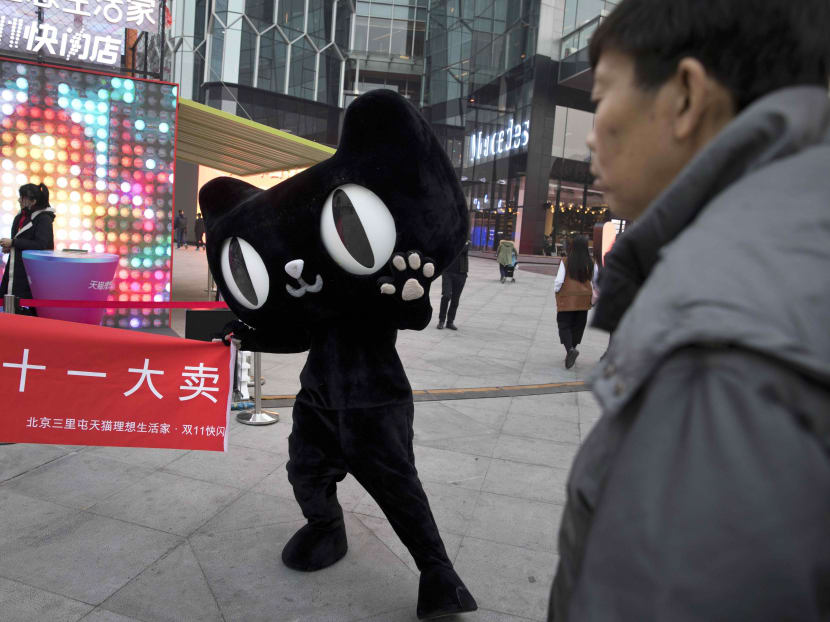
A mascot for Tmall, an online shopping website owned by Alibaba, holds up a banner with the word "Double 11 big sale" during an event to promote Singles Day in Beijing on Monday, Nov 6, 2017. Photo: AP
HONG KONG — Alibaba and JD.com are taking the battle for shoppers’ wallets to everything from the seasonal delicacy hairy crabs to luxury labels as China’s e-commerce titans prepare to face off on Singles Day.
The brainchild of Alibaba, Singles Day turned the anti-Valentine’s Day on November 11 into the biggest frenzy of consumption in the retail calendar.
It worked: last year consumers spent US$18 billion (S$24.5 billion), triple the US$5.9 billion spent on Black Friday, Cyber Monday and Thanksgiving combined in the United States.
“It has tremendous staying power,” says Alibaba vendor John McPheters, co-founder and chief executive of streetwear retailer Stadium Goods. “I think we’ll see much more 11.11 Singles Day activity in the US as it continues to grow.”
The day is one of the biggest engines in China’s economy. Shoppers spent US$750 billion online last year, roughly equivalent to the annual economic output of the Netherlands. Goldman Sachs reckons that will double to US$1.7 trillion by 2020.
Chinese consumers are responsible for almost half of all online shopping, according to research consultancy eMarketer.
JD.com has sought to counter rival Alibaba’s superior clout — with more than 500 million shoppers it has roughly double JD.com’s 258 million — by stitching up data-sharing deals with some of China’s biggest tech groups. These include Tencent, the social media group with almost 1 billion users on its WeChat service; Baidu, which runs China’s dominant search engine; news aggregator Toutiao; Tencent-backed search engine Sogou, and NetEase.
JD.com has some 50 such deals, allowing it to target individual customers. For example, someone reading news about young children on Toutiao can be targeted with nappies.
Both companies are also offering subsidies to merchants and couriers. Alibaba’s logistics arm Cainiao is spending 1.5 billion yuan (S$300 million) on subsidies, while JD.com is reportedly shelling out 2.1 billion yuan.
“The scale of the face-off with JD.com needs watching,” writes Bhavtosh Vajpayee, analyst at Bernstein Research in a report. “Small discounts across Alibaba’s 500 million-plus customer base can start adding up quickly if the competitive jostling gets out of hand.”
An earlier battle over hairy crabs demonstrated the lengths to which the duo go. JD.com set up warehouses to shorten the supply chain, while one of Cainiao’s partners kitted themselves out with 40 refrigerated trucks to ensure multiple deliveries. Both promised to reimburse customers if the crustaceans were dead on arrival.
Similarly, the two companies are pushing into the luxury sector, with JD.com setting up a standalone “white gloves” service and buying into cultish e-commerce site Farfetch.
“Mass-market categories such as consumer products are already saturated on these sites, so they are branching out into other sectors such as luxury,” says Ms Liz Flora, who heads up Asia Pacific Research at digital agency L2.
Platforms are also making a play for top-performing merchants, wooing them with incentives such as site placements and discounts. This year, 40-odd brands have reportedly ditched JD.com to sell exclusively on Alibaba’s platforms.
While Alibaba is widely expected to reveal a figure that comfortably surpasses last year’s Singles Day sales figure, “the number itself is not the primary objective”, says Mr Jason Ding, a partner with consultancy Bain & Company.
The controversial criteria used to measure sales on the day are the subject of a long-running probe by the US Securities and Exchange Commission.
Analysts have also questioned the numbers, suggesting they have been inflated by “brushing” — the practice of merchants sending out empty packages to boost their rankings.
Mr Ding points to Alibaba’s move from e-commerce to “new retail” — a blend of online and offline shopping. “That will be the new trend going forward, so 11.11 in the original format is not that relevant any more,” he says. FINANCIAL TIMES
Stay in the know. Anytime. Anywhere.

Subscribe to our newsletter for the top features, insights and must reads delivered straight to your inbox.
By clicking subscribe, I agree for my personal data to be used to send me TODAY newsletters, promotional offers and for research and analysis.






