
Civil activists, website editor object to using laws to tackle online falsehoods
SINGAPORE — The Select Committee studying online falsehoods on Tuesday (Mar 27) took issue with articles written by The Online Citizen’s chief editor and a freelance journalist, while the journalist — along with two other witnesses giving oral evidence — disagreed with government survey findings which showed strong public support for strengthening laws to deal with the spread of false information.
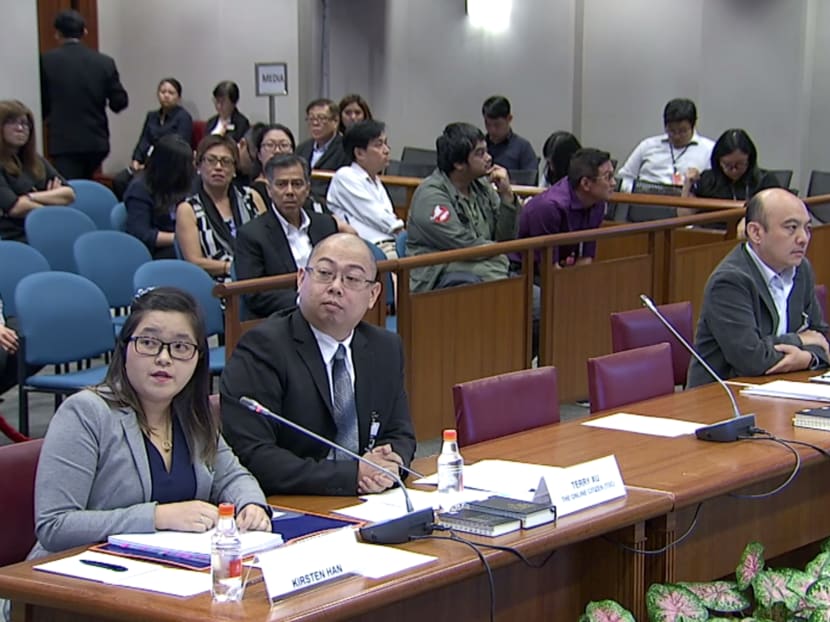
Ms Kirsten Han, a freelance journalist, and Mr Terry Xu, The Online Citizen’s chief editor, attend the sixth day of the public hearings on online falsehoods on March 27, 2018. Photo: Parliament

SINGAPORE — The Select Committee studying online falsehoods on Tuesday (Mar 27) took issue with articles written by The Online Citizen’s chief editor and a freelance journalist, while the journalist — along with two other witnesses giving oral evidence — disagreed with government survey findings which showed strong public support for strengthening laws to deal with the spread of false information.
The witnesses also argued against the need for legislation in tackling online falsehoods.
.embed-container { position: relative; padding-bottom: 56.25%; height: 0; overflow: hidden; max-width: 100%; } .embed-container iframe, .embed-container object, .embed-container embed { position: absolute; top: 0; left: 0; width: 100%; height: 100%; }Mr Edwin Tong, a member of the committee and Member of Parliament (MP) for Marine Parade GRC, questioned Mr Terry Xu on The Online Citizen’s articles on the death of teenager Benjamin Lim, noting that parts of those articles were at odds with the police statement at the time of the incident. Benjamin had jumped to his death after being questioned by the police over an alleged case of molest, and his case sparked a public debate on how police interviews with young people should be handled.
When pressed by Mr Tong on whether he would take down or update the articles, Mr Xu said that he does not have a practice of going back to change the articles. He would do so if the authorities reached out to him or if he could view camera footage of the police interview to back up the authorities’ statement.
Mr Tong also asked about an article that Ms Kirsten Han wrote on the Public Order and Safety (Special Powers) Bill in the Asia Times, which he said had partially cited a provision in the bill and was possibly misleading to readers.
Ms Han, a freelance journalist who is also a civil activist, disagreed with his opinion, adding that they both interpreted that portion in the article differently.
Mr Tong raised these issues with them given their roles as “content providers”. Mr Xu said that he does not call himself a journalist, but agreed that he has to do his due diligence to publish what “is correct as (of) what (he) knows”.
The committee’s exchanges with Mr Xu and Ms Han lasted about five hours on the sixth day of the public hearings, which began on March 14 at Parliament House.
The Select Committee, which is made of 10 MPs, had invited close to 80 individuals and organisations to give evidence and views at the ongoing sessions.
Other witnesses on Tuesday included Mr Ngiam Shih Tung, the vice-president of civil society group Maruah, and PhD student Howard Lee.
NOT CONVINCED BY SURVEY FINDINGS
At the hearing, the group of witnesses were also asked about the findings of a Reach survey released on Monday (March 26).
The survey from the government feedback unit had found, among other things, that about 80 per cent of the respondents had supported tightening laws to stem the spread of false information. The majority of those surveyed (92 per cent) also wanted to have more effective laws that require those who publish fake news to remove or correct the inaccurate information.
Ms Han, Mr Ngiam and Mr Lee disagreed with the findings. They said that they were concerned about how the questions in the survey were phrased, how “fake news” was defined, and other issues.
The committee also asked them about examples of false or offensive content found on social media sites, and if those content warranted requests for social media companies to take down the content.
Ms Han said that while governments are well within their rights to engage these companies on the content they find problematic, she cautioned against passing laws that would allow the governments to be arbiters what should or should not be allowed..
Freedom of expression came up during the exchange as well, such as when Ms Han was asked about blogger Amos Yee’s posts and if those posts should be taken down.
She said that while she would not publish those views herself, Mr Yee’s views did not meet the international standards of what is considered incitement of harm.
Mr Tong asked Ms Han to clarify if she was saying that no action should be taken regardless of whether the content led to the incitement of religious feelings or could harm destruction of property, loss of lives, for instance.
“I never said nothing should be done. I believe there should be engagement,” she replied. Saying that she is not advocating absolute freedom of speech or expression, she added: “What I counsel against is further legislation that would police content. I think it should always be tied to serious harm and incitement of harm, and that’s usually the international... generally held standard on hate speech. It has to have incitement of violence or some harm.... And the wounding of religious feeling is very far below that standard.”
LONGEST HEARING AT 11 HOURS
Earlier in the day, Law and Home Affairs Minister K Shanmugam weighed in on the exchanges, clarifying that the discussion with the committee involves factual falsehoods, not opinions and comments.
The marathon hearing on Tuesday — which spanned 11 hours in total, the longest so far — saw social worker Jolovan Wham appearing as the last witness to give oral evidence.
At around 9pm, Mr Wham was asked by Mr Tong to confirm his position — as reflected in his written representations — that “fake news” does not pose a credible threat to Singapore. Mr Wham agreed that he was still unconvinced that there is a problem with online falsehoods, despite earlier evidence given by other witnesses during the public hearings.
Marine Parade GRC MP Seah Kian Peng, who was chairing the session, then asked if any of the committee members — there were three others left by then — had questions for Mr Wham.
With no further questions, Mr Seah thanked Mr Wham for his patience and said his turn has ended — less than 10 minutes after Mr Wham took his seat at the witness table. This prompted Mr Wham to ask: “Is that all?” He pointed out that he had waited for his turn since 2pm and “came all dressed for this” by donning a suit for the first time in years.
While Mr Wham said that he had questions for the committee, Mr Seah reiterated that the hearing was for the committee to ask witnesses questions, and the members would answer his questions “in due course”.
Stay in the know. Anytime. Anywhere.

Subscribe to our newsletter for the top features, insights and must reads delivered straight to your inbox.
By clicking subscribe, I agree for my personal data to be used to send me TODAY newsletters, promotional offers and for research and analysis.






