
CNB officer jailed 1.5 years for switching man’s urine sample with his own to avoid paperwork
SINGAPORE — When Central Narcotics Bureau (CNB) officers asked a man to take a urine test at Woodlands Checkpoint, he pleaded for leniency, saying he might fail it since he had inhaled second-hand methamphetamine fumes earlier.
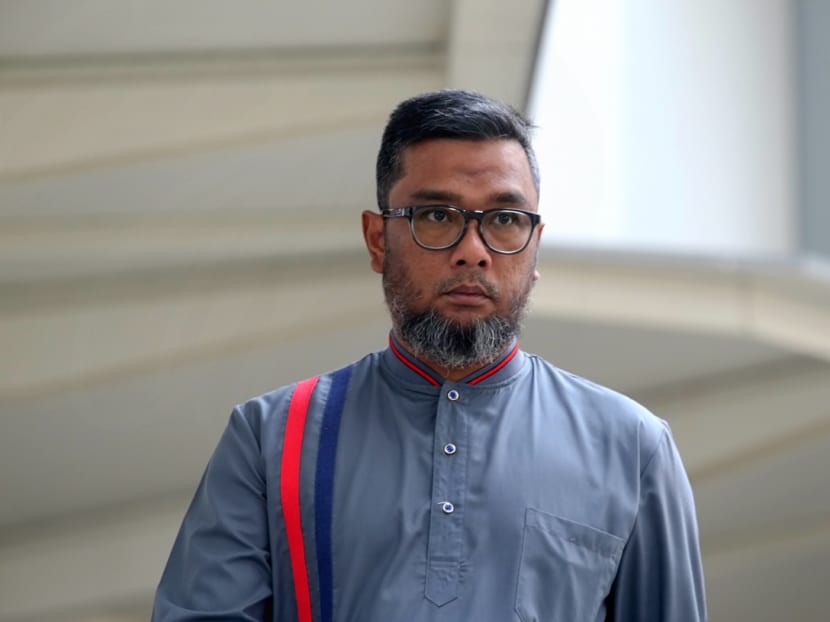
Staff Sergeant Mohamed Hafiz Lan in a photo taken in October 2019.



- Staff Sergeant Mohamed Hafiz Lan agreed to the plot with two colleagues
- They had an uncooperative detainee and wanted to process his case quickly
- The officers were caught when the man was detained again and confessed
- The officers have been suspended without pay since July last year
SINGAPORE — When Central Narcotics Bureau (CNB) officers asked a man to take a urine test at Woodlands Checkpoint, he pleaded for leniency, saying he might fail it since he had inhaled second-hand methamphetamine fumes earlier.
Staff Sergeant Mohamed Hafiz Lan then agreed to switch the man’s urine sample with his own — all to avoid preparing the paperwork to charge the man with an offence.
On Monday (Aug 3), the CNB officer of 21 years was sentenced to one-and-a-half years behind bars. He pleaded guilty to a single charge of conspiring to obstruct justice by tampering with the urine sample.
Two other CNB officers — Staff Sergeant Abdul Rahman Kadir and Sergeant Muhammad Zuhairi Zainuri — were charged alongside him last year. Their cases are still pending.
In response to TODAY’s queries, a CNB spokesperson said that all three have been suspended from work without pay since July last year.
“The CNB does not condone any act of misconduct by our officers, and takes a serious view of any complaint or allegation of impropriety about our urine testing processes,” the spokesperson added.
The three officers committed the offence on Aug 15, 2018, the court heard on Monday.
As part of their duties, they administered instant urine tests to suspected drug consumers. CNB officers then had to register such offenders’ particulars in the system.
WHAT HAPPENED
At about 9pm that day, Immigration and Checkpoints Authority (ICA) officers stopped Maung Moe Min Oo, a Singaporean, and a 26-year-old Thai woman at Woodlands Checkpoint as they were entering Singapore.
A swab test revealed that both could have taken drugs earlier that day. ICA then referred the duo to CNB.
Maung declined to give a urine sample and asked to speak to Abdul Rahman privately.
The officer took him to an interview room, where he asked for Abdul Rahman to help him pass the urine test.
He told Abdul Rahman that he might fail it since he “had been in a room with someone smoking methamphetamine and may have inhaled some of the fumes”, Deputy Public Prosecutor (DPP) Thiagesh Sukumaran told the court.
The truth was that Maung had taken methamphetamine earlier that day.
While Abdul Rahman and Maung discussed the matter, Zuhairi, who was in the room, left and told Hafiz that Maung did not appear to be cooperating.
DPP Thiagesh said: “Knowing the process to procure urine from Maung might take some time, Zuhairi suggested to Hafiz that they could tamper with Maung’s urine sample by switching it with another sample.
“This would expedite the out-processing of Maung’s departure from the CNB office with no further action against Maung.”
Hafiz agreed and both officers went to a toilet at the CNB office.
Zuhairi left an empty bottle inside the toilet and looked for a used one in the rubbish bin in the toilet, then threw it away in a bin outside the toilet before walking off.
This was meant to give the impression that Zuhairi had discarded the bottle he took into the toilet — the toilet entrance was covered by a closed-circuit television camera.
Hafiz then urinated in the empty bottle and added water to it before leaving it in a cubicle.
Abdul Rahman later escorted Maung out of the interview room, telling him to take this as a “second chance” and that he did not want to see him again.
Hafiz and Abdul Rahman then spoke separately. Abdul Rahman told Hafiz that Maung was “cunning” and Hafiz responded: “You know what to do.”
Later, both officers escorted Maung to the toilet.
On Hafiz’s instructions, Maung transferred Hafiz’s urine sample to three other bottles.
When Maung tested negative for any drugs during the instant urine test, he left Singapore with the Thai woman, whose urine sample also tested negative.
However, Maung re-entered Singapore the next day and was detained again by a different CNB team. He told them that Abdul Rahman helped him pass the urine test the previous night.
Maung was eventually admitted to the Drug Rehabilitation Centre for consuming a specified drug.
‘VERY SERIOUS AND GRAVE MISTAKE’
DPPs Thiagesh and Navin Naidu sought the sentence imposed, noting that Hafiz and his colleagues play an “integral role in enforcing Singapore’s anti-drug policies”.
“Given how critical their law enforcement role is, there is a serious impact on society and the credibility of the CNB when their officers act in dereliction of duties which undermine the very laws they are empowered to uphold,” they told the court.
They also argued that the offence was planned, premeditated and amounted to a serious obstruction of justice. It was “purely fortuitous” that Maung was caught the next day at Woodlands Checkpoint, they added.
In mitigation, Hafiz’s lawyer Amarick Gill — who sought 12 to 15 months’ jail — said that his client understood that he had committed a “very serious and grievous mistake”.
Mr Gill added that Zuhairi and Hafiz “did not want to put up with preparing the paperwork to charge Muang for failing to provide a urine sample”.
Mr Gill also said that Hafiz had an exemplary record at CNB, but DPP Navin noted that he had “certain disciplinary-related transgressions” but did not elaborate.
In sentencing Hafiz, District Judge Ow Yong Tuck Leong said that law enforcement officers who commit offences in the course of duty can expect to receive heavier sentences, even if they did not gain financially.
Hafiz could have been jailed up to seven years or fined, or both.
Related topics
court crime CNB ICA drugs urine testStay in the know. Anytime. Anywhere.

Subscribe to our newsletter for the top features, insights and must reads delivered straight to your inbox.
By clicking subscribe, I agree for my personal data to be used to send me TODAY newsletters, promotional offers and for research and analysis.






