
Coming to a supermarket near you: Made-in-Singapore strawberries
SINGAPORE — Ideally suited for a cooler climate with temperatures between 16°C and 27°C, strawberries are hard to grow here — until now.
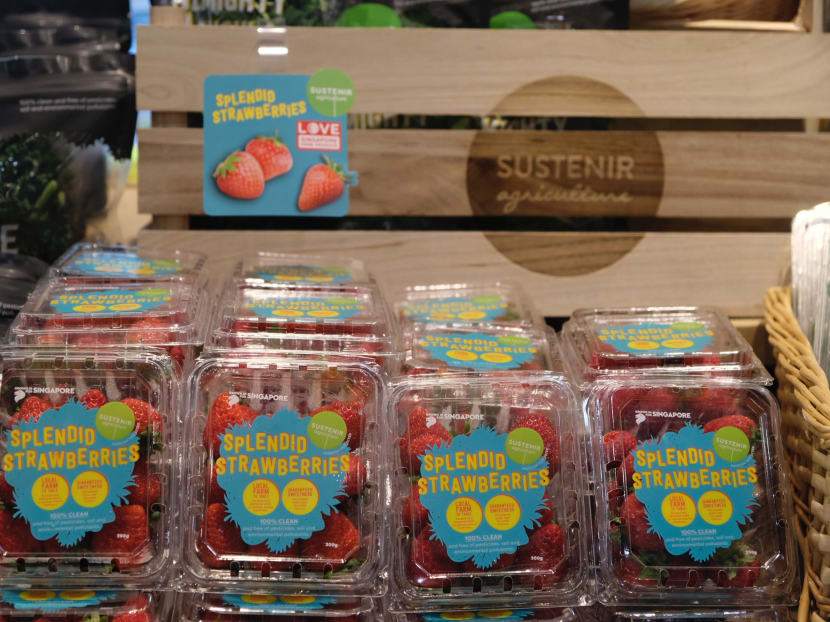
Singapore start-up Sustenir has managed to produce strawberries in Singapore, on a commercial scale, and in a controlled indoor environment.

SINGAPORE — Ideally suited for a cooler climate with temperatures between 16°C and 27°C, strawberries are hard to grow here — until now.
In what is touted as a first in the country and the region, a Singapore start-up Sustenir has managed to produce strawberries on a commercial scale, in a controlled indoor environment.
Buoyed by its success, the enterprise has set its sights on made-in-Singapore grapes and even wine.
Speaking at the launch of its research and development lab at JTC Launchpad in one-north on Wednesday (June 20), Mr Benjamin Swan, 37, co-founder and chief executive officer of Sustenir, said: "The sky is the limit to this because, effectively, we can grow anything indoors."
The strawberries are now sold at selected Cold Storage supermarkets and online grocer RedMart at S$12 for a 200g packet, and Mr Swan said that there may be plans to sell them at more shops in the heartlands.
The fruit is produced using patented technology, which allows Sustenir to maximise its output in land-scarce Singapore, to grow more with less.
For example, a traditional farm can grow an average of 140 tonnes of leafy greens in one hectare of land, but Sustenir can produce 2,100 tonnes in the same space using 95 per cent less water.
A typical farm also takes about seven to eight weeks to grow strawberries from the plant stem using regular farming methods, but Sustenir can do so in under six weeks.
Its vertical farm at Sembawang — which is certified under the food safety management systems scheme, ISO 22000 — has been cultivating other non-native vegetables such as kale and arugula (rocket) since 2014, and can now produce about 800kg of strawberries monthly all year round. Plans are afoot to double the size of its 54sqm strawberry farm.
Mr Swan, a former UOB and Citibank banker before he co-founded Sustenir, said that because its products are cultivated in "perfectly clean conditions that are free from pesticides, contaminated soil and any form of haze or air pollution from outside", there is no need to wash its fruits and vegetables before consumption, and they can last for two weeks when refrigerated.
While the firm took just two months to research and cultivate its first batch of strawberries, but pollination — which usually happens with bees outdoors — was a challenge.
Pollination is now done manually, but the company is looking to introduce bees indoors, and perhaps from there, even create "100 per cent clean honey", Mr Swan said.
He stressed that Sustenir is not out to compete with Singapore farmers for staple vegetables and fruits. "We can grow bok choy and so forth locally, but do we want to grow (bok choy) here indoors or outdoors? Of course not. What we are doing is focusing on imported products."
It is this same imported-produce-first strategy that Sustenir is taking to Hong Kong, where it will open a vertical farm in the third quarter of this year.
He added: "We are going as far as the more medicinal products. Take TCM (Traditional Chinese Medicine). We are working with NUS (National University of Singapore), for example, so that we can extract the enzymes out of (nutrient-rich) kale, a superfood to help with (the well-being of) cancer patients."
POTENTIAL FOR MASS-MARKET PRODUCE
On Wednesday, Sustenir also launched the sale of its strawberries at Cold Storage's new one-north outlet.
When asked about the S$12-per-200g price of its strawberries, Mr Swan said that they are "very competitive" compared with the South Korean varieties, for instance.
An online site sells strawberries from South Korea for S$11.60 per 330g box, while a 250g box of strawberries from the United States costs S$6.50 at Cold Storage.
Dr Koh Poh Koon, Senior Minister of State for Trade and Industry, who was present at the launch event, was asked if urban farmers are limited to producing just high-value fruits and vegetables.
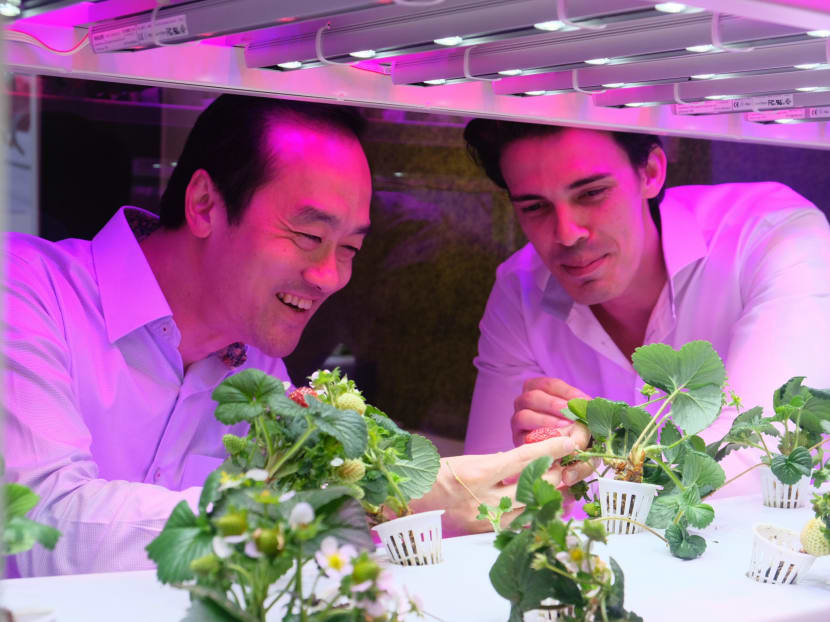
He noted that the technology has the potential for other common vegetables such as bok choy to be grown locally for commercial use.
"Strawberries is one of those varieties that we would not have imagined possible growing in Singapore. But for a controlled environment, by manipulating the growth conditions, we see that strawberries are now possible.
"If you know how to grow strawberries in an indoor environment, you know how to manipulate conditions, I think it will not take a big leap for (urban farmers) to switch to more mass-market vegetables like bok choy, for example," Dr Koh said.
"It's only left to our imagination to see how (urban farmers) can capitalise on this to do more with less and get ourselves more fruits, and be self-sufficient."
Stay in the know. Anytime. Anywhere.

Subscribe to our newsletter for the top features, insights and must reads delivered straight to your inbox.
By clicking subscribe, I agree for my personal data to be used to send me TODAY newsletters, promotional offers and for research and analysis.






