
Conserve historic Dakota Crescent estate, MP urges Govt
SINGAPORE — Lamenting the rapid loss of familiar buildings and neighbourhoods in Singapore, Member of Parliament Lim Biow Chuan has urged the government to reconsider its plans for redeveloping the historic Dakota Crescent estate.
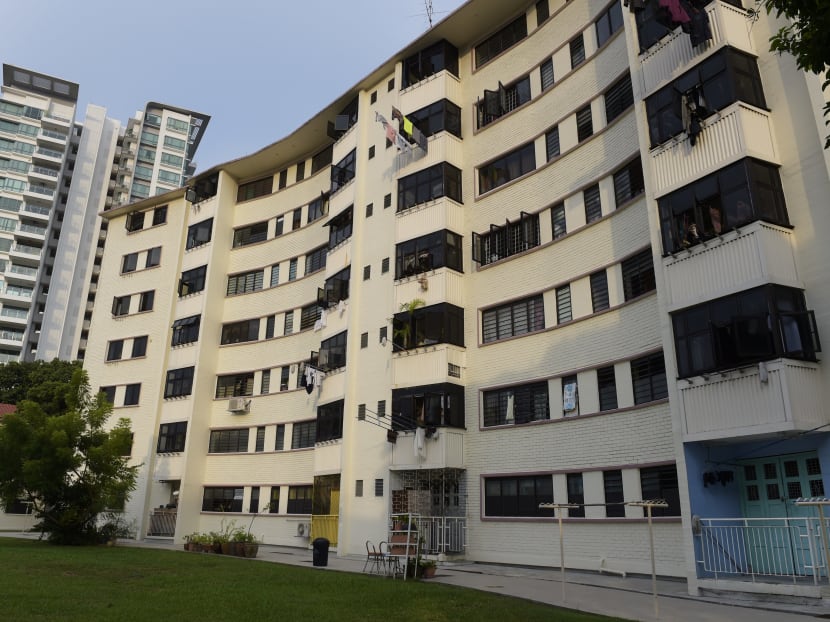
TODAY file photo

SINGAPORE — Lamenting the rapid loss of familiar buildings and neighbourhoods in Singapore, Member of Parliament Lim Biow Chuan has urged the government to reconsider its plans for redeveloping the historic Dakota Crescent estate.
Built in 1958 as one of Singapore’s earliest attempts at public housing and named after a plane that had crashed at Kallang Airport, Dakota Crescent comprises 17 blocks of low-rise flats. Fifteen of the 17 blocks have been ear-marked for redevelopment, and existing residents have to relocate by the end of the year.
“The fact that this estate is older than Singapore is a cause for celebration and should be an important consideration for conservation,” Mr Lim said in Parliament on Monday (Oct 10) as he proposed a motion to conserve Dakota Crescent.
He is the MP for Mountbatten constituency, which includes Dakota Crescent. In his speech, Mr Lim spoke about how the buildings he grew up with have been — or will soon be — demolished. The old National Library at Stamford Road, where he spent countless hours reading as a child, was demolished in 2005 to make way for Fort Canning Tunnel. The iconic, multi-coloured flats at the Rochor Centre, where he lived from 1977 to 1990, will soon be torn down to make way for the North South Expressway.
Mr Lim said: “I recognise that Singapore needs to progress and development has to take place. However, when Singaporeans experience loss of too many familiar buildings, familiar places of entertainment and environment, there will be this sense of loss of roots, a loss of emotional attachment to Singapore.
“One of my concerns is that when a Singaporean leaves the country to work or study for a few years, when he returns, the place becomes unrecognizable because new buildings keep sprouting up and older buildings get demolished.” NMP Kok Heng Leun rose to support Mr Lim’s motion, citing how residents and other Singaporeans who wanted to preserve Dakota Crescent have rallied together and even produced their own proposal for the estate’s conservation.
“(This) is exactly what the government has always been looking for: grounds-up initiatives with a bold vision,” added Mr Kok. “This proposal requires us to work with many different communities within and outside of Dakota, to redevelop the place into something inclusive, yet deeply respectful of the heritage and community of Dakota Crescent.
According to Mr Lim, the report, which had been prepared for the Urban Redevelopment Authority and the National Heritage Board, had good suggestions on how Dakota Crescent could be re-developed for use by arts groups, social enterprises, or as rental flats for couples waiting for their Build-To-Order flats. In his response, Senior Minister of State for Home Affairs and National Development Desmond Lee said the Government has always been mindful of striking the right balance “between preserving our past, and catering to the needs of the present and the future”.
He added that the Ministry of National Development has placed more emphasis on the conservation of buildings over the years as an integral part of Singapore’s urban master plan, noting that the Republic has 70 national monuments and 7,000 conserved buildings currently. “In the case of Dakota Crescent, we recognise that the area holds special memories for many people who grew up there,” said Mr Lee.
“And that is why NHB has worked on several initiatives to commemorate the heritage of Dakota Crescent.” Some of these initiatives include a research project on Dakota Crescent’s key community landmarks and buildings, and a video documentary on the estate. “Beyond these efforts, our planners are open to look at the different ways in which the area can be redeveloped and rejuvenated, while retaining its distinctive identity and character,” Mr Lee said.
Stay in the know. Anytime. Anywhere.

Subscribe to our newsletter for the top features, insights and must reads delivered straight to your inbox.
By clicking subscribe, I agree for my personal data to be used to send me TODAY newsletters, promotional offers and for research and analysis.






