
Covid-19: Changi Airport’s Terminal 2 to suspend operations for 18 months to save running costs, says Khaw Boon Wan
SINGAPORE — Changi Airport’s Terminal 2 will suspend operations for 18 months from May 1, Transport Minister Khaw Boon Wan said in Parliament on Monday (April 6).
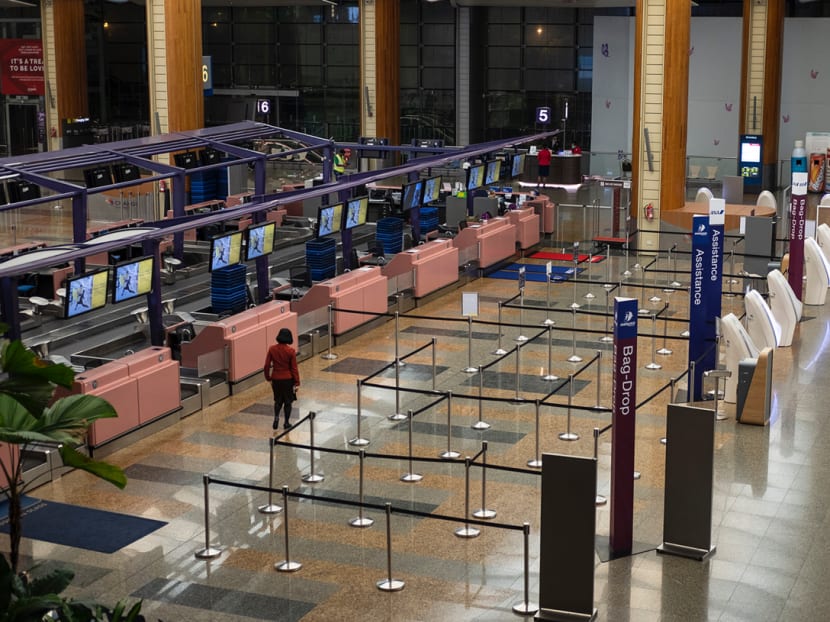
Empty check-in counters at Changi Airport Terminal 2 on March 28, 2020.



SINGAPORE — Changi Airport’s Terminal 2 will suspend operations for 18 months from May 1, Transport Minister Khaw Boon Wan said in Parliament on Monday (April 6).
Separately, the airport development levy will be waived for passengers who bought airline tickets departing from or transiting through Changi Airport. It applies to passengers who bought tickets issued for travel between April 13 and March 31 next year.
The levy was introduced in July 2018 at a rate of S$10.80 for passengers who begin their trips from Changi Airport and S$3 for passengers who start their trips elsewhere and connect through Changi Airport.
Speaking during the debate on support measures for Singaporeans affected by the Covid-19 pandemic, Mr Khaw got emotional towards the end of his speech when he said that 2020 will be remembered as Singapore’s finest moment.
After pausing for about 10 seconds to collect himself, Mr Khaw continued: “And Singaporeans will again come together, defeat Covid-19 and emerge stronger.”
SHUTTING DOWN TERMINAL 2
The shutting down of Terminal 2 would bring down running costs for the airport operator, retail tenants, airlines and ground handlers, said Mr Khaw.
It will also speed up current upgrading works at the terminal and shorten the project time, which is currently scheduled to end in 2024, by one year.
Airlines at Terminal 2 will be reallocated to the remaining terminals still open: Terminal 1, Terminal 3 and Terminal 4.
Singapore Airlines (SIA) will consolidate operations at Terminal 3. Mr Khaw noted that other airlines will also be affected.
Acknowledging that it is “not business as usual” at Changi Airport as the Covid-19 pandemic has obliterated demand for international air travel, Mr Khaw said that one terminal is enough to handle the current volume of travel.
“Changi Airport is deserted. Airlines, ground handlers, airport shops and restaurants have all experienced a sharp fall in business. Their workers have seen huge pay cuts. I met them often, face to face, at the airport. As the virus grew into a global pandemic, I saw increasing fear in their eyes,” he said.
In a media statement by Changi Airport Group (CAG) on Monday, the airport operator said that operations at Terminal 4 have scaled down considerably due to the “very small” number of flights at the terminal.
“If the remaining airlines at T4 choose to suspend or adjust their flight schedule, CAG will also consider suspending operations at T4 temporarily but with the objective of restarting operations quickly when airlines confirm the resumption of flights,” read the statement.
Despite the huge impact the outbreak has had on the aviation sector, Mr Khaw said plans for post-pandemic recovery need to be made.
“While full recovery this year is unlikely, partial recovery next year is probable. We must be ready to lead and ride the recovery when it happens,” he said.
Mr Khaw said airline crews have not been sitting idle. They are still mounting around 40 passenger flights every week.
SIA is utilising some of its passenger aircraft to carry only cargo, so that essential goods, such as medical supplies and other food, are still being supplied.
Airline staff have also been redeployed to help out at hospitals and social service offices.
LAND AND SEA TRANSPORT
Besides the aviation sector, Mr Khaw recognised that the Covid-19 outbreak has also affected land transport workers, such as taxi drivers, as well as private hire drivers working for ride hailing companies Grab and Gojek.
Some drivers affected have applied for the temporary relief fund, said Mr Khaw.
“Many have experienced Sars (severe acute respiratory syndrome) but unlike Sars, they know a speedy recovery is unlikely this time round,” he added.
The seaport, however, is still busy with cargo activities, noted Mr Khaw, as the port has remained open to keep global supply chains intact.
“We had put in place precautionary measures to ensure a safe working environment for staff and crew. With this, our port continues to service the world and safeguard our essential supplies,” he added.
RECOVERING FROM COVID-19
Singapore’s status as a transhipment hub will no longer be status quo even after the Covid-19 pandemic is over, said Mr Khaw.
That is because supply chain resilience will become more important and more local production is to be expected.
“As global trade flows shift, we must still secure and strengthen our role as a major node in global supply chains. The efficiency and connectivity of our sea port and airport will become even more critical.
“Just as 9/11 (the Sept 11, 2001 attacks on New York and Washington) changed aviation security forever, expect Covid-19 to impact air travel and airport operations,” said Mr Khaw.
While he believes that air travel growth will eventually return, he said a quick rebound is unlikely. But Singapore must revive international transport links which are crucial for the global economy and trade flows once the Covid-19 situation improves, Mr Khaw added.
For now, he said the focus of his ministry would be to keep the air and sea ports operational to ensure the global supply chain can continue to function, as well as to protect the health of transport workers and ensure the safety of commuters.
“The coming months will be very challenging and hard for all of us. But the world is not coming to an end. Better times will surely return,” said Mr Khaw.
Related topics
Changi Airport Khaw Boon Wan Terminal 2 ParliamentStay in the know. Anytime. Anywhere.

Subscribe to our newsletter for the top features, insights and must reads delivered straight to your inbox.
By clicking subscribe, I agree for my personal data to be used to send me TODAY newsletters, promotional offers and for research and analysis.






