
Culture, yes. A culture industry? No thanks
Is Singapore shaping up to be a city of literature? This is not a “fluffy” question. It is an inquiry into the shape of our future society. To answer it is to consider Singapore’s turn towards “culture”.
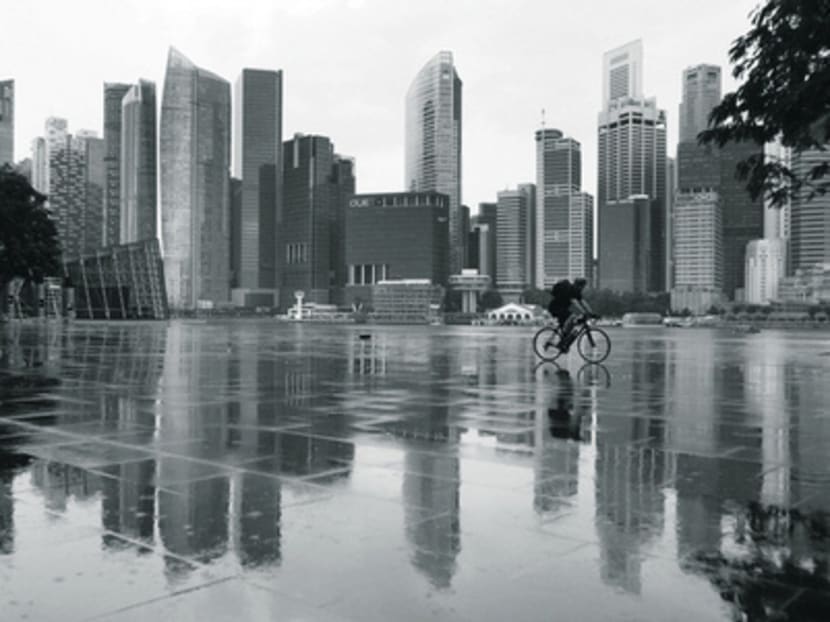
Given its small size, Singapore’s economic survival is contingent on its relevance in the international space. Photo: Reuters

Is Singapore shaping up to be a city of literature? This is not a “fluffy” question. It is an inquiry into the shape of our future society. To answer it is to consider Singapore’s turn towards “culture”.
The recently concluded Singapore Writers Festival (SWF) suggests that this turn is serious business. This year saw the launch of a bumper crop of books to meet the demand for local literature expressed through last year’s SWF survey.
This turn also conforms to the Singapore Cultural Statistics 2013 report that shows ticketed arts and cultural events have raked in millions.
Both developments have been hailed as indications that Singaporeans are more cultured.
That is to say, if we have become more literary, it is because we have produced and sold more books. If we have become artful, it is because we have attended a greater number of theatre productions.
Read this way, Singapore is better interpreted as an industry — not city — of literature and the arts.
While these trends can be taken as an encouraging sign of the increasing worth of culture in our society, they can also point to a less flattering conclusion: Singapore may be managing culture in the same way we manage the economy — culture is, to us, a numbers game.
PRETTY LITTLE ART
Art critic Sarah Kent, in a recent article for The Guardian, argued the same about the state of the arts in the United Kingdom. She points to a telling example of how the arts was relegated to the backdrop of a social setting: “Private views in West End galleries attract a slightly older and wealthier crowd, who are still primarily there to drink free beer, meet each other and take selfies.”
If Singapore continues on this path of industrialising “culture”, we could end up the same. We are already in danger of becoming purveyors of “boutique” art, in which prose, poetry and paintings are pretty little things we desire to possess.
Already, books and artwork decorate our equally pretty bookshelves and walls. Yet, most will probably agree it is computer games and Facebook — not books — that command our full attention in trains, buses and cafes. Thus, we must ask ourselves again: Are we cultured?
To truly encapsulate a cultured existence is to embrace the arts as a process and not a product. Here, we can take a critical look at the Singapore Writers Festival. Why not rebrand it the Singapore Writing Festival? By a simple turn of a phrase, we can immediately tune our idea of “culture” to a matter of experience rather than commodity.
This can also train our social consciousness towards a less elitist Singapore. By shifting the attention from authors to authoring, we are also moving away from the idea of the Author-God, who dictates the way his or her text should be interpreted and received.
In a democratic society, the reader must surely play a role in making meaning. Indeed, such is the view of Mohsin Hamid, author of the Booker Prize shortlisted novel The Reluctant Fundamentalist, during his SWF lecture on Sunday, when he said something to this effect: “As an author, I see myself writing only half the novel. The other half is written by the reader.”
AN ‘IMAGINE’ NATION
The situation is not entirely dystopian, though. In our pursuit to transform Singapore into a city of literature, there are some indications that the National Arts Council is on the right page.
Here, the move to build up expertise in literary translation is encouraging if seen as an attempt at situating Singapore within the bigger world.
Yet, to focus on literary translation alone may lead us down the path of commodifying “culture”. We could end up translating texts for the sole reason of making a quick buck.
To mediate such excesses, it is perhaps better to couple this venture into translation by also embracing comparative literature, which denotes a serious study of how cultures interact or develop in tandem with others.
The latter can become the much-needed “software” that fuels our foray into literary translation — steering us away from the dangers of over-managing culture.
There is yet another gap that needs addressing if Singapore is serious about becoming a city of literature — the dearth of art critics.
Indeed, the recently concluded SWF featured a lot more writers than literary critics. A thriving literary city operates on an ecosystem that must include critics who can help us make sense of the plethora of creative work out there.
But art criticism can never take root here if Singaporeans fear theories and ideas. This has been expressed in common phrases such as “academics are armchair critics”, or “we need to talk about ground realities” — responses that I have encountered not only in the aftermath of my paper at the SWF Malay Literary Forum, but also elsewhere in various conversations with Singaporeans.
Art is built on the practice of abstract thinking. The theme of this year’s SWF, Utopia, Dystopia, is testament to this. In art, utopias and dystopias can only ever be envisaged. For Singapore to be a city of literature, this nation must imagine.
ABOUT THE AUTHOR:
Dr Nazry Bahrawi is a humanities lecturer at the Singapore University of Technology and Design and a research fellow at the Middle East Institute-NUS.
Stay in the know. Anytime. Anywhere.

Subscribe to our newsletter for the top features, insights and must reads delivered straight to your inbox.
By clicking subscribe, I agree for my personal data to be used to send me TODAY newsletters, promotional offers and for research and analysis.






