
Death of woman killed by tree at Botanic Gardens a tragic misadventure, coroner rules
SINGAPORE — No one, not even experts, could have seen it coming that a Tembusu tree at the Singapore Botanic Gardens would topple and cause the death of a 38-year-old woman in February last year, a coroner said on Monday (April 30).
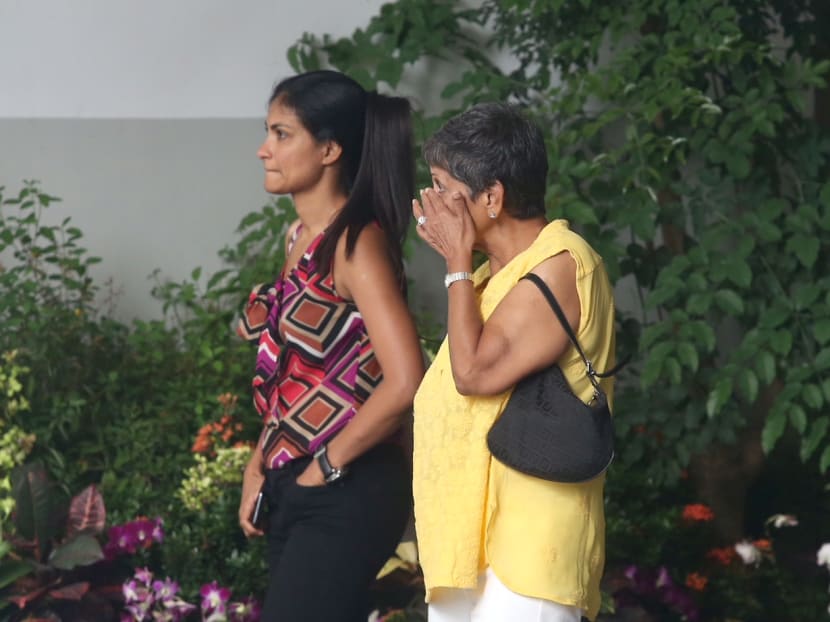
(Left) Ms Aarti Angara and her mother are seen leaving the State Courts on Monday, April 30, 2018.



SINGAPORE — No one, not even experts, could have seen it coming that a Tembusu tree at the Singapore Botanic Gardens would topple and cause the death of a 38-year-old woman in February last year, a coroner said on Monday (April 30).
However, the family of the deceased, Indian national Radhika Angara, are “stricken” with grief by the finding, which ruled her death as a “truly tragic misadventure”.
They still believe it was the “inaction” of the National Parks Board (NParks) that caused the woman to die.
Ms Angara’s sister Aarti Angara, on behalf of her parents and brother-in-law Jerome Rouch-Sirech, said: “Everything we heard over the course of this inquest, suggested to us that the people-in-charge were remiss in their duties to keep the public safe at a Unesco world heritage site.”
Referring to the inquiry, which uncovered that at least 70 per cent of the 270-year-old heritage tree’s core at its 2m point – measured from the ground level – was decayed, she added: “These people have the tools and the wherewithal to prevent this mishap… This could have and should have been prevented. Instead it is my niece and nephew who will have to bear the burden of this disaster, and who will never get to know their mother.”
Ms Radhika Angara, who was regional digital marketing head for Asia-Pacific at MasterCard, is survived by her French husband, Mr Rouch-Sirech, and twins Chloe and Rafa, who are two years old.
She was carrying Rafa in her arms when she was hit by the 40m-tall tree last year on Feb 11. Rafa suffered abrasions on his limbs and contusions on his head, while his mother died of fractured ribs and traumatic asphyxia when she could not breathe after being pinned under the tree.
Mr Rouch-Sirech covered his face with his hands as Coroner Marvin Bay delivered his findings after a four-day inquest that was held over a period of about nine months. He left the courtroom crying.
In a 19-page report, Mr Bay ruled that Mr Thaddeus Cheng, the NParks’ arborist (tree doctor) responsible for the massive tree’s last inspection in September 2016, followed existing protocol. The tree was checked twice a year for the presence of open cavities.
Mr Cheng and his supervisor, Mr Elango Velautham — who also inspected the tree as a follow-up to Mr Cheng’s report — could not have detected the presence of decay unless they performed an advanced inspection, which would require the use of diagnostic tools such as a resistograph and sonic tomographs.
Mr Bay noted that their most significant discovery did not warrant that level of inspection. The men had taken note of a 1.5m long flute that is 30cm at its widest point and 20cm deep at its deepest point, although no decay was found.
The higher-level assessments only kick in if there are reasons to suspect internal decay or any issue that might affect structural integrity.
In this case, Mr Elango, who is the deputy director of Botanic Gardens' Arboriculture and Plant Resource, testified that a massive internal cavity extending a height of 2.9m was only discovered after the tree had uprooted on Feb 11 last year.
Although the cavity was close in distance to the flute structure, it was hidden inside the trunk, he said.
NParks lead arborist Abdul Hamid, along with two other independent arborists — Mr Rick Thomas of ArbourCulture and Mr Derek Yap of Camphora — submitted that the collapse could not have been predicted.
Accepting NPark’s account, Mr Bay said that heavy rainfall and strong winds of 30 to 40km/h in the week leading up to the accident contributed to the tree’s collapse, besides its weak trunk.
“The wind had initiated the process by buffeting the 40m-tall tree (with an asymmetric canopy load), causing considerable swaying. The swaying had transferred these strong imposed forces down the trunk and, in turn, caused the degraded tension roots to fracture,” he said, adding that the tree has a shallow root depth of just 70cm at its maximum.
Explaining how the decay started, Mr Bay said that in the distant past, the roots of the tree were cut to build a path nearby, so they became degraded when they could not propagate further. The cuts also allowed pathogens to be introduced into the tree’s system, causing severe decay in the roots below soil level.
The rot eventually migrated to the trunk itself, leading to massive internal decay.
Two months after the accident, National Development Minister Lawrence Wong said in a parliamentary response that as of November 2016, an enhanced inspection regime involving the use of diagnostic equipment were put in place for large trees that are older than 50 years old.
Mr Bay called the change a positive step, which “will do much to obviate the risk of a sudden and potentially catastrophic tree failures in the future”.
Related topics
Tembusu tree Singapore Botanic Gardens deathStay in the know. Anytime. Anywhere.

Subscribe to our newsletter for the top features, insights and must reads delivered straight to your inbox.
By clicking subscribe, I agree for my personal data to be used to send me TODAY newsletters, promotional offers and for research and analysis.






