
Driverless cars may be closer to reality
SINGAPORE — Imagine this: A completely car-free town and residents taking “personalised MRTs” in the form of driverless pods running underground from under their block to public transport nodes.
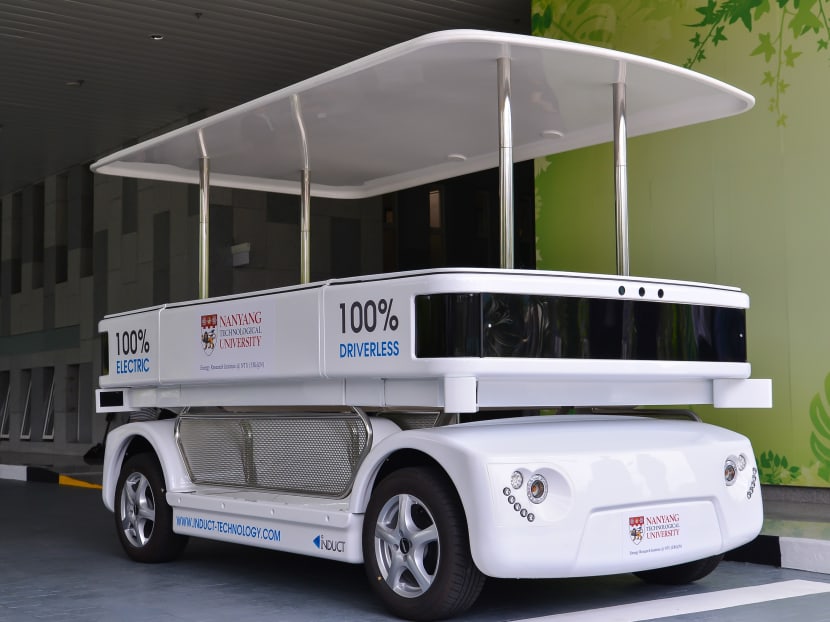
NTU Driverless Vehicle. Photo: NTU

SINGAPORE — Imagine this: A completely car-free town and residents taking “personalised MRTs” in the form of driverless pods running underground from under their block to public transport nodes.
This seemingly fantastical vision accelerated towards reality — perhaps only 10 or 15 years down the road — after the Government yesterday announced its venture into autonomous vehicle (AV) technology.
While AVs have been developed or even trialled here in recent years, they have been the work of disparate organisations (see box on page 2).
But under a new partnership called the Singapore Autonomous Vehicle Initiative (SAVI) — announced by Senior Minister of State (Transport) Josephine Teo yesterday — the Land Transport Authority (LTA) and Agency for Science, Technology and Research (A*STAR) will jointly oversee the setting up of a technology platform to spur research and development as well as the testing of AV technology, applications and solutions.
A Committee on Autonomous Road Transport for Singapore (CARTS), headed by the Transport Ministry’s Permanent Secretary Pang Kin Keong, will also be formed to chart the strategic direction and study opportunities for AVs deployed here. Among the possibilities being explored are the use of AVs for the transport network, such as driverless buses, or for intra-town shuttles in future residential developments.
SAVI will also look into the regulations required for the mass adoption of such vehicles, such as liability issues when accidents happen and infrastructural requirements.
The Republic will also be the first country to actively incorporate AV into future town-planning, said Mrs Teo. For instance, in new town developments, the Government can study having dual-layered decks within the town centre, with a driverless feeder service plying one of the decks, she added.
“Our dream is to design a totally new mobility concept for a green-field, future town that is about a decade to two away in the making, at which time we think AV technology would have matured sufficiently,” Mrs Teo said at a conference titled Autonomous Transport: Paving the Road for Future Mobility. “In our dream town, its surface would be dominated by green and open spaces for residents ... and free of the smoke, noise, congestion and safety concerns posed by vehicles today.”
Outlining some exciting possibilities, Mrs Teo said AVs that can take people to any destination — instead of running on fixed routes, such as the trains on the North-East and Downtown lines — could facilitate car-sharing or curtail demand for cars.
Towns could even be car-free at the street level, with pods that can be summoned at an underground network to take someone to where he or she wants to go — whether it is within or between towns — like a personalised MRT system, she added.
The LTA is working towards a framework to allow AVs that meet safety standards to be tested on all public roads next year. As a start, routes connecting Biopolis, Fusionopolis and Mediapolis will be provided by JTC Corporation for testing purposes from January. Both JTC and the LTA will assess the test proposals to ensure vehicles have comprehensive safety procedures and third-party insurance before they get approved.
Industry experts TODAY spoke to said there are challenges involved, such as reliability, liability issues — who does one claim insurance against when an accident arises, for example — and public acceptance.
Although AV technology has been applied in special circumstances, such as in space exploration, A*STAR chairman Lim Chuan Poh said “the challenge is to bring this to an urban setting ... and to bring it into a human environment where humans feel comfortable with driverless vehicles going around”.
Dr Emilio Frazzoli, Professor of Aeronautics and Astronautics from Massachusetts Institute of Technology and a CARTS member, said they would look at how to develop the right regulations — for instance, whether drivers’ licences are needed for AV.
While they agreed it is early days yet, observers are optimistic about the prospects of AV deployment.
Associate Professor Marcelo Ang from NUS’ department of mechanical engineering, who heads the varsity’s team of researchers who developed an autonomous car, said it can go commercial if they get big software firms interested in the technology or by partnering car manufacturers to market autonomous driving as an option for new cars.
While he noted that Singapore has been at the forefront in testing transport concepts and transport technologies over the past three decades, Associate Professor Gopinath Menon, who teaches transportation engineering at Nanyang Technological University, pointed out the small market here as a possible speed bump.
Stay in the know. Anytime. Anywhere.

Subscribe to our newsletter for the top features, insights and must reads delivered straight to your inbox.
By clicking subscribe, I agree for my personal data to be used to send me TODAY newsletters, promotional offers and for research and analysis.






