
Ex-NUH surgeon cleared of professional misconduct
SINGAPORE — The High Court has cleared a former National University Hospital (NUH) surgeon of professional misconduct, overturning the ruling of a disciplinary committee set up by the Singapore Medical Council (SMC).
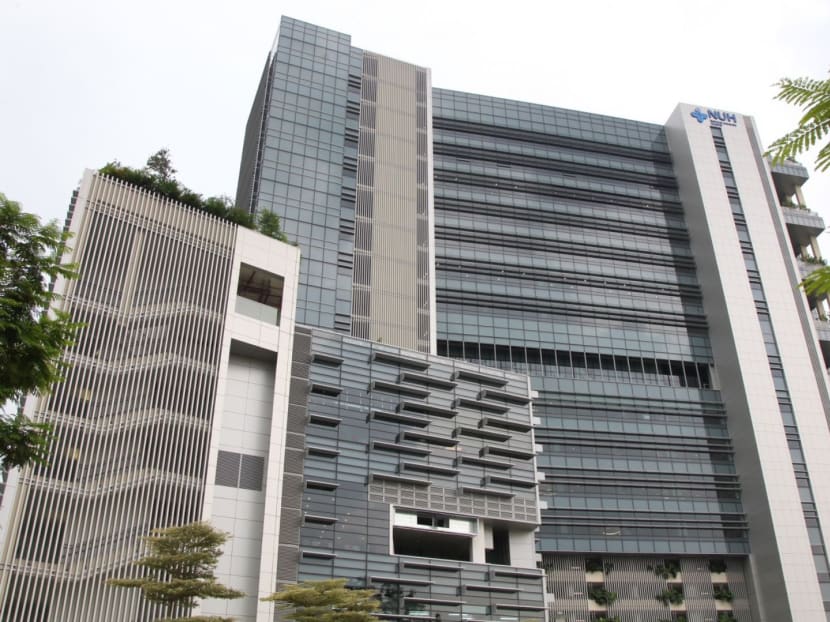
Facade view of the NUH Medical Centre opened in April 2014. Photo: Don Wong/TODAY

SINGAPORE — The High Court has cleared a former National University Hospital (NUH) surgeon of professional misconduct, overturning the ruling of a disciplinary committee set up by the Singapore Medical Council (SMC).
Associate Professor Uwe Klima had given his patient a substance to stop the heart during surgery in its undiluted form, which is potentially fatal. The patient, who was two years old during the surgery in December 2007, had to undergo an emergency operation to save his life and now needs help with daily activities.
Dr Klima had failed to check with his colleagues operating the heart-lung machine that the substance, cardioplegia, had been diluted, but his colleagues also had a duty to inform him, the judges noted.
Cardioplegia is either diluted with a patient’s blood, or by another chemical.
Taking into account the breakdown in communication and “systemic failure” that transpired, they found Dr Klima’s oversight insufficient to constitute professional misconduct.
The boy had required surgery because of a diseased right coronary artery. The operation took longer than expected and Dr Klima asked for “cardioplegia solution”.
According to the staff operating the heart-lung machine, this was an unusual term to use.
Two members of the team claimed to have mentioned that the cardioplegia was undiluted, but one admitted that Dr Klima was then engrossed in suturing.
He apparently confirmed that the syringe contained “cardioplegia solution” before using it on the boy.
The SMC’s disciplinary committee had in January last year found Dr Klima — who graduated from the Medical School of the University of Vienna in Austria in 1988 and joined the NUH in 2006 — guilty of willful neglect of duty to his patient.
He appealed against the decision and on Monday (April 13), the High Court judges — comprising Chief Justice Sundaresh Menon and Judges of Appeal Chao Hick Tin and Andrew Phang — ruled that his failure to check with his colleagues cannot be the sole ground to convict him.
Dr Klima’s lawyer, Senior Counsel N Sreenivasan, had argued that because everyone involved knew undiluted cardioplegia cannot be used on a patient, Dr Klima was entitled to assume he had been given its diluted version.
The SMC’s lawyer, Ms Josephine Choo, had argued that it was possible for cardioplegia to be diluted with blood at the operating table. However, the judges ruled that this had not been the SMC’s “dominant case theory” before the disciplinary committee, nor was Dr Klima asked about drawing sterile blood from the patient at the operating table.
Dr Klima was also part of a system where team members each had a duty to ensure the substance had been diluted, but the system failed in this case due to a breakdown in communication, the judges wrote.
They cautioned that not every case of systemic failure lets a doctor off the hook, as precise circumstances need to be analysed.
Dr Klima — who left the National University Heart Centre, Singapore, in 2009 — was also cleared of a second charge of allowing another doctor to operate on the patient in his absence.
Both doctors were under conditional registration, which meant that Dr Klima was in no position to supervise his colleague in the first place. The judges noted that the disciplinary committee had convicted him of failing to obtain his supervisor’s go-ahead, and not what was stated in the charge.
Dr Klima had been facing a nine-month suspension and a S$10,000 fine.
The judges said they sympathised fully with the boy and his parents, and added that various hospitals and the SMC, the medical watchdog, may wish to revisit protocols to see if there could be even more guidance on the administration of cardioplegia.
Stay in the know. Anytime. Anywhere.

Subscribe to our newsletter for the top features, insights and must reads delivered straight to your inbox.
By clicking subscribe, I agree for my personal data to be used to send me TODAY newsletters, promotional offers and for research and analysis.






