
Explainer: Boris Johnson’s Conservatives have won. What now for Brexit?
SINGAPORE — The Labour Party has been dealt a crushing blow in United Kingdom's “Brexit” election as the Conservative Party led by incumbent Prime Minister Boris Johnson won its biggest majority in parliament since Margaret Thatcher’s 1987 election victory.
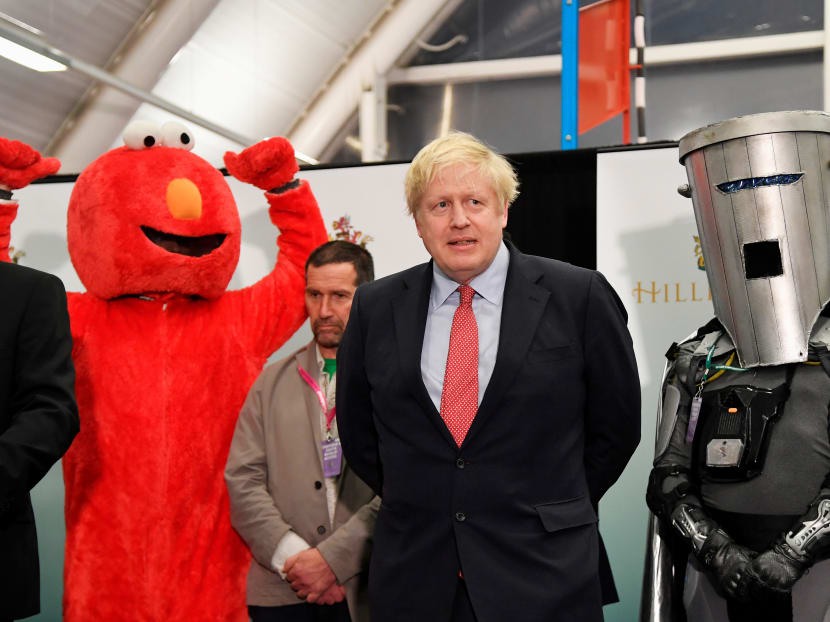
British Prime Minister Boris Johnson after winning his seat of Uxbridge and South Ruislip in Britain's general election, flanked by a man dressed as Sesame Street character Elmo and Lord Buckethead, a self-proclaimed satirical political character. Both stood as candidates in the election.



SINGAPORE — The Labour Party has been dealt a crushing blow in United Kingdom's “Brexit” election as the Conservative Party led by incumbent Prime Minister Boris Johnson won its biggest majority in parliament since Margaret Thatcher’s 1987 election victory.
Out of the 650 seats, the Conservatives have won by a comfortable majority of 364 by the time this article was published, making inroads into historically Labour territories.
The Labour Party under its leader Jeremy Corbyn suffered its worst defeat since 1935, losing 59 seats to secure only 203.
TODAY explains what a Conservative win mean for Brexit and whether this would have any impact on Singapore.
WHAT DOES A CONSERVATIVE WIN MEAN FOR BREXIT?
With a majority win by the Conservatives, observers agree that the deadlock that has been plaguing the British parliament, impeding any progress on Brexit, will be removed.
The whole reason why Mr Johnson called for this election — the UK’s third in less than five years — was because the lack of a working majority in the British parliament had stalled the Brexit process even for his predecessor Theresa May.
The Brexit deadline has been pushed back several times, as no agreement has been struck on the manner the UK would leave the European Union ever since the fateful referendum in 2016.
Mr Johnson’s campaign slogan of “Get Brexit done” succinctly captures his intent with this election, which is to get out of the impasse by winning a parliamentary majority so that he can enact his Brexit plans.
He promised that he would get the UK out of the EU if he wins the majority, setting Jan 31, 2020 as the deadline for Brexit.
Mr Song Seng Wun, an economist at CIMB bank, said the risk of a disorderly Brexit or a no-deal exit has now been minimised, and the process would likely be smoother going forward.
However, observers pointed out that even if the UK could successfully leave the EU by Mr Johnson’s deadline, it is just the first step of a very complicated process.
While the deal Mr Johnson’s government reached with the 27 member states of the EU, known as the Withdrawal Agreement Bill, would likely pass parliament given that the Conservatives are in power, the UK will have to negotiate their future political and economic relationship with the EU, said Professor David De Cremer from the National University of Singapore Business School.
For one, it has to negotiate another trade deal with the EU, and a final agreement needs to be produced by June next year, in time for it to be signed and ratified by the end of 2020.
“(Mr) Johnson has already vowed he wants to have the trade deal and everything else done by the end of 2020. If this does not happen and he commits to his promise (which he never does), the risk of a no-deal still exists,” said Professor De Cremer.
WILL THERE BE ANY IMPACT ON SINGAPORE?
While there is now greater certainty that a Brexit is on the horizon, economists said that there would be minimal impact on Singapore businesses.
Irvin Seah, an economist at DBS Bank, said that the Brexit process has been ongoing for so many years that markets have already priced in the various scenarios that could result from it.
“Companies and businesses have taken into account and done the necessary work to minimise impact,” he said.
The uncertainties resulting from Brexit was more a result from the deadline getting pushed back constantly, said Mr Song.
“Because Brexit has been a slow grind over the last three years, businesses have adjusted their plans either in Europe or the UK,” he added.
As to how bilateral ties might change between the UK and Singapore, Mr Song said that both countries are not starting from a blank slate.
Given that Singapore has already signed a free trade agreement with the EU, it could be used as a template to work out an agreement between Singapore and the UK in a shorter time than expected.
Related topics
United Kingdom Boris Johnson UK elections brexit Conservative PartyStay in the know. Anytime. Anywhere.

Subscribe to our newsletter for the top features, insights and must reads delivered straight to your inbox.
By clicking subscribe, I agree for my personal data to be used to send me TODAY newsletters, promotional offers and for research and analysis.






