
Explainer: What are the key issues in Taiwan's Jan 13 elections, and how will the outcome affect global geopolitics?
SINGAPORE — More than 19 million people are eligible to vote when Taiwan heads to the polls on Saturday (Jan 13) to elect a president and legislature.
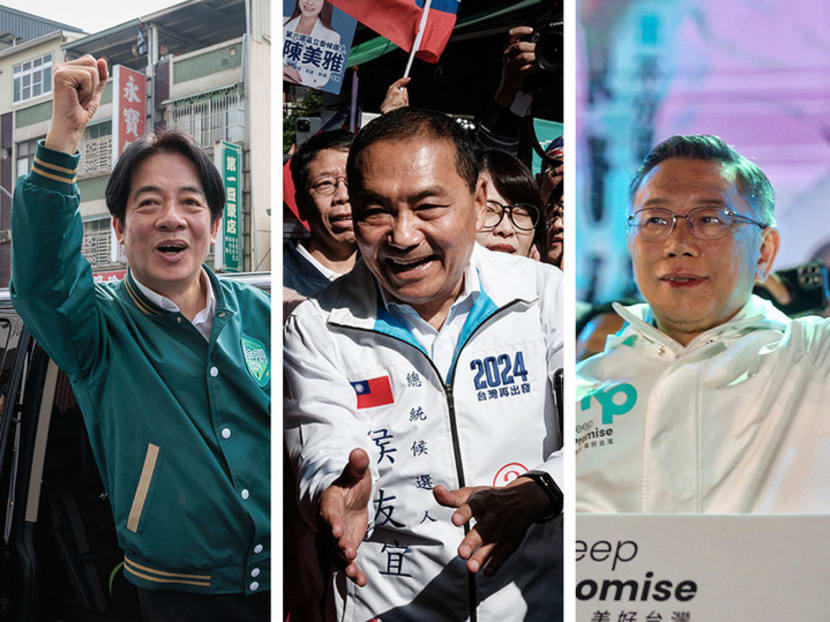
From left: Dr William Lai Ching-te, Taiwan's vice-president and presidential candidate of the ruling Democratic Progressive Party; Mr Hou Yu-ih, presidential candidate of the main opposition Kuomintang; and Dr Ko Wen-je, candidate from the Taiwan People's Party.

- Taiwan is headed to the polls to elect a new president and legislature on Jan 13
- Three candidates from three parties with differing views on the island's relationship with China are competing for the presidency
- Experts said that this election will have an impact on cross-strait ties and the United States-China relationship
- TODAY explains who the candidates are, what issues are set to influence the vote and what this means for the world and Singapore


SINGAPORE — More than 19 million people are eligible to vote when Taiwan heads to the polls on Saturday (Jan 13) to elect a president and legislature.
Their votes will decide if the ruling Democratic Progressive Party (DPP) — which leans towards an independent Taiwan — will earn an unprecedented third straight term, with 64-year-old William Lai Ching-te seeking to be president.
The current president Tsai Ing-Wen of the DPP has to step down due to Taiwan's limit of two terms. Dr Lai is now vice-president.
Dr Lai faces competition from Mr Hou Yu-Ih, 66, from Kuomintang (KMT) and the incumbent New Taipei City mayor, as well as Mr Ko Wen-je from Taiwan People’s Party (TPP) and a former mayor of Taipei.
Political observers are watching the elections carefully because they will affect cross-strait ties and United States-China relations.
Beijing considers Taiwan as a breakaway province to be reunited with China and has not ruled out the use of force to achieve that outcome.
Most countries do not recognise Taiwan as an independent nation, but the US, among others, is not backing Beijing's plans.
TODAY breaks down who the candidates are in the election, what issues will determine the outcome and the likely implications of the results for the rest of the world.
WHO ARE THE CANDIDATES?
1. Dr William Lai Ching-te from Democratic Progressive Party
The veteran politician is the front-runner who is leading opinion polls to become Taiwan's next president.
Before becoming vice-president, Dr Lai was mayor of Tainan, Taiwan's former capital, from 2010 to 2017, and was a lawmaker and kidney doctor for several years before that.
He has described himself as a "practical worker for Taiwan independence" and has repeatedly promised to continue the current administration's policy of maintaining democratic Taiwan's de facto independence.
The presidential hopeful also told reporters on Tuesday that he hopes to reopen dialogue with China should he be elected.
"Our door will always be open to engagement with Beijing under the principles of equality and dignity," he said.
"We are ready and willing to engage to show more for the people on both sides of the Taiwan Strait. Peace is priceless and war has no winners.”
China, on the other hand, had labelled Dr Lai as a "troublemaker through and through" and a separatist last August after he made a visit to the US.
Dr Lai's running mate is Ms Hsiao Bi-khim, 54, who was the Taiwanese envoy to the US from 2020 until November.
2. Mr Hou Yu-ih from Kuomintang
The 66-year-old incumbent New Taipei City mayor had previously climbed the ranks of the police force, serving as its director-general from 2006 to 2008.
In 2010, he became the deputy to the then New Taipei mayor, and then took over the mayoralty in 2018.
On the campaign trail, Mr Hou has endorsed the 1992 Consensus, in line with his party's stance hoping for friendlier relations with the mainland.
The consensus is an agreement between KMT and the Chinese Communist Party (CCP) that there is "one China", though both sides have different interpretations of what "China" means.
An advocate to lower cross-strait tensions, Mr Hou has called for talks with CCP and framed the election as choosing between "war and peace".
3. Dr Ko Wen-je from Taiwan People’s Party
A trauma surgeon and university professor before entering politics, 64-year-old Ko was elected Taipei mayor in 2014 as an independent candidate.
Backed by DPP then, he has since shifted towards a more China-friendly approach and founded TPP in 2019.
He and his party tread a middle path between the island's two traditional political parties, often more ambiguous about Taiwan's relations with China than his two competitors.
With his savvy social media campaign strategy — including a viral rap music video — he has attracted a mostly youth supporter base. To them, he represents a third choice between provoking China and deferring to it.
In the most recent opinion polls, the Economist magazine reported that Dr Lai was in the lead with a polling average of 36 per cent. Mr Hou had a polling average of 31 per cent and and Dr Ko, 24 per cent.
Taiwan does not allow new opinion polls to be published within 10 days of an election.
WHAT ARE THE KEY ISSUES INFLUENCING THE VOTE?
Dr Chen Gang of the East Asian Institute at the National University of Singapore (NUS) noted that relations with mainland China are a major factor influencing the youth vote.
"They do not want war and many of them hope the second largest economy can bring them business and job opportunities. Politically, they prefer the status quo," he said.
Relations with China is a key matter, but political analysts told TODAY that several other issues will influence the poll results.
They include the state of Taiwan's economy, which has lost some steam recently, Dr Chen said.
"If DPP remains in power, current policy will continue, and it is difficult for Taiwan to find business opportunities on mainland China."
Dr Chong Ja Ian, a political scientist at NUS, said that housing and affordability, as well as wage rises for young workers are also hot topics in the campaign.
Housing prices across Taiwan have more than doubled since 2008.
And although the average annual salary for full-time employees in Taiwan hit an eight-year high of NT$694,000 (about S$30,000) last year, this was a mere 2.5 per cent increase from 2022, online human resources platform 104 Job Bank reported.
WHAT IS LIKELY IMPACT OF TAIWAN ELECTIONS?
Experts told TODAY that the elections will affect cross-strait ties and US-China relations.
Dr Chen noted that if Dr Lai is elected, cross-strait relations are likely to deteriorate because DPP does not agree with Beijing on the 1992 Consensus.
Dr Chong said: "Beijing is not going to let up on controlling Taiwan, as seen in repeated statements from the People's Republic of China leaders including Xi Jinping. The question is how this pressure would manifest."
Should DPP win, Dr Chong said that China is likely to continue intimidating Taiwan.
Should KMT or TPP win over the electorate, Beijing would seek to further integrate Taiwan's economy with China's, creating a greater dependency.
There may not be any impact on the US beyond support for Taiwan's democratic system.
However, Mr Rupert Hammond-Chambers, senior adviser at business advisory firm BowerGroup Asia, said that bilateral ties between US-China may be affected.
This is if there is an impact on "areas of bilateral cooperation between the US and Taiwan such as military cooperation or technology cooperation", he added. Mr Hammond-Chambers is also president of the US-Taiwan Business Council.
Dr Chen said that the election results could become a "flash point" for China-US rivalry since Taiwan is "the largest obstacle for China-US relations". This could potentially drag the two superpowers into war.
However, with all three presidential candidates being pro-business, Singapore is unlikely to be affected in "any meaningful way".
"The outcomes are unlikely to change Singapore’s policy toward the island and economic cooperation is likely to remain significant, particularly in the technology supply chain," Mr Hammond-Chambers said.
Agreeing, Dr Chong said: "The question is how Beijing chooses to react — will it seek to put more pressure on Taiwan in ways that are disruptive or will it largely live with the status quo?"
Related topics
Taiwan China United States electionStay in the know. Anytime. Anywhere.

Subscribe to our newsletter for the top features, insights and must reads delivered straight to your inbox.
By clicking subscribe, I agree for my personal data to be used to send me TODAY newsletters, promotional offers and for research and analysis.






