
Explainer: What is the Pfizer Covid-19 vaccine and is an end to the pandemic near?
SINGAPORE — Interim results of a vaccine trial released on Monday (Nov 9) by American drugmaker Pfizer has sent hopes soaring that a vaccine for the coronavirus, which has claimed the lives of nearly 1.3 million people globally, is within reach.
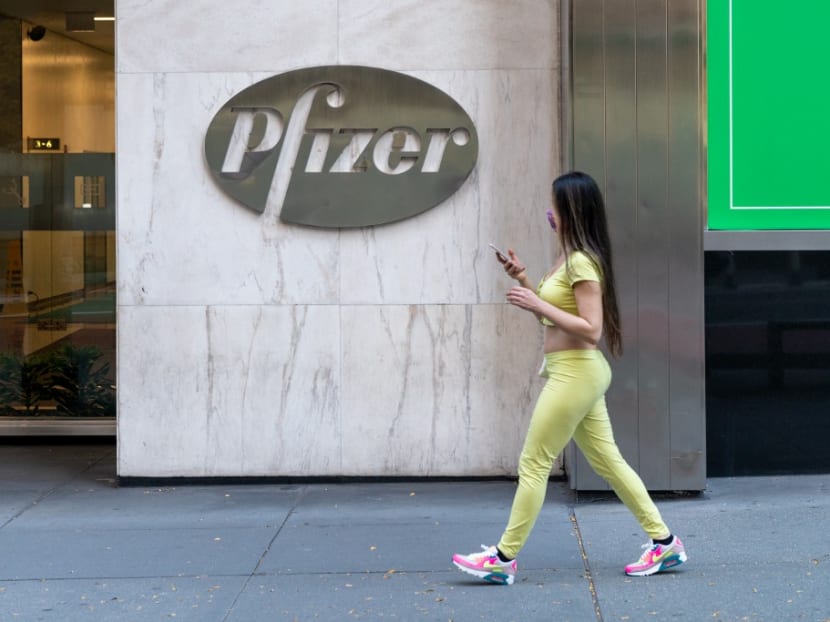
A woman walks by the Pfizer headquarters in New York City. The pharmaceutical firm announced positive early results on its Covid-19 vaccine trial.



- Pfizer is the first to release data showing that its vaccine worked in a large, late-stage clinical trial
- While experts are excited about the results so far, the optimism should be tempered with caution, they said
- They raised questions such as how much protection it offers, to whom and for how long
SINGAPORE — Interim results of a vaccine trial released on Monday (Nov 9) by American drugmaker Pfizer has sent hopes soaring that a vaccine for the coronavirus, which has claimed the lives of nearly 1.3 million people globally, is within reach.
Results of the trial showed that the vaccine was more than 90 per cent effective at preventing Covid-19.
Pfizer, which developed the vaccine with German drugmaker BioNTech, is the first to release data showing that its vaccine worked in a large, late-stage clinical trial.
With details still scant, TODAY finds out from experts the unsettled questions they have and whether it is optimistic to think that this will mark the end of the pandemic.
WHAT DO WE KNOW ABOUT THE VACCINE?
The vaccine uses messenger RNA (mRNA) technology, a genetic material that enables human cells to make specific coronavirus proteins that produce an immune response.
To assess how well the vaccine works, the firms are testing it against a placebo of saline solution in healthy participants to see if the rate of Covid-19 infection among those who got the vaccine is significantly lower than in those who received the dummy shot that does not contain the vaccine.
Pfizer said that its interim analysis was conducted after 94 participants in the trial developed Covid-19, and its findings suggested that the vaccine is more than 90 per cent effective against the coronavirus.
So far, 38,955 people have received two doses of the vaccine or placebo, and the Pfizer team will be conducting a further analysis of the results once 164 participants in its trial develop Covid-19.
As a standard practice in clinical trials, the data was “blinded” to prevent conscious or unconscious bias.
This means that no one except the independent board — not even the participants, researchers or the company’s top executives — knows how many of the 94 people got the vaccine or the placebo.
WHAT DO WE NOT KNOW?
While infectious diseases experts are excited about the results so far, the optimism should be tempered by caution, they said.
Associate Professor Alex Cook said that the results are preliminary and have yet to be published in a scientific journal with details on the licensing and deployment of the vaccine.
The vice-dean of research at the Saw Swee Hock School of Public Health at the National University of Singapore (NUS) added that there are still unsettling questions such as how much protection it offers, to whom and for how long.
“We don’t know, for instance, whether the protection afforded by the vaccine differed according to the age of the patient, as it does for the flu vaccine,” Assoc Prof Cook said, adding that if it is at all like an influenza vaccine, then repeat vaccination will be necessary.
Assoc Prof Hsu Li Yang, who heads the infectious diseases programme at the Saw Swee Hock School of Public Health, said that it is also possible — although extremely rare — that unusual and serious adverse effects may present when the vaccines are given to a large population of people.
This is similar to the cases of Guillain-Barre — a type of neurological disorder that may result in paralysis — that developed after the rapid deployment of the flu vaccine in 1976, she added.
Dr Ling Li Min, an infectious disease specialist at Mount Elizabeth Novena Hospital, said that there are certainly logistical challenges that need to be ironed out, since the vaccine has to be stored at minus 70°C.
“This may prove to be challenging for transport and distribution especially if (Pfizer is) manufacturing in volumes to meet global demand,” she added.
IS THE END OF THE PANDEMIC NEAR?
Notwithstanding all that is still unknown, the experts said that the development of this vaccine is a major milestone.
Dr Ling said that the vaccine is an “impressive” achievement in view of the scale and speed of enrolment.
Agreeing, Assoc Prof Cook said: “There are many vaccines under various stages of development, and most won’t make it through to the market, so every vaccine that reaches advanced-stage trials and shows results like this should be cheered.”
He added that the progress to get the vaccine to this stage is “astounding”, given that the search for vaccines for ailments such as dengue, for instance, took decades.
Data that suggests that there is a 90 per cent efficacy is also considered high for a vaccine, he said. This means that not everyone who gets vaccinated will be protected, but the vast majority will.
“To protect the other 10 per cent, we need to vaccinate broadly so that herd immunity can be attained,” he added.
“Small outbreaks will still occur, but they will not sustain themselves. That will be the point at which we can finally relax our guard, stop the physical distancing and go back to the old normal,” he added.
WILL IT BE AVAILABLE IN SINGAPORE?
Pfizer said on Monday that it could have 30 million to 40 million doses of the vaccine before the end of the year, enough for 15 million to 20 million people to get an initial shot and a booster three weeks later.
Singapore’s Health Minister Gan Kim Yong said on Tuesday at a press conference by the governmental task force tackling the pandemic that the country is in talks with various pharmaceutical firms, including Pfizer, on Covid-19 vaccines.
He did not elaborate on the discussions with Pfizer due to the confidential nature of the negotiations.
Mr Gan, who co-chairs the task force, said that even with the availability of vaccines, the Government probably does not intend to vaccinate the entire population.
A vaccine may not be a silver bullet to end the pandemic but is an important part of an “arsenal of measures against Covid-19”, he added.
WHAT OTHER VACCINES ARE MAKING PROGRESS?
There are a range of Covid-19 vaccines in development and undergoing clinical trials globally, and many of them are on a similar schedule.
American pharmaceutical company Arcturus Therapeutics, which is working on a clinical trial for a coronavirus vaccine with researchers from the Duke-NUS medical school, said on Monday that it found positive preliminary results.
The first shipments of the vaccine are expected in the first quarter of next year. TODAY has reached out to Duke-NUS medical school for comments on how the progress of its trial compares with that of Pfizer.
The Russian health ministry on Monday also announced the approval of a second new coronavirus vaccine in the country following a statement by Pfizer and BioNTech.
Called the Sputnik V, the vaccine is said to be more than 90 per cent effective, a Russian health ministry representative claimed, referring to data collated from vaccinations of the public rather than from an ongoing trial.
Related topics
Covid-19 coronavirus coronavirus vaccine Pfizer BioNTechStay in the know. Anytime. Anywhere.

Subscribe to our newsletter for the top features, insights and must reads delivered straight to your inbox.
By clicking subscribe, I agree for my personal data to be used to send me TODAY newsletters, promotional offers and for research and analysis.






