
Exported, retrained or retired? 700 racehorses face uncertain fate after Singapore Turf Club closure
SINGAPORE — Still at the peak of its form, four-year-old racing steed Super Salute sprinted past the finish line ahead of other horses to clinch first place at the Singapore Turf Club's (STC) Silver Bowl on Sunday (June 11) to the celebratory roars of punters and spectators at the Kranji racecourse.
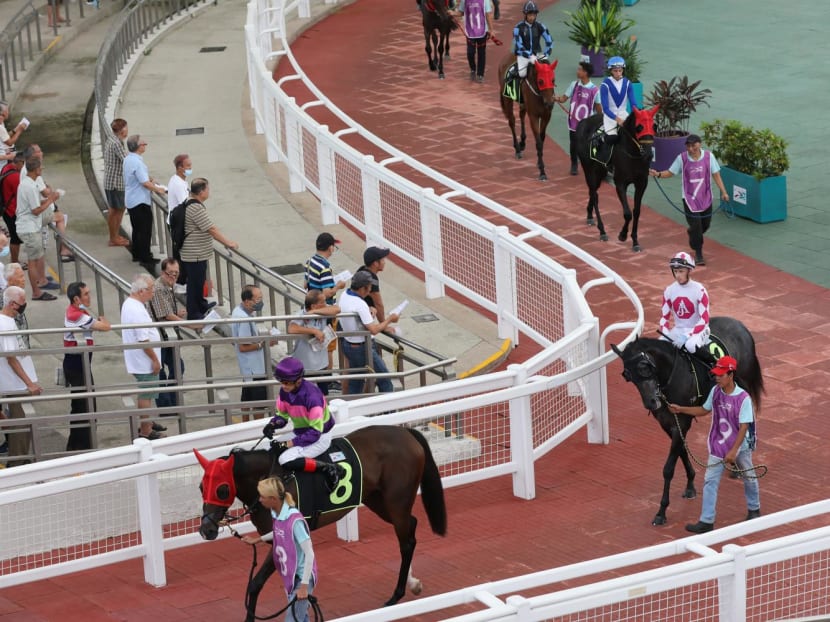
Horses walking the parade ring on June 11, 2023.

- The fate of over 700 racehorses currently residing at the Singapore Turf Club hangs in the balance
- Horse trainers estimate that less than 10 per cent of horses are considered "elite" and can feasibly be exported for racing
- While suitable racehorses can be retrained for other work, there are limited spaces in Singapore and Malaysia to house them
- People in the industry say that injured horses and those who cannot find new homes will likely be put down


SINGAPORE — Still at the peak of its form, four-year-old racing steed Super Salute sprinted past the finish line ahead of other horses to clinch first place at the Singapore Turf Club's (STC) Silver Bowl on Sunday (June 11) to the celebratory roars of punters and spectators at the Kranji racecourse.
But behind its trainer Jason Lim's restrained smile lies a nagging worry about his prized horse, which began after last Monday's bombshell announcement that the STC will be shuttered in 2027, with the last race scheduled for October next year.
The 42-year-old trainer said wistfully to TODAY after Super Salute's winning race: "He’s such a good horse, where (will he end up) next time?”
With over 700 racehorses currently stabled here, their futures remain up in the air after last week's announcement that they have another 16 more months to race. The closure of Singapore's last horse racing ground was due to falling attendances and redevelopment needs for public housing.
The hot favourites and star horses may be sold and repatriated to racecourses abroad, but many are doubtful that the rest would end up as lucky, several jockeys, scyes and assistant trainers said to TODAY last week.
Scyes are more commonly known as a stable hands, who take care of horses' basic needs like feeding and bathing them.
On June 9, STC president and chief executive Irene Lim met Singapore racehorse trainers at the racecourse, where the topic of the 700 horses was briefly brought up during the meeting. By all accounts, however, the meeting did not yield anything conclusive.
The trainers have been informed that horse owners will be given S$700 per horse to aid in their maintenance, a spokesperson from STC confirmed.
STAFF DEPARTURES
Even before the horses' fates can be decided, several trainers are also concerned about the horses' welfare before the Oct 2024 deadline, fearing that the remaining stable staff may be gone before the horses find greener pastures elsewhere.
After all, the 16-month window just started but many stable staff are already looking for an exit and mulling their post-racing career options.

Should staff members leave in droves, this would spell disaster for the horses as they require consistent daily care, maintenance and exercise, said jockey Zyrul Nor Azman, 35.
“(The Government) just gave them 15 to 16 months (to continue racing). If the (horse) owners don't want to pay the trainer, the trainers can’t pay the employees, and the employees don’t want to come to work… then who will want to take care of the horses?" he said.
Other stable staff were visibly emotional when asked about their futures and that of their horses.
“Who is going to feed them? When they find a colic in the box, who's going to call the vet to treat them?” said 52-year-old professional trainer Mahadi Taib.
“Every day you’ve got to take them out to exercise, to maintain their fitness… to keep them safe. If all these men just left… if (only) two or three of my staff go... I will die. I can't manage — one man, 38 horses.”
FEW WILL CONTINUE TO RACE OVERSEAS
Among the hundreds of horses currently at STC, horse owners say that less than 10 per cent are “elite” — or of the required level to be competitive in other lucrative racing jurisdictions like Hong Kong, Australia and New Zealand.
“Out of the 700 horses... only 50, or even 30 (are good enough to race overseas)," said horse owner Victor Chng, 60.
But the process of getting the horses registered in these countries is not straightforward.
“There are certain rules that we need to follow. We can’t say that, oh, we want to race there and we send them over straightaway,” said Mr Chng's son Jonathan, 32, who is also a horse owner and founder of Everest Racing Club.
For instance, the younger Chng said that South Korea imposes a cap on horses’ market values to keep their races competitive within the circuit, and its primary use of sand tracks makes it hard for horses who are used to competing on other surfaces, like turf or polytrack.
This means that horses who lack experience in racing on those sand tracks will not perform as well.
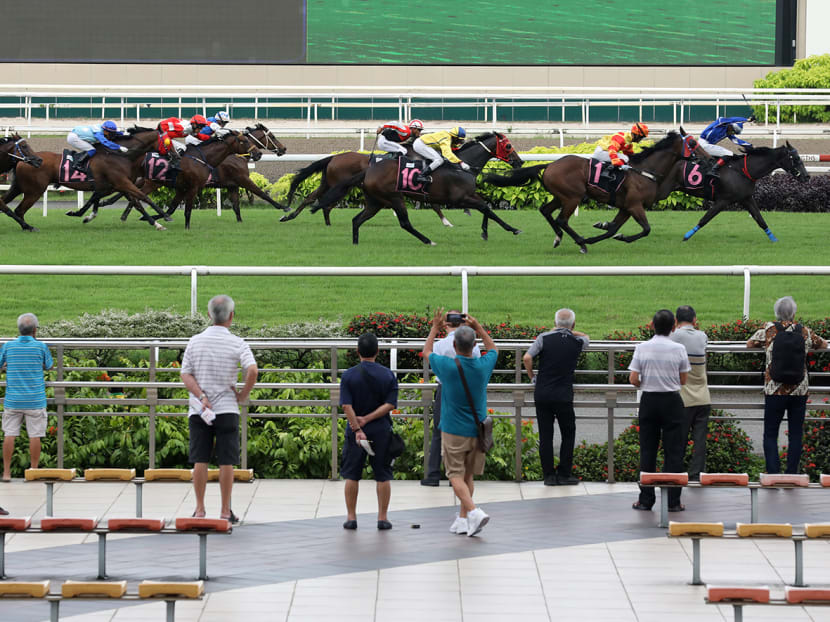
In order to race in Hong Kong, owners have to ballot for a permit before importing them, and horses must have a specific handicap rating that qualifies them to compete.
If the possibility exists for horses with race potential to leave Singapore, Mr Chng said, owners will likely want them shipped out as soon as possible due to the lengthy export process, which can take up to several months.
According to Mr Jason Lim, Australia accepts only eight horses in a month from Singapore into their quarantine facilities.
Furthermore, there is also the need for the horses to adjust to their new surroundings.
“We need to quarantine them, we need to ship them over, and we need to find a trainer to get them up to the right fitness levels. They (also) need to get used to the racing in other jurisdictions,” said Mr Chng.
For those that remain, exporting them to compete in Malaysia is a distinct possibility, though there are further concerns that there would not be enough facilities to handle the influx of hundreds of horses over a short period.
Selangor Turf Club, part of the same Malayan Racing Association as STC, had informed trainers last week that they are planning to build another stable at their grounds to accommodate 200 horses from Singapore, Mr Lim said.
But that process will also take time.
“So far, they haven’t started work yet. When they start building it will probably take another year, so I’m not sure if they will be ready for (them) or not,” said 41 year-old trainer Richard Lim.
RETRAINING AS AN OPTION
The primary breed of horse used for racing is the thoroughbred, as they are athletic and intelligent horses that can be incredibly quick. According to the Singapore Polo Club, thoroughbreds are also occasionally used for other equestrian activities such as riding or dressage.
In response to queries from TODAY, the Singapore Polo Club stated that while the process of retraining horses is difficult, its instructors have experience doing so, citing the example of Pensamiento, also known as Mr Percy, a former racehorse that the club adopted from the racetrack in 2014.
“Mr Percy initially exhibited skittish behaviour, often getting easily frightened and displaying a readiness to charge. However, through the dedicated efforts of our skilled instructors, he underwent a year-long retraining process that transformed him into a disciplined and obedient equine companion.”
While the prospect of reschooling or retraining the racehorses for other purposes is possible, those in the equine industry said it comes with its own set of challenges.
“It would take time, from many months to even years, before these horses can be used for riding lessons or polo,” said Mr Rickard Hogberg, honorary secretary of the Singapore Polo Club.
Factors like the horse’s temperament, age and availability of stable accommodations also need to be carefully assessed.
“The cost of retraining them may well exceed the cost of a trained horse from overseas,” he added.
Mr Hogberg said that while the club is currently not considering the possibility of using horses from STC for conducting lessons, they “remain open and ready to explore such opportunities if the necessary conditions align for a smooth transition”.
Secretary-General of the Equestrian Federation of Singapore, Ms Monique Heah, said that the federation does adopt racehorses regularly in small numbers, although those from STC might not make the cut as they are “currently almost at full capacity”.
FINDING A NEW HOME ‘NOT EASY’
For the other horses that cannot be retrained or are not in demand by racehorse owners elsewhere, the remaining option is retirement.
For 50-year-old horse owner Derek Tan, who has been in the industry for 31 years, he has made plans to send a few of his horses over to Sabah, Malaysia, where his friends own a barn.
“There, they can retire happily. But I know other people are not so lucky to have these contacts,” he admitted.
While such “horse retirement homes” exist in various parts of the world, they are all subject to available accommodation, and monthly maintenance of horses comes at a steep price — about S$4,000 to S$5,000 each month.
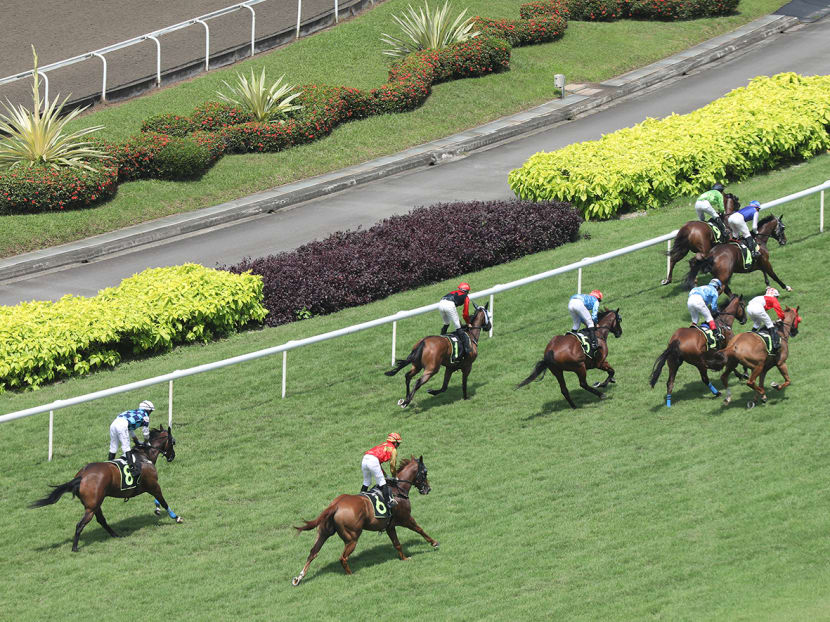
Horse owner Freddy Goh, 73, said that usually only the best horses end up in such places.
“Some horses are lucky. The owners appreciate what they have done for them, so they put them in very nice pastures for them to grow old and enjoy their time until they die… (but) they have to pay for the horse to be there, they’re eating the grass of that piece of land.”
One of Mr Goh’s horses, Kranji First Hero, first arrived on Singapore’s shores as a promising racehorse in Oct 2022, and now, barely eight months on and without a race to his name, has to find a new home.
But for injured horses who are unable to race or work, the situation is even more dire.
Trainers said that some horse owners would be unwilling to pay for the maintenance of the horses following STC’s closure, leaving trainers to bear the cost and without feasible options for exportation or retraining.
In the end, with ailing health and nowhere to go, it is likely that some of these horses would be put down.
Mr Zyrul, who competed in multiple races at the Silver Bowl Cup on Sunday afternoon, welled up in tears as he spoke to TODAY.
“I'm a human being. I can still learn a new skill… But for the horses, what can the horses do? They are born (and) they are bred to race. And these are 700 live animals you're talking about.
“You can't bring them home to your house. And the saddest thing is those older horses most probably will get shot. They'll get put down.”
Mr Goh said: “It’s a very sad thing. Horses, they run for you, they make you happy, they give you the thrills, and in the end, they get slaughtered.
“These 700 horses will not find a new home so easily.”
CORRECTION: An earlier version of this article said that Mr Zyrul Nor Azman, 35, is a horse trainer. This is incorrect. He is a jockey. We are sorry for the error.
Related topics
Singapore Turf ClubStay in the know. Anytime. Anywhere.

Subscribe to our newsletter for the top features, insights and must reads delivered straight to your inbox.
By clicking subscribe, I agree for my personal data to be used to send me TODAY newsletters, promotional offers and for research and analysis.