
Failing to report info on HIV data leak an offence? MPs pose more questions in Parliament
SINGAPORE — After Health Minister Gan Kim Yong addressed the data leak of HIV patients on Tuesday (Feb 12), Members of Parliament (MPs) raised more questions.
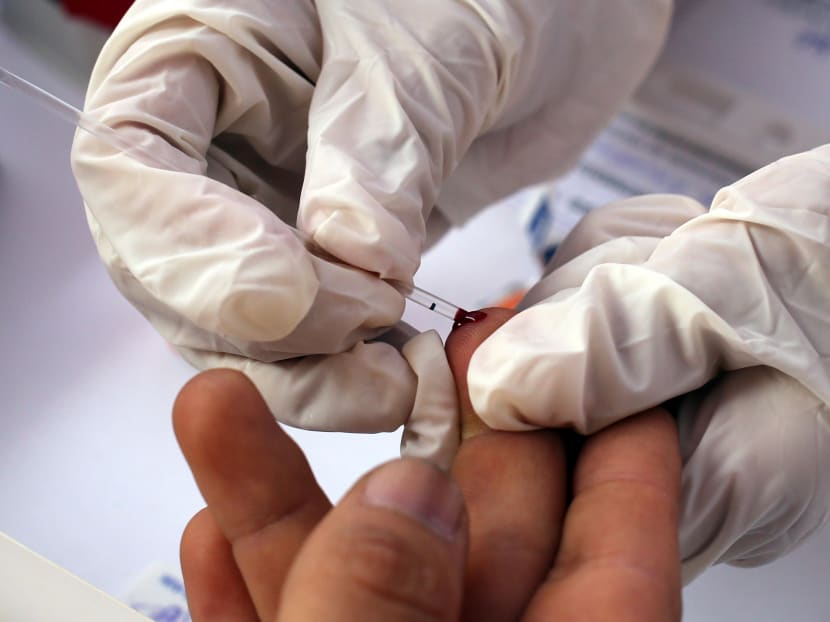
Two weeks ago, the Ministry of Health announced that Mikhy K Farrera Brochez, an American, had leaked the confidential records of 14,200 HIV-positive Singaporeans and foreigners, along with 2,400 of their contacts.



SINGAPORE — After Health Minister Gan Kim Yong addressed the data leak of HIV patients on Tuesday (Feb 12), Members of Parliament (MPs) raised more questions.
These included whether people are liable for prosecution if they come into possession of the leaked HIV data, whether the Government can better support patients diagnosed with the human immunodeficiency virus (HIV), whether it is time to review laws banning HIV-positive foreigners from living long-term in Singapore.
Two weeks ago, the Ministry of Health (MOH) announced that Mikhy K Farrera Brochez, an American, had leaked the confidential records of 14,200 HIV-positive Singaporeans and foreigners, along with 2,400 of their contacts. The information spanned almost three decades from 1985 up to January 2013.
Since then, the ministry has successfully contacted 2,400 of the 3,500 affected HIV-positive Singaporeans who are still alive, Mr Gan said on Tuesday.
He clarified that many of the affected foreigners were work-pass applicants who never worked in Singapore, or previously worked here but are no longer in the country.
Here are some questions that the MPs posed:
1. Will those whom Brochez contacted be liable for prosecution, if they did not report it to MOH? (Non-Constituency MP Daniel Goh)
Following the public announcement last month, a few parties informed MOH that Brochez tried to make contact with them last year and gave them links to the confidential information online. The links have since been disabled.
Mr Gan said that whether it was illegal or legal for the parties to retain the information or links, they should forward what they received to the ministry and the police for investigations.
Law and Home Affairs Minister K Shanmugam chimed in to say: “Technically, (there) could potentially be some offences under the Official Secrets Act, particularly if further action is taken upon receipt to publicise it or send it to others. But as (Mr Gan) said, if it’s sent to MOH, I don’t see the AGC (Attorney-General’s Chambers) taking action in those circumstances.”
In his ministerial statement, Mr Gan reminded the House that the police would “take stern action”, including prosecution, against those who possess, communicate or use any of the data.
Should the MOH detect any disclosure or online publication of the confidential information, it will work with the relevant authorities and parties to take down the content and disable access to the data, Mr Gan added.
2. What specific measures is MOH taking to ensure that decades of painstaking effort to encourage people to get tested for HIV are not negated? (Nominated MP Anthea Ong)
Mr Gan reiterated that anonymous HIV testing is available at 10 sites across Singapore, as part of efforts to make HIV testing and counselling services more widely available.
“The identity of the person will be kept anonymous. MOH will only receive an aggregated number of people who have tested; we do not get identities,” he said.
The ministry will continue to step up public education efforts to reduce the stigma on HIV patients, and will “do our utmost to protect data and information as much as we can”, Mr Gan added.
“At the same time, I think the effort is not just the Government alone. Society as a whole should come together and show support with those living with HIV. By showing them support, we are encouraging more of them to come forward for testing and treatment,” he said.
Earlier, the Health Minister noted that over the years, the MOH has increased financial support and lowered the financial barriers for HIV treatment through the Central Provident Fund’s MediSave and MediFund. HIV treatment has improved significantly over the years, and early treatment can delay its progression and improve quality of life.
Since 2015, HIV-positive individuals have been covered by MediShield Life should they be hospitalised, Mr Gan added.
3. In light of the move to destigmatise HIV, would it be appropriate to review immigration or employment regulations for those with HIV? (Nominated MP Walter Theseira)
Mr Gan would only say that the Government conducts such reviews “quite regularly”, taking into account the concerns and interests of Singaporeans, as well as practices around the world.
Restrictions on short-term stays for HIV-positive foreigners were lifted in 2015. Under the Immigration Act, foreigners who have HIV or acquired immune deficiency syndrome (Aids) are still barred from working or living here long-term.
Countries such as Australia and New Zealand have similar restrictions on long-term stay, Mr Gan pointed out.
“As I explained, HIV remains a very serious infectious disease. We need to be very cautious approaching this issue, and we want to make sure we are able to manage the disease environment here and protect Singaporeans where possible,” he added.
4. Will MOH consider formalising and bolstering a support system for HIV-positive individuals? (Holland-Bukit Timah GRC MP Christopher De Souza)
Mr Gan said that the ministry works with advocacy and support groups, such as Action for Aids, to see how best to support those with HIV.
“We’ll look at how we can formalise this arrangement in a more structured way, so it’s more sustainable and there’s a continuity in the efforts. We take your point and will explore other possibilities,” he added.
Mr De Souza also mentioned an Australian voluntary welfare organisation, Living Positive Victoria, that has a team of peer navigators who are also persons living with HIV. They work extensively with HIV-positive individuals and their families one-on-one, he added.
Mr Gan said: “Indeed, we will learn from many other countries and their experiences, and share their practices on how to better support persons with HIV.”
5. What is the risk of potential suicides among affected individuals? What could MOH be doing to provide them more support? (MacPherson SMC MP Tin Pei Ling)
Medical social workers who have been calling the affected individuals to inform them of the data leak have told him that some of them were suicidal, Mr Gan said.
When that happens, the social workers will “very often” try to refer them to people they are familiar with, especially those who were in their support group so that they may continue supporting them, he said.
“They have to manage the case very delicately. They have to sense the distress patients are facing and make a judgement, how much to tell them, (whether to) stress them further or refer them to help,” he said.
“But these are very delicate issues and I don’t want to go into specific details for various reasons.”
Earlier, Mr Gan addressed some MPs’ questions on how to protect the psychological welfare of affected individuals.
Medical social workers helped to first identify those likely to require more support, so the designated MOH officers could exercise extra care and provide more support when calling them. Counsellors were also on standby.
Doctors and medical social workers were at the relevant public hospitals to attend to affected individuals, Mr Gan added.
The Ministry of Manpower and agencies such as the Life Insurance Association also provided public assurances on some concerns, including wrongful dismissals on the grounds of HIV.
Stay in the know. Anytime. Anywhere.

Subscribe to our newsletter for the top features, insights and must reads delivered straight to your inbox.
By clicking subscribe, I agree for my personal data to be used to send me TODAY newsletters, promotional offers and for research and analysis.