
Fall in new dengue cases in Singapore’s worst dengue cluster in Woodlands: NEA
SINGAPORE — Singapore’s worst dengue hotspot, in Woodlands, has reported a marked decline in the number of new cases, although the number of Aedes aegypti mosquitos — which transmit the dengue virus — in the area remains high.
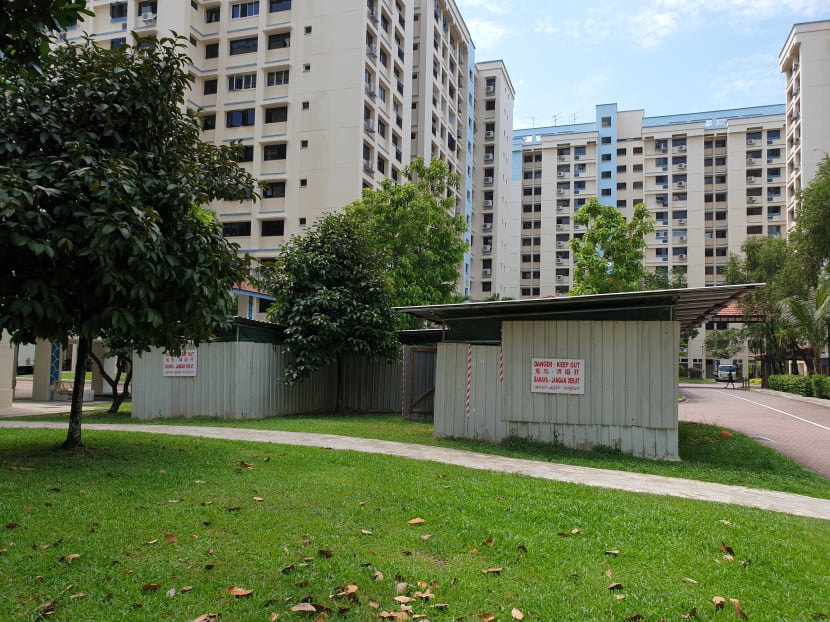
A construction site store near Block 787C in Woodlands Crescent. Some residents are worried that construction activity provides breeding grounds for the Aedes aegypti mosquito that transmits dengue.



SINGAPORE — Singapore’s worst dengue hotspot, in Woodlands, has reported a marked decline in the number of new cases, although the number of Aedes aegypti mosquitoes — which transmit the dengue virus — in the area remains high.
In an email response to TODAY on July 10, the National Environment Agency (NEA) said that there had been seven cases of dengue reported in the Woodlands cluster over the two weeks ending July 9. This was a drop from 27 cases reported in the final week of May when transmission was at its peak.
Woodlands is home to the largest cluster of dengue in Singapore, in an area covering Woodlands Avenue 6, Woodlands Circle, Woodlands Crescent, Woodlands Drive 60, Drive 70 and Drive 72.
As of July 12, a total of 215 cases of dengue had been reported in the cluster so far. In comparison, the second-largest cluster covering Geylang Road, Guillemard Road, Sims Avenue and Westerhout Road has recorded 168 cases.
This dengue season in Singapore has been one of the worst in several years, with more than 6,700 dengue cases across the island so far — more than the last two years combined. The virus has also claimed five lives so far, equal to the total death count in all of 2018.
The NEA said it had observed a slowing down in dengue transmissions in the last six weeks following intensive vector control operations and ground engagement efforts with community partners in the Woodlands cluster.
“Since the cluster was notified on March 28, NEA has conducted multiple rounds of inspections in the cluster areas. NEA officers are continuing with our inspection of the area.”
The NEA said that it had found and destroyed 86 mosquito breeding habitats of which 75 were in residential premises and the remaining were in common areas.
However, the NEA warned that the population of Aedes aegypti mosquitos remains high in the Woodlands cluster.
“Data from our Gravitrap surveillance indicates that the adult Aedes aegypti mosquito population remains high. As adult mosquitoes could be resting in indoor spaces, we also request residents to allow NEA officers to carry out spraying in their homes,” said the agency.
TOWN COUNCIL STEPPING UP ESTATE INSPECTIONS
Residents in Woodlands that TODAY spoke to pointed to poor maintenance as well as the presence of construction sites, which could have led to potential mosquito breeding spots.
When TODAY visited the area along Woodlands Ave 6 on June 24, banners around the cluster showed that 190 people had been infected with dengue as at that date.
Ms Maggie Tan, 67, felt that her neighbours had not properly maintained their potted plants, leading to a rise in mosquito breeding spots.
Ms Tan, a furniture salesperson and resident of block 762 for four years, said that she took an extra effort to empty dishes with stagnant water and only grew plants which did not require regular watering.
Mr Robert Michael Karuppiah, an operations executive and 20-year resident of block 787B Woodlands Crescent, also felt that the lack of cleanliness could have contributed to the area becoming a dengue hotspot.
“I’ve already noticed that the area has become dirtier in the past few months, even before it became a dengue hotspot. I’ve seen rubbish being uncleared for many weeks, and it is only recently that they have been cleared.”
He said that water collected in leaf litter in drains and on open spaces, as well as in rubbish around the block could have turned them into mosquito breeding spots.
Mr Robert and his two children, aged 15 and 19, all came down with dengue in May this year. It was Mr Robert’s second bout of dengue, with his first occurring in October last year.
Another Woodlands resident, Ms Latchami Govindasamy of block 764 Woodlands Circle, also pointed to construction sites and stores which hold construction equipment around the area as possible places in which breeding sites could have formed.
“These areas are not open, so we are not sure if there could be breeding spots in there or if checks (by the authorities) have been conducted.”
However, Ms Latchami added that NEA officials had been conducting regular checks at her block, and noted that they had visited her home for checks the week before.
In response to comments made by residents that estate cleanliness and the presence of construction sites could have contributed to a higher number of mosquitoes in the area, the Sembawang Town Council said that it had preventive measures in place to control dengue in its estates.
“Our pest control operators have intensified the efforts in the treatments and misting in the estates. Fogging operations are also being carried out jointly with NEA,” said the Sembawang Town Council in an email response to TODAY’s queries on July 3.
It added that estate inspections have also been stepped up to ensure that drains are cleared and treated daily.
“Any discarded receptacles found at the common areas and landscape sites are removed immediately. Scheduled rooftop inspections are also being conducted and larvicide is applied to eliminate any possible potential mosquito breeding,” added the Town Council.
WHY SOME AREAS ARE MORE PRONE TO DENGUE
Assistant Professor Vincent Pang of the National University of Singapore’s Saw Swee Hock School of Public Health attributed the rise of dengue clusters in certain areas to three factors.
First, a dengue cluster has more chance to occur when there is a greater clustering of households within a residential area.
Second, the risk of a dengue cluster occurring increases when cluster herd immunity is low against the predominant dengue-serotype. Cluster herd immunity refers to the protection on a population afforded by vaccination. There are four dengue serotypes, with the predominant circulating serotype being dengue-2.
Lastly, an area is also more likely to be vulnerable to dengue if there is a high frequency of residents travelling to dengue-endemic countries such as Malaysia, Indonesia, Thailand and the Philippines. Residents travelling to those countries have a higher risk of being infected with dengue and importing the virus into Singapore, making their neighbourhood more at risk.
He noted significant increases in dengue cases in these neighbouring countries. In Malaysia, for example, the number of dengue cases from Jan 1 to June 14 was 56,497, up from 32,435 for the same period last year.
Dr Pang said that areas with a greater number of construction sites are also more susceptible to dengue, and thus it is important for those in the construction industry to look out for potential mosquito breeding areas within their work sites and monitor the trend of workers who fell ill due to dengue.
“Older buildings may also be at higher risk of mosquitoes breeding as compared to newer ones as there may be more cracks and holes suitable for mosquito breeding. These could be at areas beyond access for maintenance or mosquito-control efforts by town councils,” he said.
Related topics
dengue Woodlands Aedes mosquitoStay in the know. Anytime. Anywhere.

Subscribe to our newsletter for the top features, insights and must reads delivered straight to your inbox.
By clicking subscribe, I agree for my personal data to be used to send me TODAY newsletters, promotional offers and for research and analysis.






