
FB groups help rekindle kampung spirit
SINGAPORE — Set up initially by would-be residents of new Build-to-Order (BTO) projects to keep one another up-to-date with the pace of construction, neighbourhood Facebook groups subsequently enabled homeowners to band together to rectify flat defects and address other teething issues.

SINGAPORE — Set up initially by would-be residents of new Build-to-Order (BTO) projects to keep one another up-to-date with the pace of construction, neighbourhood Facebook groups subsequently enabled homeowners to band together to rectify flat defects and address other teething issues.
But these groups have not only remained long after the settling-in period, they have also grown in size and influence — so much so that political analysts and Members of Parliament (MPs) believe they are changing the face of municipal politics.
At some precincts, residents who set up the Facebook groups went on to join the Residents’ Committees (RCs), and the groups are used as a link between the RCs and the residents. However, at other precincts, the groups could be supplanting the RCs by organising social activities and meeting the needs of the residents. MPs told TODAY that they support these groups, as they build community spirit and enable residents to help one another. In some cases, the groups help MPs reach out to residents, they said, but there have also been instances where MPs were barred from joining the groups.
Some residents of The Peak@Toa Payoh recently banded together on the precinct’s Facebook group page to voice their objection to the building of an RC centre at a void deck. The group has about 1,100 members.
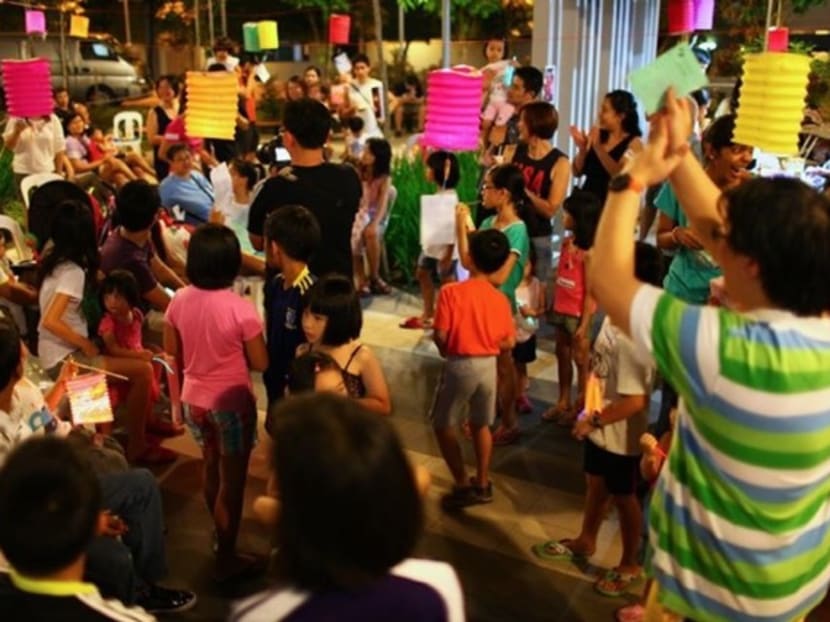
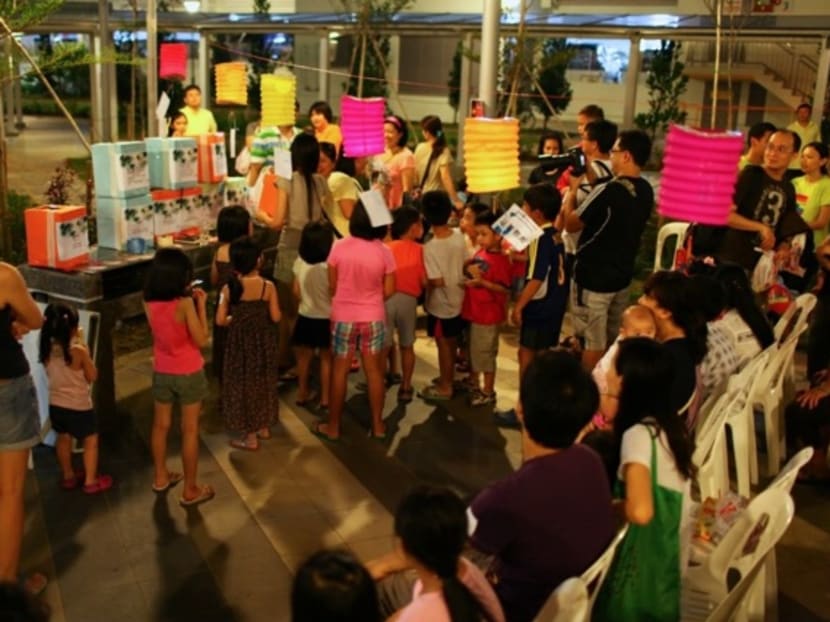
A member of the group has also created a messaging service that allows residents to alert their neighbours when the headlights of their parked vehicle are left on. The group has organised social gatherings during occasions such as Halloween and the Mid-Autumn Festival, which were well attended.
“It feels like the kampung days all over again, with everyone chipping in (to help one another),” said Ms Geraldine Wee, a moderator of The Peak@Toa Payoh Facebook group. She recalled how a resident asked the Facebook group if others wanted fried oyster omelette, which he was going to buy, and ended up buying 30 packets for his neighbours.
For residents in the 720-member Blossom Residences Facebook group, they organise last-minute potluck or movie sessions, among other things. They are currently soliciting views to arrange for a private bus service that residents can take to go to work in the Central Business District every morning.
Over at the Segar Meadows precinct, some residents once detected a pungent smell wafting into their homes during the Chinese New Year period, and posted on the estate’s Facebook group. A resident then created an online survey to identify when the smell usually surfaces. The problem was traced to a new condominium nearby, and it was addressed.
Ms Hilda Ng, an administrator of the Segar Meadows Facebook group, said: “You felt part of the community and if there was anything I am unsure of, I can post it online and get a reply in the next half-hour.” She is now a member of the RC, with her neighbour, Mr Alex Chen.
In fact, Mr Chen chairs the RC. He said he sees himself as a middleman who collects feedback from residents and passes it on to the authorities.
He said his Facebook group initially organised social activities for residents, but since the community has grown, the events are now done by the RC, which has the resources to organise large-scale events.
Mr Jarod Yeo, who is active on the Anchorvale Cove Facebook group, which has about 990 members, pointed out that unlike Facebook groups, RCs are able to connect residents across different estates, and have dedicated people to organise events. Mr Yeo said he is interested to join the RC.
However, though she sits on the RC, Ms Ng feels that residents are more inclined to join and take part in activities by a group that had evolved organically.
Mrs Wee said RCs “tend to be associated with political affiliations”. Adding that she was not convinced that RCs adequately represent residents’ voices, she said that residents can engage in meaningful dialogue on Facebook. “(RC activities) have a political feel to it, with the grassroots adviser wearing the hats of both advisor and Member of Parliament,” she said.
RCs were introduced in 1978 to foster community spirit and improve the neighbourhoods’ living environment.
Reiterating the role of RCs as the official bridge between residents and the Government, MPs said they would encourage those active on the Facebook groups to join RCs.
Holland-Bukit Timah GRC MP Liang Eng Hwa noted that RCs and online groups cater to different segments of the population, as not everyone is IT-savvy. Together, RCs and the groups complement each other, he said.
Tampines GRC MP Baey Yam Keng stressed that the roles and functions of RCs and online groups were not mutually exclusive, and both help residents connect with their community. Still, he acknowledged that RCs have to be more proactive now, such as getting feedback on community activities if attendance is low, he said. Indeed, RCs have to raise their game and leverage on the informal online groups formed among residents, said Pasir-Punggol GRC MP Zainal Sapari.
Political analysts and observers felt that RCs still have a role to play, particularly in supporting vulnerable groups such as the elderly, said National University of Singapore sociologist Paulin Straughan who noted that RCs were not just meant to organise social activities.
Still, Singapore Management University law don Eugene Tan said: “One concern I have is whether (the presence of) these (online) communities suggest that the RCs are not engaging these people adequately and whether their concerns are not attended to.”
While the online groups could spur RCs to reach out to residents through more varied ways, they may also become echo chambers that are exclusive in their membership, he said.
Former Nominated MP Siew Kum Hong welcomed the presence of these online communities as they reflect greater empowerment of residents. “Over time, we can expect these self-organised groups to influence the political agenda more actively, if only at the municipal level. So the RCs and MPs will have to adjust and accommodate,” he said.
Stay in the know. Anytime. Anywhere.

Subscribe to our newsletter for the top features, insights and must reads delivered straight to your inbox.
By clicking subscribe, I agree for my personal data to be used to send me TODAY newsletters, promotional offers and for research and analysis.






