
Financial sector staff must enhance skills as technology advances: Tharman
SINGAPORE — Workers in the financial sector must continue to enhance their capabilities as rapid changes in technology will call for wider and deeper skills, said Deputy Prime Minister and Finance Minister Tharman Shanmugaratnam yesterday.
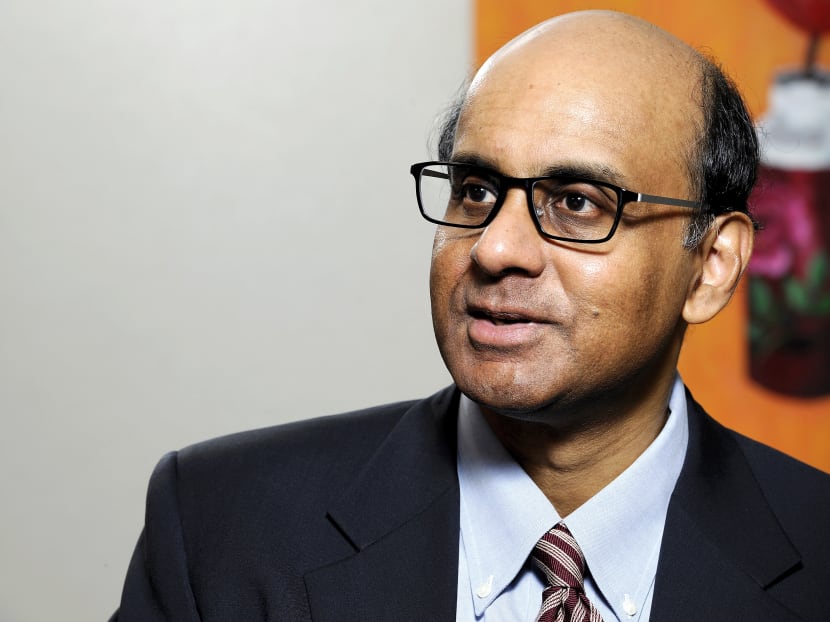
Mr Tharman Shanmugaratnam. Photo: Bloomberg

SINGAPORE — Workers in the financial sector must continue to enhance their capabilities as rapid changes in technology will call for wider and deeper skills, said Deputy Prime Minister and Finance Minister Tharman Shanmugaratnam yesterday.
The advent of mobile devices and online platforms has changed the face of banking services, while greater availability of information has led to more sophisticated customers and higher compliance requirements, he noted.
“For rank-and-file workers, this has meant handling new and more complex tasks, whether in serving a customer or meeting compliance and risk management requirements …The need for greater skill and expertise will apply to PMEs (professionals,managers and executives) too,” he said at the 60th anniversary dinner of the Singapore Bank Employees’ Union (SBEU).
Today, the financial sector employs almost 190,000 people, nearly three-quarters of whom are Singaporeans, Mr Tharman said. He noted that the number of clerical workers had remained stable in the past 15 years, while PME jobs grew fourfold.
While the Government will continue to invest in talent development, employers will also need to do their part, he said. “They should proactively develop people, integrate skills development into their business strategies and develop structured pathways for workers to progress in their careers.”
As Singapore’s workforce continues to age, the banking industry must ensure older workers can be meaningfully employed should they wish to be, he added.
This has been a key focus of the labour movement and the SBEU has been an active advocate over the years.
“Through the SBEU’s commendable efforts, nine banks — covering three-quarters of the SBEU’s ordinary membership — now offer re-employment to workers aged 62 to 65,” Mr Tharman said, adding that the re-employed workers did not suffer any cut in wages. The nine banks are OCBC, UOB, Standard Chartered, HSBC,Maybank, Bank of America, RHB, Bangkok Bank and Credit Agricole.
“I hope the SBEU and employers will continue to work together on this, and (I) can assure you the Government will support you in this effort,” he said, as he urged the sector to tap the Government’s Special Employment Credit and Workfare Training Support schemes.
Registered as a trade union in 1954, the SBEU has 33 member banks and around 6,000 member employees in the rank-and-file workforce. The union was instrumental in negotiating a flexible wage system for these workers during the financial crises of the late 1980s and early 2000s, helping the sector stay resilient in tough times.
Mr Tharman commended the SBEU for these achievements, which had helped workers keep their jobs and enjoy long-term wage growth.
“Indeed, (financial industry employees) earn about 26 per cent more than rank-and-file workers in other industries,” he said.
Stay in the know. Anytime. Anywhere.

Subscribe to our newsletter for the top features, insights and must reads delivered straight to your inbox.
By clicking subscribe, I agree for my personal data to be used to send me TODAY newsletters, promotional offers and for research and analysis.






