
With friend’s recipe in hand, aspiring hawker took up NEA’s scheme to get business going
SINGAPORE — After working in a bank, making watches and being a bartender, Mr Kwan Yee Liang finally decided to try his hand at being a hawker when he found a low-cost way to do it.
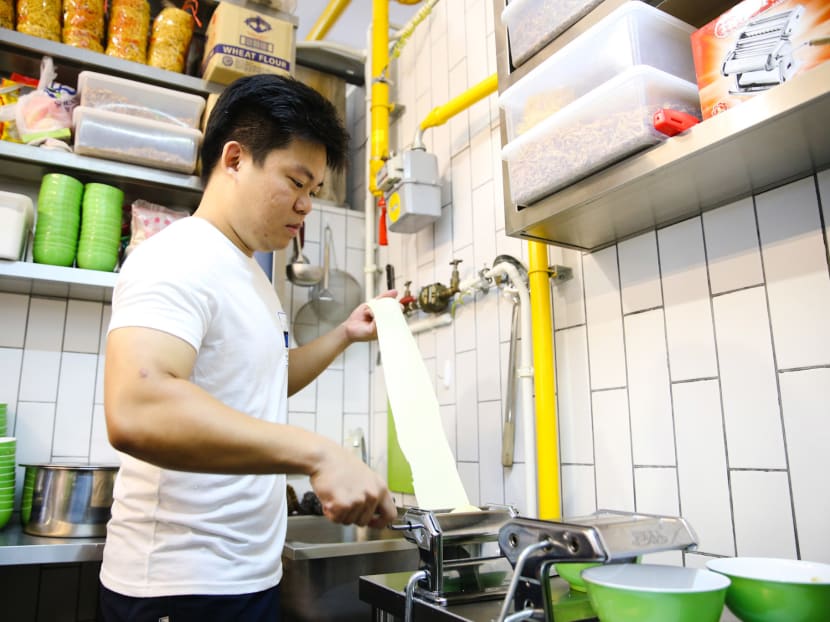
Mr Kwan Yee Liang, 29, is one of 12 hawkers who have joined the National Environment Agency's Incubation Stall Programme since it started in late February this year.



SINGAPORE — After working in a bank, making watches and being a bartender, Mr Kwan Yee Liang finally decided to try his hand at being a hawker when he found a low-cost way to do it.
For more than five years, the 29-year-old had toyed with the idea of selling traditional Kuala Lumpur handmade noodles in Singapore, ever since he tried them at his Malaysian friend’s stall in KL. However, his friend was reluctant to take his business to Singapore.
Then, if he did it himself, the cost of starting up may be high and he was “not very good” at cooking. “Cooking food at home, I also don’t do,” Mr Kwan jested.
In the end, he managed to persuade his friend to teach him how to make the dish, and all that was left was successfully bidding for a hawker stall.
As he began researching, he found out that the National Environment Agency (NEA) had rolled out its Incubation Stall Programme, where successful applicants get to run a hawker stall at half the usual rent for six months.
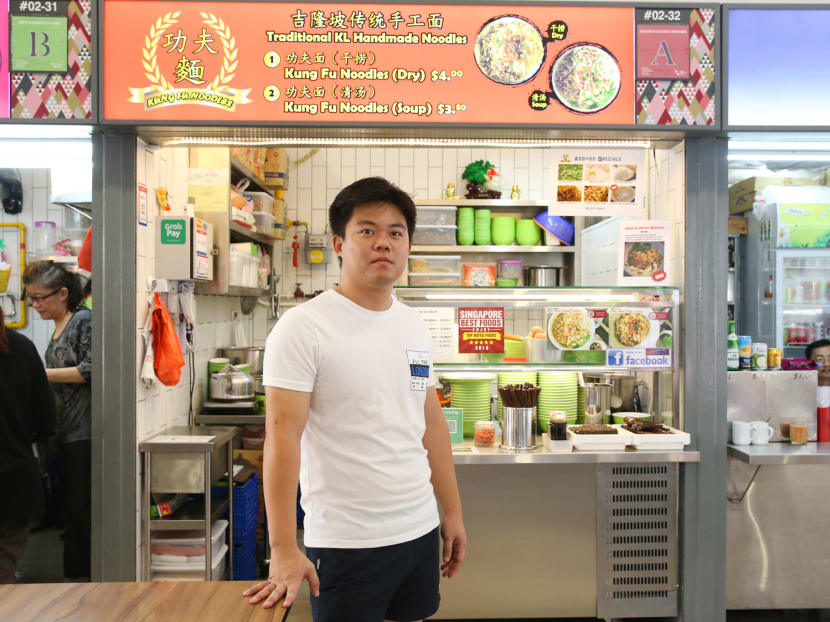
With no knowledge of the hawker trade, Mr Kwan jumped at the chance to learn the required skills.
He now runs Kung Fu Noodles, which opened in July, at Bukit Merah Central Food Centre.
Mr Kwan is one of 12 hawkers who have joined the incubation programme since it started in late February this year. The NEA has received more than 40 applications, and 10 out of 13 stalls are now occupied. The stalls are located at 10 hawker centres around the island and they come pre-fitted with basic equipment to lower the upfront capital investment needed to start the business.
Applicants must not have had prior experience in managing or operating a food stall or shop.
MONITORING TAKE-UP RATE
On Wednesday (Oct 10), Dr Amy Khor, Senior Minister of State for the Environment and Water Resources, announced that two more stalls will be added, bringing the total number to 15. The new stalls will be at Chinatown Complex Food Centre.
“This programme is quite new — we will continue to monitor the take-up rate and get feedback from the earlier batch of stallholders before we decide whether we should add more (stalls). We are also looking at making a decision about long-term plans for these stallholders, if and how we can improve on the programme,” she told reporters during a visit to Bukit Merah Central Food Centre and the hawker centre in Ghim Moh.
Of the three stallholders who joined the programme when it began in February, Dr Khor said that the NEA allowed one of them to stay beyond the six months to April next year, as she was looking for a permanent stall.
One terminated the contract for personal reasons, while the other felt that it was not his cup of tea, Dr Khor added.
She noted that the average age of the stallholders is about 34.
For Mr Kwan, the programme has been useful, even though he struggled at first when learning the ropes.
“To me, everything is new. You need to get ingredients from the supplier and all these come in big quantities. It's not easy to cook for a hundred people… On the first day, everything was a mess,” he recalled.
Along with his parents, who help out during lunchtime, he sells two types of handmade ban mian (noodles): the “dry” version goes for S$4, while the “soup” version costs S$3.80.
Despite the long hours — his stall is open every day — Mr Kwan enjoys being a hawker more than his previous jobs.
“This is more flexible. I can wear slippers; if I wake up late, I just earn less,” he said.
Sign up for TODAY's WhatsApp service. Click here:
Stay in the know. Anytime. Anywhere.

Subscribe to our newsletter for the top features, insights and must reads delivered straight to your inbox.
By clicking subscribe, I agree for my personal data to be used to send me TODAY newsletters, promotional offers and for research and analysis.






