
The Future of Work: Building robots to rule the world? No, the field of AI is more than that — and less scary
SINGAPORE — Robot assassins wiping out humans in the Terminator movies. Humans tapping the “power” of cutting-edge artificial intelligence technology with unforeseen consequences, as depicted in science-fiction series Black Mirror on Netflix. While such too-close-for-comfort predictions and scenarios can be unsettling, those working in the rapidly emerging field are quick to correct the misperception.
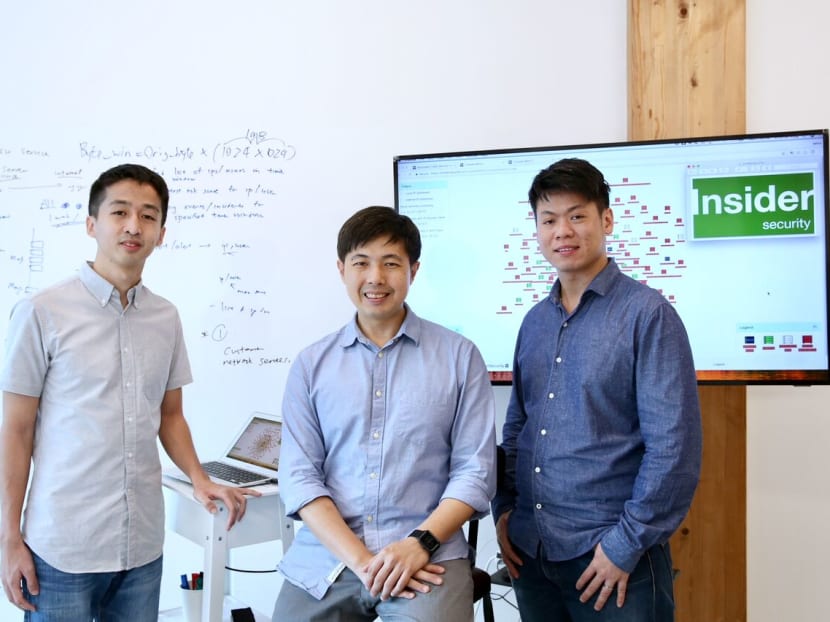
(From left to right): InsiderSecurity's algorithm engineer Heng Wancong, and co-founders Jonathan Phua and Chen Kin Siong.

Late last year, a study by consulting firm McKinsey estimated that almost a quarter of work activities in Singapore could be displaced by 2030. At the same time, however, a vast amount of jobs will be created, with new technologies spawning many more jobs than they destroyed, the study pointed out. The introduction of the personal computer, for example, has enabled the creation of 15.8 million net new jobs in the United States in the last few decades, even after accounting for jobs displaced.
In a new weekly series, TODAY looks at The Future of Work — the emerging jobs fuelled by technological advancements which may not even have existed a few years back, but are set to proliferate within the next decade or so. In the third instalment, we feature tech experts in the rapidly-emerging field of artificial intelligence, which — beyond the wild Hollywood depictions — has the potential to improve almost every aspect of everyday life.
SINGAPORE — Robot assassins wiping out humans in the Terminator movies. Humans tapping the "power" of cutting-edge artificial intelligence technology with unforeseen consequences, as depicted in science-fiction series Black Mirror on Netflix.
Entertainment media has no lack of fictitious examples to show how gadgets and digital advancements affect daily lives, take away jobs and human independence, alter political outcomes, and perpetuate violence, among other dangers.
While such too-close-for-comfort predictions and scenarios can be unsettling, those working in the rapidly-emerging field are quick to correct the misperception.
The application of artificial intelligence, or AI for short, is so vast that it is limited only by human imagination and has the potential to improve almost every aspect of everyday life, they said. Surpassing conventional approaches, it can even pick up hostile activities that cannot be detected otherwise.
Product engineer Michael Lee, 34, for example, works at homegrown start-up JobTech. He spends much of his time in the office tinkering with the algorithm of the AI that powers the firm's job-matching search engine.
Since he started work in January this year, his family and friends have often asked whether he is "building machines that can eventually rule the world".
"Those are perceptions created by pop culture," he said.
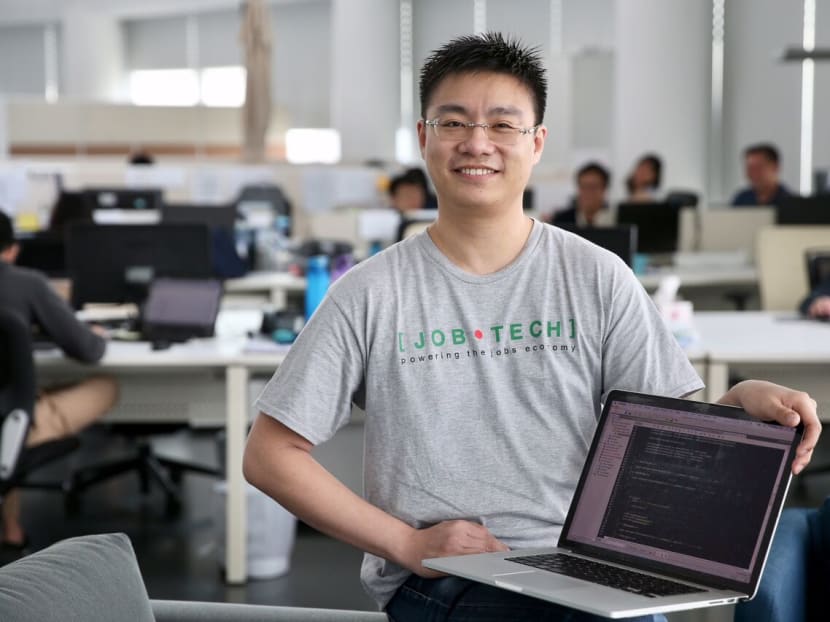
Product engineer Michael Lee, 34, works at homegrown start-up JobTech. He spends much of his time in the office tinkering with the algorithm of the AI that powers the firm's job-matching search engine. Photo: Koh Mui Fong/TODAY
Another "myth" is that people often think of AI "as a magical box, where you can feed it any information and it will tell you what you want", he added.
Such self-generated special powers assigned to standalone technology are overrated. "In reality, engineers build the AI system. We have to define what kind of information it accepts, how it uses the information, and finally what kind of things it will do or tell you," Mr Lee explained.
The goal of AI is to "benefit people, by performing tasks that were previously not possible, at an unprecedented scale", he insisted.
At JobTech, what the AI primarily does is to run through the database of job candidates to determine whether they match the criteria listed in job postings.
Once a match has been identified, an email alert will be sent to the employer, who can then get in touch with the candidate.
In adjusting the algorithm, therefore, there are factors that Mr Lee has to consider. These include whether the AI is able to detect the minimum job experience and necessary skills of jobseekers, when it extracts information from candidates' resumes, the job descriptions posted on other recruitment portals as well as companies' websites.
He also pointed out that AI comprises other technologies such as data mining and machine learning. To facilitate machine learning, for example, the system — no matter how smart — still has to rely on users feeding it information about the labour market, including analysis from economists and employers.
JobTech's AI system also has to "understand" the various skills required in a range of disciplines. This means analysing 150 million global job postings before it can create an immense skills map that spans all industries and all skill sets.
"Using this, our product can then analyse very large volumes of job descriptions and resumes efficiently, to extract information, make sense of it and identify the best matches," Mr Lee said.
At the end of the day, his goal and that of the firm is clear: The AI is a tool to help find fitting roles for the more than 50,000 active jobseekers in JobTech's database.
"We want the AI to do it as effectively and efficiently as possible."
Mr Lee is JobTech's first product engineer — before that, the responsibility of dealing with the AI system fell to one of the firm's founders.
Having worked for a robotics firm that deals with autonomous vehicles, Mr Lee said that his latest job scope is not much different from his last. "It's all about data and how you make use of it."
AI-POWERED SURVEILLANCE
Over at InsiderSecurity, a Singapore cyber-security start-up, AI also fuels part of its operations.
The firm's AI system, called InsiderSecurity Monitor, was created to detect any hidden malware that has been planted in their clients' networks.
The job of algorithm engineer Heng Wangcong is to improve the AI's algorithm, so that it can better study the behaviour of its client's networks and detect any anomalies.
On why AI is needed for such surveillance, the 27-year-old said that when a malware or an attacker is hiding in the network, it will give out different signals, which can be hard to detect without advanced sensors or sophisticated algorithms.
Mr Heng, who joined the firm last December, is the first person to be hired in such a role.
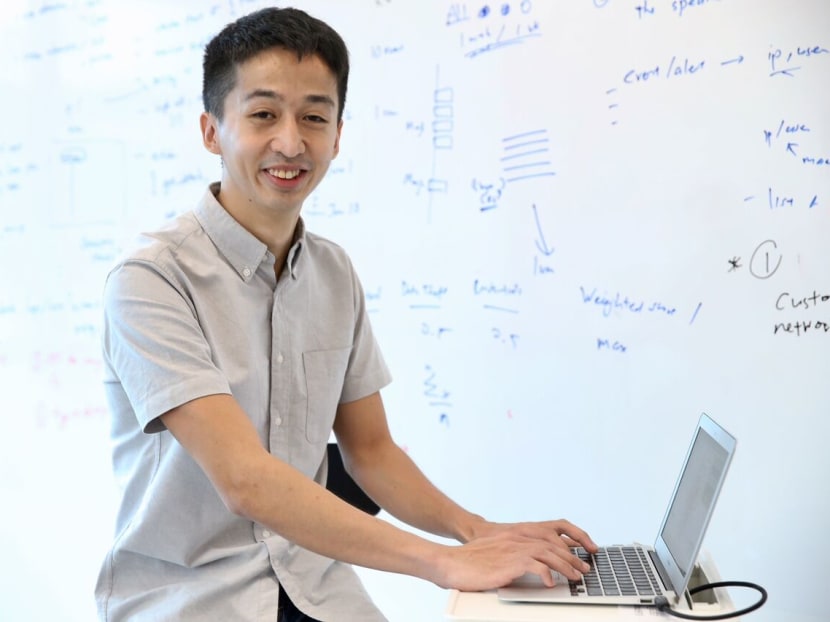
Algorithm engineer Heng Wangcong said that when a malware or an attacker is hiding in the network, it will give out different signals, which can be hard to detect without advanced sensors or sophisticated algorithms. Photo: Koh Mui Fong/TODAY
Before him, this task was handled by the firm's co-founders when operations started in 2015. Mr Jonathan Phua, 40, and Mr Chen Kin Siong, 36, the co-founders, used to work at the DSO National Laboratories, Singapore's largest defence research-and-development organisation.
Majoring in physics at Nanyang Technological University, Mr Heng did not possess much knowledge on computing software, and had to learn about AI on the job.
Asked whether it was a steep learning curve for him, he said: "What you learn (from studies) is very, very different from how it's applied in the real world. What I did in (university) for six months, I can learn everything in one month through real-life application."
In short supply though, are the opportunities for him to learn more about how to beat the stealthy and innovative tactics employed by cyber hackers.
Overturning the far-out drama of security systems being seized and overtaken by malicious agents, Mr Heng said of the reality for him: "Hackers don't come constantly. The challenge that we face is the lack of real attacks. So, if they don't attack, we won't know how to counter it and improve our counter-measures."
In dealing with the invisible hand of technology, the AI system has to be conditioned to detect various types of hidden malware. The firm thus has to simulate attacks on its own networks, as part of machine learning.
Mr Phua said that this is needed to tackle instances where, after an attacker or malware has breached a network, it can stay hidden for as long as 17 months on average.
Its AI has to discover and stop the hidden attacker as early as possible to contain the breach before there is any serious business impact.
One benefit of using technology is that physical or mental exhaustion will not affect its function when vigilance is needed. The system, for instance, has detected cyber-attacks that it was not designed to uncover. It once caught a covert botnet originating from Singapore that had been targeting one of its customers.
"This dangerous, stealthy Singapore botnet would have been impossible to detect via manual monitoring or traditional approaches," Mr Phua said.
THE HUMAN CONNECTION
The use of AI can be found in almost every sector, from cars that self-navigate in the streets to streetlights that analyse traffic flows and automatically adjust the level of brightness.
Having been around for more than 20 years, AI systems have been able to do "more data crunching and analysis, that was previously not possible, but possible now", Mr Chen said.
Contrary to popular belief, the application of AI is also not confined to smart robots, which many fear will take over jobs.
While United States-based research firm Gartner reported that AI is projected to eliminate 1.8 million traditional jobs worldwide by 2020, the good news is that it is also set to create 2.3 million jobs — that is 500,000 more jobs — by the same period.
Human resources are still needed to create, build up, power and manage the technological advancements.
AI plays by a certain order in the system, and that can also be thrown off by something it cannot "learn", predict and master: Human behaviour and impulses.
Mr Lee from JobTech said that there have been times when the firm's AI system managed to find a perfect job match for a candidate, only for the person to turn it down because "he was not really looking for a job".
There is an assumption that AI can "mind-read", but he dispels such a notion, saying that the effectiveness of AI depends on the data it is being fed.
In an attempt to improve this, JobTech gathers feedback from jobseekers so that the algorithm can be adjusted to enable it to extract data from the various unsuccessful cases, absorb the information and enhance the job-matching process.
"There is a chaotic, human element when it comes to job matching. Suddenly, the jobseeker will say, 'I'm not looking for this job, I'm looking to switch industry'," Mr Lee said. "There's no way we can get it perfect."
To bolster the AI systems, which are not so perfect and larger-than-life, the focus is more on striving to grow a dedicated team to manage it.
For JobTech, it is planning to hire two more engineers by the end of this year, while InsiderSecurity is looking to employ five engineers in the next two years to refine its AI system.
Mr Chen from InsiderSecurity said: "We are not really out to replace humans. We are solving a fundamental issue where there isn't enough experts in this area.
"So, ultimately, the goal is to allow the human experts to do higher quality work."
For instance, machines can do mundane work such as scouring a network continuously for hidden attackers. After detection, there is still a need for people to carry out an investigation to determine the source and intention of the attackers.
"You still need intuition and creativity from the human investigators," Mr Chen said.
Stay in the know. Anytime. Anywhere.

Subscribe to our newsletter for the top features, insights and must reads delivered straight to your inbox.
By clicking subscribe, I agree for my personal data to be used to send me TODAY newsletters, promotional offers and for research and analysis.






