
GE2020: WP urges public inquiry into lessons learnt from Covid-19 outbreak in wide-ranging manifesto
SINGAPORE — The Workers’ Party (WP) on Sunday (June 28) called for an independent commission of inquiry to be held in public into lessons learnt from the Covid-19 pandemic once the crisis subsides.
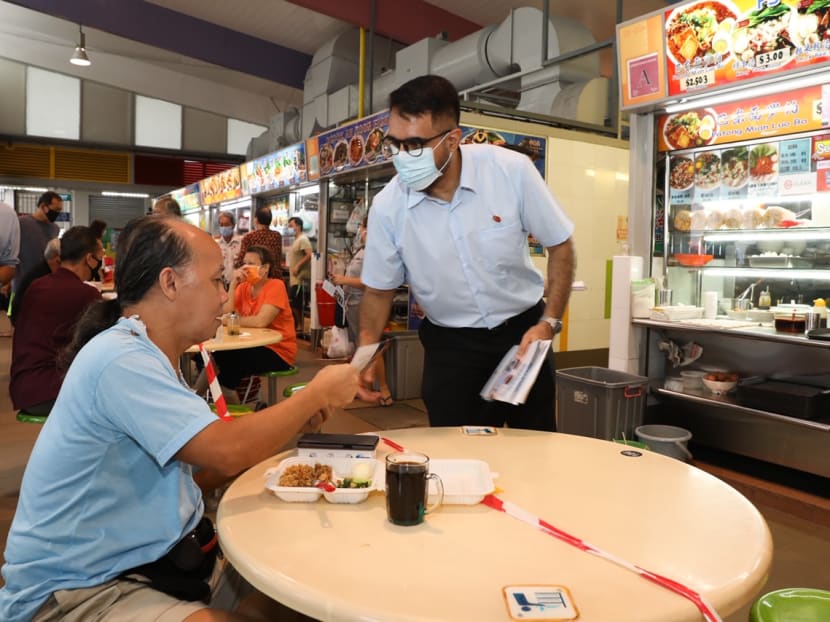
Workers’ Party secretary-general Pritam Singh during a walkabout at Bedok North Market and Food Centre on June 27, 2020.



- Inquiry should lead to changes to nation’s pandemic readiness strategy, says WP
- WP criticised the Government’s U-turn on mask-wearing
- Party’s GE2020 manifesto also delves into a range of longer-term issues
SINGAPORE — The Workers’ Party (WP) on Sunday (June 28) called for an independent commission of inquiry to be held in public into lessons learnt from the Covid-19 pandemic once the crisis subsides.
Singapore’s main opposition party also urged “greater political will” to improve the living conditions of migrant workers, whose cramped quarters hastened the spread of the coronavirus.
The WP is proposing that a statutory board be set up to stipulate and enforce work and living standards for all work-permit holders.
These and other proposals were set out by WP in its 39-page manifesto published on Sunday in the run-up to the General Election (GE) on July 10.
The manifesto also sketched out proposals on a repertoire of longer-term issues, from education and social policies to cutting the cost of living and seeking greater accountability for political and governance institutions.
These include increasing access to university education for all Singaporeans, cutting average class sizes to 20 from the present 29 to 34, and setting a national minimum wage for workers.
Devoting the first chapter of its manifesto to the coronavirus response, WP outlined its call for a public inquiry, adding that Singapore should institute changes to its pandemic preparedness strategy, plan and protocols that are identified by the commission.
“The commission’s proceedings and findings should be made public, and both experts and ordinary Singaporeans should be given an opportunity to provide input,” WP said.
The roll-out of the plan should start immediately after the revisions are made, to better prepare Singapore for the next disease outbreak, it added.
This is not the first time that a call has been made for a public inquiry into aspects of the Government’s pandemic response.
Nominated Members of Parliament (MPs) Walter Theseira and Anthea Ong had last month asked for an inquiry into the cause of the outbreak at migrant workers’ dormitories.
In its manifesto, WP also criticised the Government’s U-turn on the wearing of masks in public.
It noted that on April 3, 10 weeks after the first Covid-19 case emerged in Singapore, the Government “abruptly changed its position and announced the distribution of reusable masks to all residents”.
“Would many infections have been prevented if the advice had been given earlier to wear masks to cut down the risk of infection, as advised by some doctors from the beginning?” WP asked.
It became compulsory for everyone to wear a mask from April 14, in a reversal of an earlier advisory for people to use face coverings only if they were unwell.
“The initial governmental advice telling people not to wear masks unless they are feeling unwell appears to have been driven more by concerns about a shortage of masks,” WP said.
The Government has said that the rule change was based on the latest findings and medical advice that people without symptoms or with mild symptoms of Covid-19 could be spreading the virus.
While WP acknowledged the Government’s efforts in dealing with the pandemic, it said it was its duty as a responsible opposition party to make “a constructive contribution to the policy discussion on how best to deal with this outbreak and emerge stronger as a nation”.
WP chief Pritam Singh said in Parliament earlier this month that his party had, until then, chosen not to publicly criticise the Government’s handling of the crisis in ways that would undermine the national effort.
WP also noted that despite regular communications during the pandemic, the Government made changes to measures too frequently, resulting in confusion and “rule fatigue”.
“Moreover, rules were often announced but with exceptions announced a short while later,” it said.
Major rule changes should not happen daily, the party said, adding that exceptions to a new rule should be announced at the same time that the rule is introduced.
WP also mooted an independent medical advisory board to make public and private recommendations to the Government’s medical team to pre-empt blind spots.
When Covid-19 vaccines are available and approved, the party urged the Government to provide them free to all residents, starting with the most vulnerable groups.
The People’s Action Party (PAP) Government has said that every Singaporean needing a vaccine, if and when it becomes available, will get it at an affordable rate.
At an online press conference on Sunday to present its final slate of candidates and introduce its manifesto, Mr Singh shed light on the thinking behind WP’s slogan for the polls: Make your vote count.
Mr Singh, an outgoing Member of Parliament (MP) for the Aljunied Group Representation Constituency, said the phrase called into focus the PAP’s “overwhelming parliamentary supermajority”.
“There is a real risk of a wipeout of elected opposition MPs, with 100 per cent of the elected seats in PAP hands, at this General Election,” he said.
“We need elected Workers’ Party MPs to be voted into Parliament.”
Here are some of the proposals WP laid out in its manifesto:
BETTER ACCESS TO UNIVERSITY PLACES
Universities should roll out programmes and mentorships to allow students from all backgrounds an opportunity to attend a varsity, especially those from underprivileged families with no history of a university education
These programmes should start at secondary schools and include financial help to ensure participants are not only admitted to varsities but complete their degrees
Participants should be given mentorships and holiday work placements, since they may not have the resources or knowledge to secure such placements
SMALLER CLASSES
Prune average class sizes to 20 — from the present 29 to 34 in primary and secondary schools
In nations that are part of the Organisation for Economic Cooperation and Development, whose membership comprises mostly rich countries, the average class size is between 21 and 24
The smaller classes should be instituted progressively, with academically weaker students benefiting first. Priority should be given to foundational subjects in primary schools and Normal stream subjects in secondary schools
MINIMUM WAGE
Institute a minimum monthly take-home wage of S$1,300 for full-time workers. For part-time work, this can be pro-rated
More than 100,000 Singaporeans, WP noted, earn a take-home wage of less than S$1,300 a month for full-time work
This is below the S$1,300 an average four-person Singapore household needs to spend monthly on basic necessities, such as food, clothing and shelter
FREE PUBLIC TRANSPORT FOR SENIORS, PEOPLE WITH DISABILITIES
Offer free rides on public buses and trains for over-65s and all persons with disabilities to ease their financial burden
This would be funded by the Budget and Public Transport Fund for needy households
This could spur more seniors and people with disabilities previously deterred by transport costs to take on casual or part-time jobs
The increased employability of seniors and people with disabilities will aid inclusiveness and active ageing, and raise workforce participation
CONSIDER OTHER OPTIONS BEFORE RAISING GST
Consider other sources of revenue before raising the Goods and Services Tax (GST) from 7 to 9 per cent between 2022 and 2025
The tax increase will further burden families already struggling with high costs
The Government should release revenue and expenditure projections for the remainder of the decade, so that the public can make a more informed decision on the GST hike
Make up the revenue shortfall by tapping up to a fifth of the S$15 billion that the Government typically collects from land sales yearly
Alternatively, increase the Net Investment Returns Contribution — returns from Singapore's reserves that go into the Budget — by up to 10 per cent
This move will not lower the Government’s reserves, which will continue to expand — albeit at a slightly slower pace
Related topics
SGVotes2020 Workers' Party Singapore General ElectionStay in the know. Anytime. Anywhere.

Subscribe to our newsletter for the top features, insights and must reads delivered straight to your inbox.
By clicking subscribe, I agree for my personal data to be used to send me TODAY newsletters, promotional offers and for research and analysis.






