
#trending: 'It's basically free' — women jump on 'girl math' trend to justify spending. Some say it's fun, others warn of potential harm
SINGAPORE — If you don’t buy something that’s on sale, you’re losing money. If you return an item for a refund, you’ve made money. If you buy yourself coffee using prepaid value, the drink is free. Anything under S$5 is practically free and paying with cash doesn’t count because your bank balance didn’t decrease.
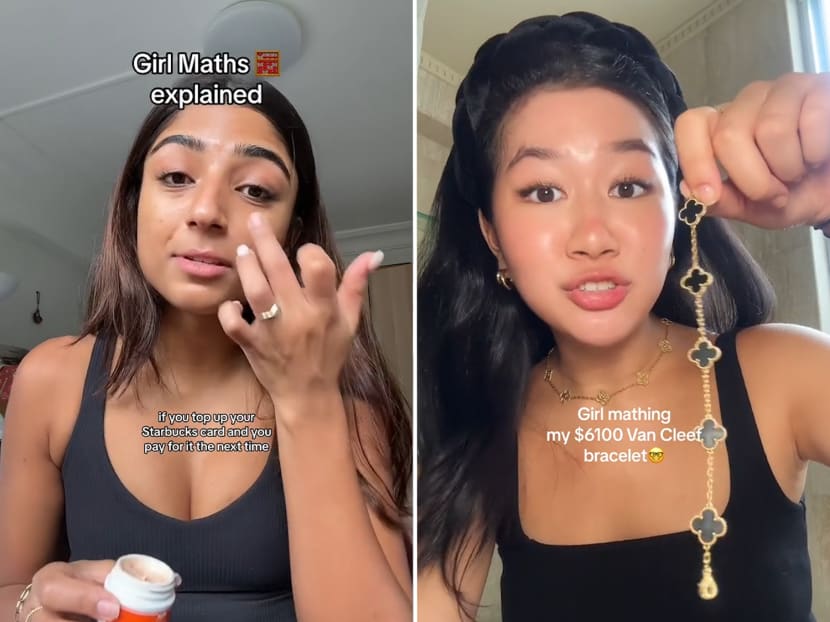
Young women are sharing ways in which they justify their spending habits using "girl math" in a trend that has taken TikTok by storm.

- In a viral TikTok trend, young women are using "girl math" to rationalise their spending habits in inventive ways that don’t always add up mathematically
- Many online users who find the concept relatable have chimed in with their own examples
- Critics have derided "girl math" for glorifying overspending and supposedly pushing stereotypes that women cannot handle their finances well


SINGAPORE — If you don’t buy something that’s on sale, you’re losing money. If you return an item for a refund, you’ve made money. If you buy yourself coffee using prepaid value, the drink is free.
Anything under S$5 is practically free. Paying with cash on hand doesn’t count because your bank balance didn’t decrease.
That’s “girl math” — a viral TikTok trend in which young women rationalise their money habits or spending in inventive ways that don’t always make mathematical sense.
While the thinking behind girl math is not novel, and certainly not gender-specific, the concept recently earned a fancy new name.
HOW DID GIRL MATH COME ABOUT?
The term “girl math” is believed to have been coined in July by a New Zealand radio show called Fletch, Vaughan & Hayley, which features a segment where the DJs help listeners justify extravagant purchases, such as spending NZ$999 (S$810) on a luxury tote bag or NZ$5,600 on four nights of Taylor Swift tickets.
In one episode, a listener calls in to the show to ask the crew to “girl math” the cost of a NZ$800 diamond ring. The caller had recently separated from her husband but said she “missed wearing a diamond ring”.
Arguing that diamond rings are an asset that can “last more than a lifetime”, a crew member named Shannon reasoned that the listener would be saving money if she handed down the ring to a future child or descendant.
“That ring is now 50 per cent off because it has two owners. If that child then has a child, we’re down to what…33 per cent? We can just keep on going until this ring is basically free,” she explained.
HOW DOES GIRL MATH WORK?
Girl math has taken TikTok by storm, with the hashtag amassing over 380 million views on the platform to date.
Despite knowing that the math in "girl math" does not actually add up, young women across the world are finding the concept relatable and chiming in with their own examples. And the list is non-exhaustive.
The trend has even caught on amongst Singapore online users.
Here is how local TikToker Atiqa Dar explains the concept, almost satirically:
- If you wanted to buy a dress that costs S$50 now, but waited until it was on sale for S$30, you made a S$20 profit
- If you go to a store and you don’t buy anything, you made money
- If you buy headphones that cost S$200 and you wear it for more than 200 times, it’s free
- If you don’t own a car but you take cabs all the time, you are still making money
- Having expensive cafe dates with a friend is a form of therapy. But it’s cheaper than going for actual therapy so technically, you’re making money
Singapore-based lifestyle influencer Chloe Liem also posted a "girl math" video justifying her purchase of a bracelet from luxury jewellery brand Van Cleef & Arpels for S$6,100.
Whipping out her father’s financial calculator, Ms Liem begins by saying that the key to “Van Cleef girl math” is the Certified Public Accountant (CPA) method which Ms Liem humorously defines as “cost per Alhambra”. Alhambra refers to the clover-shaped motifs that are iconic of the jewellery brand.
Ms Liem explains: “So if a bracelet is S$6,100, we round it down to S$6,000 and we divide that by five to get the cost per Alhambra of S$1,200. Compare that to the cost of a vintage pendant which only has one motif and this is going for S$4,050.
“If one motif costs S$4,050, the actual cost of a five-motif bracelet should be S$20,250.”
A few mental leaps and punches into the calculator later, Ms Liem concludes that she bought the bracelet at a 70 per cent discount and that earned her S$14,175 in profit.
Ms Liem’s video has garnered over four million views and 420,000 likes in just five days.
Many TikTok users flooded the comments section to share their agreement.
One person wrote: “This is legit how my brain works.”
Another said: “Fashion classes taught me that if you wear it 6,100 times, it will cost S$1 for each wear.”
Several others joked that it “actually makes sense”.
'GIRL MATH' IS JUST FUN, NOT ACTUAL FINANCIAL ADVICE
However, not everyone sees the humour in the trend.
Critics have derided "girl math" for glorifying overspending and asserted that it perpetuates the harmful and sexist stereotype that women cannot handle their money well.
Ms Vivian Tu, a former J.P. Morgan equities trader, told American news website Huffpost that although she knows "girl math" is a joke, she believes “it has the same energy as (saying) ‘women are bad drivers’”.
“It can perpetuate the stereotype that women are bad with money or math, or don’t take their finances seriously", adding that it is detrimental to society.
TikTok user "samjamess", however, argues that "girl math" is just "fun logic".
In an interview with Business Insider, financial expert Kelly Ann Winget claims that "girl math" can actually empower women in making financial decisions.
“If women are using 'girl math' to justify spending that doesn't derail their financial well-being, that is a good thing. In the end, it shows financial responsibility and actually taking a pause to think about the impact of a purchase before it's made,” she says.
Ms Jen Hemphill, an accredited financial counsellor and host of podcast Her Dinero Matters, told the Huffpost that she does not think the "girl math" trend can either be only good or bad.
“Some might live by 'girl math' and that’s the danger, right? But others will know...‘I’m giving myself some grace instead of beating myself up for making this financial decision.’
“And that’s okay.”
Related topics
Trending TikTok budgetingStay in the know. Anytime. Anywhere.

Subscribe to our newsletter for the top features, insights and must reads delivered straight to your inbox.
By clicking subscribe, I agree for my personal data to be used to send me TODAY newsletters, promotional offers and for research and analysis.






