
Go-Ahead vows ‘good service’ as it deploys first 13 bus services
SINGAPORE — Even before the Republic’s fourth public bus operator Go-Ahead Singapore’s first bus, service 82, was ready to roll out from Punggol Bus Interchange at 5.15am on Sunday (Sep 4), bus enthusiasts and commuters were already waiting in line.
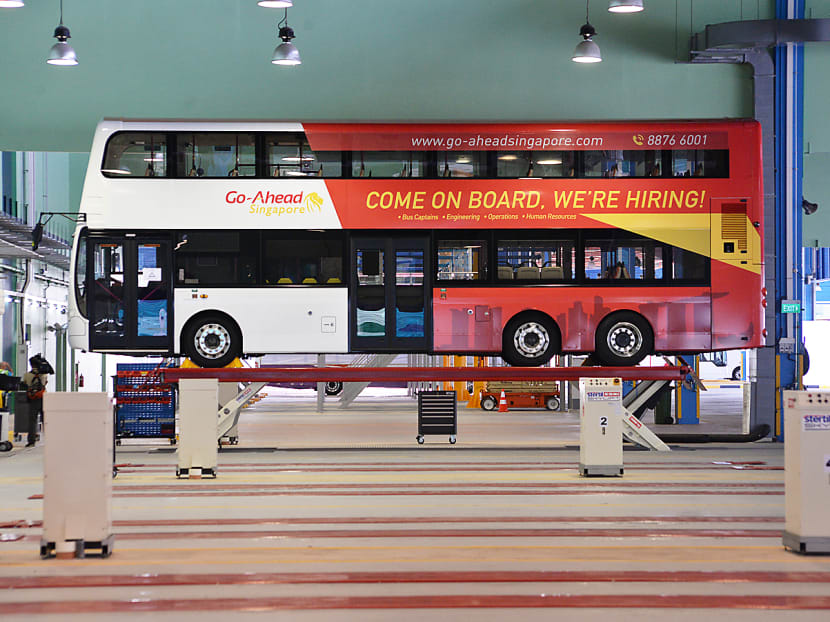
A Go-Ahead Singapore bus propped up with a Skylift for maintainence works at Loyang Bus Depot. Photo: Robin Choo

SINGAPORE — Even before the Republic’s fourth public bus operator Go-Ahead Singapore’s first bus, service 82, was ready to roll out from Punggol Bus Interchange at 5.15am on Sunday (Sep 4), bus enthusiasts and commuters were already waiting in line.
And as the United-Kingdom-based operator began its first 13 bus services under its Loyang Bus Package — serving commuters in the Pasir Ris and Punggol areas — managing director Nigel Wood promised “good service” for all its commuters.
Another 11 of its bus services will begin operations on Sept 18, while the 25th and last service will be implemented next year, with details of the route to be announced at a later date.
Speaking to the media, Mr Wood said his firm had done a lot of preparations, training and dry runs prior to yesterday.
But he acknowledged that there will be some “teething problems” in running a big operation, such as how some buses of the same service number arrived yesterday within a minute of each other. Regarding this, Mr Wood explained that, as a few buses were running slightly late, the operator decided to deploy spare buses, which were on standby, to ensure the services ran on time.
The start of Go-Ahead’s operations comes after another foreign operator, Tower Transit, which won the first contract under the bus contracting model, began services in May from the western part of Singapore.
Go-Ahead won the second contract in November, and its services will take commuters to Ang Mo Kio, Changi, Pasir Ris, Sengkang and Punggol, among other areas.
Under the bus contracting model, the Land Transport Authority determines the bus services to be provided as well as the service standards. Operators would then bid for the right to operate these services, for which they will be paid fees.
The Government retains the fare revenue and owns the depots, buses and fleet management system.
For its first 13 bus services, 290 bus captains will be driving 180 Go-Ahead buses plying the roads on weekdays. Of these bus captains, 129 are affected employees from the outgoing operator SBS Transit.
National Transport Workers’ Union executive secretary Melvin Yong, who was aboard the first Go-Ahead bus that departed from Punggol, said the union and operator have been paying close attention to two groups of workers: Those from the outgoing operator and new recruits.
“We (had) several briefings with all our workers on this transition, and we continue to do our regular visits to our bus interchanges, to the depots, to ensure that our workers’ needs and concerns are attended to properly,” he added.
First-time bus captain Ng Eng Hai, 38, said he overcame his nervousness after clocking his first shift on bus service 82. “Because I had never driven a bus that carried that many passengers, I was initially a little nervous about it ... But after some passengers boarded the bus, it became better,” added Mr Ng, who previously worked as a programmer.
Meanwhile, coffee shop assistant Wong Foo Cheong, 66, said he realised there was a change in bus operators only after he noticed that the bus captain was wearing a different uniform.
The bus captain was also polite, Mr Wong said in Mandarin before adding that he hopes the new operator will help shorten waiting times in future.
Stay in the know. Anytime. Anywhere.

Subscribe to our newsletter for the top features, insights and must reads delivered straight to your inbox.
By clicking subscribe, I agree for my personal data to be used to send me TODAY newsletters, promotional offers and for research and analysis.






