
Commission proposes ‘unbundling’ of President’s custodial, ceremonial roles
SINGAPORE — While it acknowledged the need for the President to be an elected figure in order to act as a check on the Government, the Constitutional Commission has suggested that the Government may wish to consider a more “fundamental change to the Presidency” — by “unbundling” the custodial and ceremonial roles, and having these roles filled by appointment.
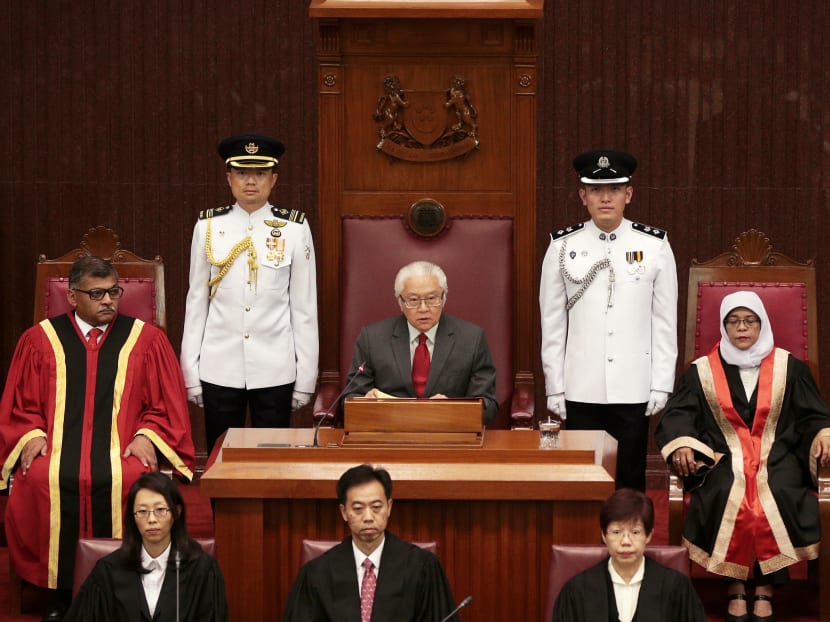
President Tony Tan speaks at the opening of the 13th Parliament of Singapore on Jan 15, 2016. TODAY file photo

SINGAPORE — While it acknowledged the need for the President to be an elected figure in order to act as a check on the Government, the Constitutional Commission has suggested that the Government may wish to consider a more “fundamental change to the Presidency” — by “unbundling” the custodial and ceremonial roles, and having these roles filled by appointment.
This is in light of the “tension” between the President’s two roles: A unifying ceremonial figure on one hand, and a custodial figure that may need to confront the Government of the day on the other, said the commission in its report on the Elected Presidency (EP), which was released on Wednesday (Sept 7).
It suggested that an appointed body of experts could take over the custodial functions, while Parliament could appoint a President to serve as a unifying symbolic figure.
In determining whether the office should remain an elected one — an issue that was beyond the commission’s prescribed scope of work — the commission had acknowledged it would be “incongruous” to have a second key in the hands of the President, if the holder of the first key appoints the holder of the second key.
The President will also likely require a popular mandate to have the authority to act as the custodian of the nation’s reserves and be an effective check against governmental action, if the need arises. “An appointed President is unlikely to have the standing or authority to effectively block a decision made by a democratically elected government,” said the nine-member commission, which was headed by Chief Justice Sundaresh Menon.
But amid an evolving environment, the commission noted the “emergence of strains rooted in the unavoidable tension” between the President’s historical and custodial roles.
The former role requires the President to be non-partisan and a unifier of the nation, while the latter role potentially requires him to confront the Government of the day, which is “somewhat at odds” with the role of the unifier.
“It seems out of place for persons seeking a non-partisan unifying office to go through a national election, which will likely be politicised and divisive,” said the commission.
The Government’s ability to function pragmatically and plan for the long-term are among the vital contributors to Singapore’s success and ability to generate and accumulate substantial reserves, and it must be willing and able to bear the political cost of making essential hard choices.
“The commission has concerns that the making of these choices engages the very issues that a politicised President who campaigns on a platform to oppose the Government of the day, could clash with the Government over,” it said.
It also pointed out that the symbolic role of the President demands certain traits, such as the ability to connect with and represent the general populace. These qualities may not always be found in individuals who have the financial qualifications and technical competencies to carry out the President’s custodial duties, it said.
Members of the public who had stepped forward to offer views on the EP had alluded to the difficulty in finding one person who could fulfil the Elected President’s job description, and also proposed “unbundling” the President’s symbolic and custodial roles as well as assigning them to two different institutions.
In its report, the commission said the important custodial role should be “largely preserved but vested in a council of highly qualified experts”, while the President should retain his symbolic and ceremonial role of the Head of State and hold an appointed office.
“The Commission considers that this is a proposal that the Government may wish to consider if and when it is appropriate and timely to undertake a more fundamental change to the Presidency,” it said.
TIMELINE OF SINGAPORE'S PRESIDENTIAL SYSTEM
Stay in the know. Anytime. Anywhere.

Subscribe to our newsletter for the top features, insights and must reads delivered straight to your inbox.
By clicking subscribe, I agree for my personal data to be used to send me TODAY newsletters, promotional offers and for research and analysis.






